





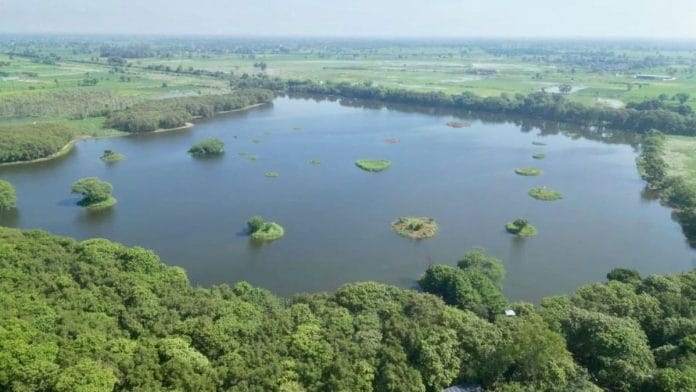


New Delhi: The Shekha Jheel Bird Sanctuary in Uttar Pradesh’s Aligarh district has been declared as India’s 99th Ramsar Wetland Site, announced Bhupendra Yadav, Union Minister of Environment, Forests and Climate Change, on Wednesday.
A freshwater lake situated 17 kms from Aligarh, the Shekha Jheel has recorded the presence of 249 bird species in its vicinity, out of which 62 are specifically dependent on the wetland. It is a famous habitat for winter migratory birds traversing on the Central Asian Flyway migratory route, such as the bar-headed goose, and the painted stork. Now, the lake will be protected as part of the list of Wetlands of International Importance, also known as the Ramsar List.
“This marks Uttar Pradesh’s 12th Ramsar Site and India’s 99th, bringing us closer to a historic century,” said Yadav in a post on X.
In 1852, the British built the Upper Ganga Canal, which flows from Hapur to Narora in Uttar Pradesh, and it was through this that the Shekha Jheel formed. Around 25 hectares in size, the lake is an important habitat not only for water birds, but also for certain other fauna like blue bulls, blackbuck, five-striped squirrels, and Indian mongoose.
Also read: A cheetah walked all the way from Kuno to Ranthambore Tiger Reserve. ‘All 3 big cats in park’
Conservation challenges
According to a case study by Kalpavriksh Environmental Action Group, the lake is managed by the forest department of Uttar Pradesh, but there are certain land use changes such as the construction of a tar road nearby, mounds and mud walls inside the lake, and the growth of water hyacinths that pose challenges to the conservation of the lake.
However, the case study also said that local people of the Shekha village take pride in the lake and understand its significance for the nearby flora and fauna as well as for maintaining the water table of the region for agriculture. They have worked alongside the forest department to conserve the lake, prevent poaching of endangered birds like purple heron, painted stork, and other central asian flyway birds, and also prevent planting trees on the banks of the lake, since it could be harmful for the wetland.
Other wetlands in UP include the Patna Bird Sanctuary, the Bakhira Bird Sanctuary, the Haiderpur wetland, and the Upper Ganga river. These sites are given international recognition under the Ramsar Convention of 1971, which is an intergovernmental treaty working toward the welfare of wetlands in the world.
While Shekha Jheel marks India’s 99th Ramsar entry, there is yet to be a single wetland on the Ramsar List from New Delhi, the capital city of India, which is home to over 1,000 waterbodies, including wetlands like Sanjay Lake, Bhalswa Lake, and Tikri Khurd lake.
(Edited by Aamaan Alam Khan)