





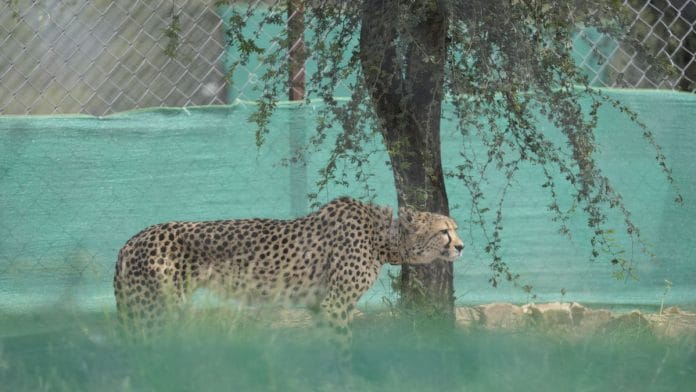


New Delhi: A young male cheetah from Kuno National Park, Madhya Pradesh has been spotted in Rajasthan’s Ranthambore Tiger Reserve over the last two days, officials told ThePrint. Tourists and forest officials photographed the cheetah in Zone 9 of the Ranthambore reserve, an area where they also found tigers and leopards.
“Cheetahs from Kuno have wandered into Ranthambore Tiger Reserve before, but they’ve never gone so deep into the tourist zone,” a senior forest official said. “Tourists can now see all three Big Cats in our Park.”
The animal, named KP-2, is an Indian-born cheetah that is one of the offspring of Asha and has been known to be a frequent wanderer. He reportedly walked more than 500 km from Kuno to Rajasthan in March, too, travelling across Baran and Kota before he was tranquilised and brought back to the park by officials. He had started preying on local livestock in Rajasthan by that time.
This is unique. Tiger, Cheetah & leopards are seen at the same tourism zone in Ranthambore.
While a young tiger from Ranthambore was spotted in Kuno & settled down, Cheetah from Kuno NP moved in to Ranthambore. pic.twitter.com/ywQziRHNXA
— Susanta Nanda IFS (Retd) (@susantananda3) April 20, 2026
KP-2 has been in Ranthambore since Saturday, but has yet to make a kill there, according to officials. Both the Kuno National Park and Ranthambore Tiger Reserve teams are continuously monitoring the animal and its whereabouts. A decision on whether to tranquilise and bring him back to Kuno is still pending.
Also read: New field guide spotlights Delhi’s 15 unique bat species, shifts focus from vermin to vital
Wandering cats
This is not the first time that cheetahs have wandered into Rajasthan from Kuno National Park, given its proximity to Ranthambore Tiger Reserve. Rajasthan has a similar terrain and ecology to Madhya Pradesh, and as Kuno’s cheetahs explore and expand their territory, they often enter the other state.
Before KP-2, in 2025, female cheetah Jwala also travelled from Kuno to the outskirts of Ranthambore Tiger Reserve, and had to be brought back by officials. Not just cheetahs, but other big cats too display this behaviour—in February this year, a male tiger from Ranthambore Tiger Reserve settled in the Kuno National Park.
He travelled from Rajasthan to find a new territory before settling in Kuno, but forest officials said that there was no plan to tranquilise him and return him to Ranthambore since it was a natural dispersion.
However, the presence of three apex predators in one region raises concerns about the safety of cheetahs in tiger reserves. Indian tigers and leopards have not interacted with cheetahs since they disappeared in the last 70 years, and Kuno’s cheetahs, too, have not come in contact with any big cats inside the park.
#Cheetah KP2 took the corridor from Kuno National Park in MP to #Ranthambore in #Rajasthan and entered Zone 9 which is dominated by Tigress 127 and Male 108
Firstly, you can’t contain the animals in boundaries. Secondly, Cheetahs can be vulnerable in front of mighty tigers pic.twitter.com/H1FkmlMn54
— Rahul Neel Mani (@rneelmani) April 19, 2026
Globally, too, tigers and cheetahs no longer share the same habitat—tigers are found in Asia, while cheetahs are limited to Africa. While there aren’t a lot of examples of tigers attacking cheetahs, there is literature and evidence that shows tigers actively suppress and kill other carnivores and competitors such as leopards and dhole (wild dogs). A cheetah would be viewed as a competitor.
Even when India began Project Cheetah back in 2022, conservationists such as Ulhas Karanth spoke about their concerns regarding the translocated cheetahs’ safety. This is because India’s national parks and grasslands are already dominated by two apex predators, tigers and leopards.
(Edited by Prasanna Bachchhav)