





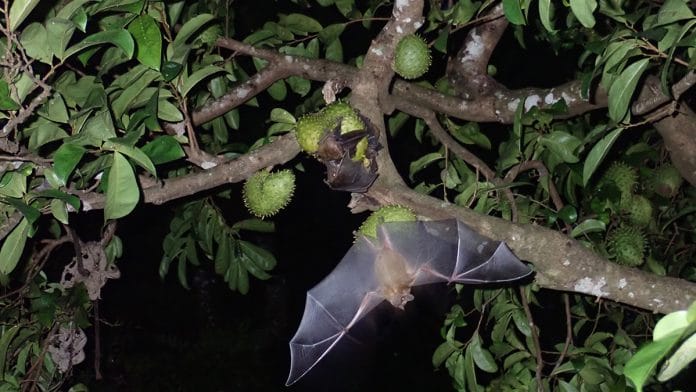


New Delhi: On 17 April, the World Wildlife Fund for Nature in India and the Nature Conservation Foundation released a first-of-its-kind field guide on the ‘Bats of Delhi NCR’. It documents the 15 different species found in the city, their anatomy, diet, habitats, as well as the threats currently facing the mammals.
From Delhi’s numerous old monuments to green forests and urban spaces, bats are found across the city, feeding on jamun and fig trees as well as flies and moths. The publication, which documents 12 of Delhi’s 15 bat species in detail, is also designed to serve as a guide for citizens and students.
“Bats are among the most misunderstood animals in our cities. Most people know them through myths rather than facts. This first fold-out field publication, ‘Bats of Delhi NCR,’ is an important step in changing that narrative,” said Neha Raghav, Director-Environment Education, WWF-India, in a press release after the launch.
The launch of the report was also accompanied by a Bat Walk, led by Rohit Chakraborty, researcher at the Centre for Wildlife Studies, in Delhi’s Sunder Nursery. Over 50 people participated in the guided walk with Chakraborty to understand the different features of Delhi’s bats, such as the Indian Flying Fox, the Lesser Mouse-Tailed Bat, and the Greater Yellow House Bat.
“The fear and misunderstanding (around bats) come because most people haven’t seen bats up close or learnt more about their behaviour,” Chakraborty said at the walk.
“Such walks have the potential to change public perception and create a well-informed citizen base that will lobby for bat conservation,” he added.
Chakraborty is also one of the authors of the State of Indian Bats report that was released earlier this week on 15 April, jointly by the Bat Conservation International and the Nature Conservation Foundation. The 200-page report was compiled by over 35 bat researchers in India and abroad, and is one of the first comprehensive reports of its kind about the nocturnal winged mammal.
There are a total of 135 species of bats found in India, making them the largest order of mammals, overtaking rodents. Out of these species, 16 are endemic to the country, and only seven bat species are listed as “threatened” in the IUCN’s Red List of Threatened Species.
However, 35 of the country’s bat species are unlisted because of a lack of data or proper assessment, exposing the need for further research in biodiversity and conservation for bats.
Also Read: Delhi’s overlooked wildlife didn’t disappear overnight; it faded slowly
What are the challenges bat conservation faces?
One of the major challenges to bat conservation pointed out during the Bat Walk, as well as in the state report, is the lack of significant scientific interest in them. The report found that there are barely 50 bat researchers in the country, despite the diverse nature of these animals.
Until 2022, most bat species were categorised as “vermin” under India’s Wildlife Protection Act, 1972, leaving the animal unprotected; it also meant that they could be hunted without a license. This classification underlies Chakraborty and Raghav’s statements that bats are often “misunderstood” as pathogens for deadly diseases, and their role in the ecosystem is neglected.
There are also other challenges to carefully studying bats, which include their nocturnal behaviour, and the “cryptic diversity” in their bodies and anatomy, which often leads to bats being misclassified.
According to the State of Indian Bats report, this has also led to a lack of understanding of bats’ significance in the food web, as well as their vital ecological roles.
“Bats perform key ecological functions by providing ecosystem services such as pollination, seed dispersal, pest control, and nutrient cycling,” the report noted.
However, bats are also known carriers of deadly viruses like Nipah, Hendra, and SARS-like coronaviruses. For both these reasons, the study concluded, it is important to understand bats as animals and their relationship with the environment.
The report suggested measures to improve taxonomical, ecological and pathogen research around bats, including the expansion of acoustic monitoring systems to understand their echolocation calls. The Bats of Delhi NCR publication also spoke about current threats to bat species in the city from activities such as monument renovations, loss of old-growth trees that sustain bat roosts, as well as mining and quarrying, which destroy the natural caves that are part of bats’ habitats.
(Edited by Insha Jalil Waziri)