



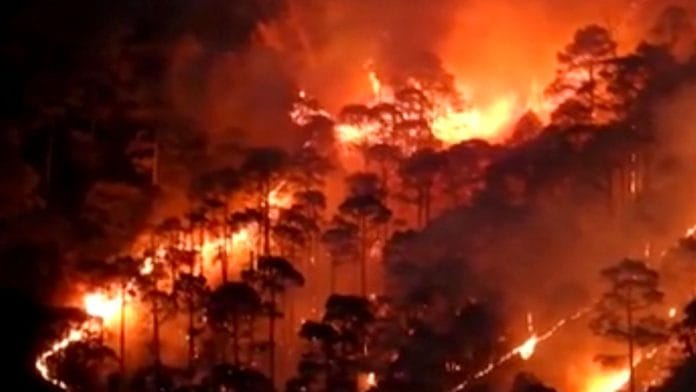
New Delhi: Despite the rising number of forest fires in India’s Himalayan region, there have been no dedicated studies tracing their long-term history or establishing their link to climate change, the Rajya Sabha Standing Committee on Science and Technology noted Friday.
The committee, headed by Medha Vishram Kulkarni, said satellite data showed that Uttarakhand recorded the highest number of forest fire incidents among all states in 2023-24. The count rose from 166 in 2019-20 to 2,711 in 2020-21, before falling to 1,329 in 2021-22 and 579 in 2022-23, then climbing sharply again to 2,441 in 2023-24.
Other Himalayan states that have recorded high numbers of forest fires include Himachal Pradesh, Jammu and Kashmir, Sikkim, and Arunachal Pradesh, the committee noted.
“The Committee notes that there is no dedicated research study to establish or quantify that climate change is a contributing factor to the rising frequency and intensity of forest fires in the Himalayan region,” the report tabled in the Rajya Sabha said.
The committee said this represented a significant “knowledge gap”. Given that the Himalayan region is ecologically fragile, topographically complex and highly sensitive to climate change, it argued that the issue requires dedicated, region-specific research rather than relying on findings extrapolated from other forest ecosystems.
It recommended a comprehensive study to establish the relationship between climate change and the intensity, frequency and seasonality of forest fires in the Indian Himalayan region.
The study, it said, should analyse long-term trends in temperature, precipitation and dry-spell duration alongside historical forest fire data. It should also assess how altitude and forest composition influence fire vulnerability under changing climatic conditions, and develop predictive fire-risk models to improve seasonal preparedness, resource deployment and early warning systems.
“It also recommends that the findings of such research be periodically updated and integrated into the Ministry’s forest fire prevention and management guidelines, so that policy responses keep pace with the evolving climate-fire relationship rather than being based on generalised assumptions,” the report said.
Uttarakhand’s deadly forest fires
The committee said Uttarakhand remains particularly vulnerable to forest fires because of its extensive chir pine forests, heavy surface fuel load, accumulation of pine needles, dry pre-monsoon weather, steep terrain, forest-fringe settlements, road networks, grazing activity and other human ignition sources.
It added that the high number of fires across Himalayan states underscored the need for intensive fuel-load management, pine-needle utilisation, community-based fire prevention measures and faster emergency response systems.
(Edited by Prashant Dixit)