





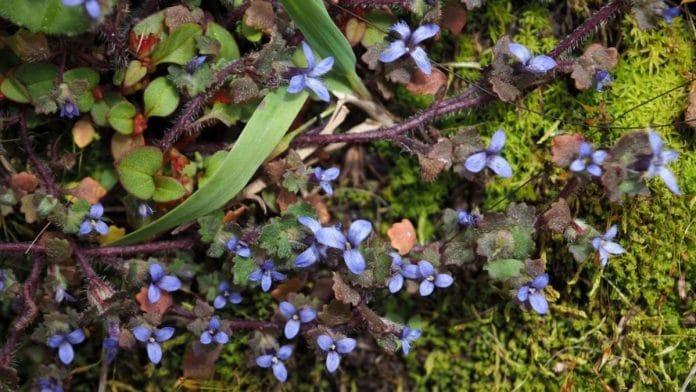


New Delhi: After 158 years, scientists have spotted a rare purple flower they call the Cyananthus hookeri in Tawang, Arunachal Pradesh. The flower was last spotted in 1876 in Sikkim by Sir Joseph Dalton Hooker, a pioneer botanist of the time.
The recent discovery was made by botanists Subhajit Lahiri and Monalisa Das who work with Dr Sudhansu Sekhar Dash of the Botanical Survey of India. In an article published in the journal Oryx, the researchers record their findings, made at an altitude of 3,600 metres in alpine grasses and rocky slopes near the Chuna Valley, close to the Mago village.
Lahiri explains that the team was not specifically looking for this little flower. Before they chanced upon the purple surprise in September 2025, they had spent nearly three years looking to document the rare and endemic flora that grows only in the Himalayas.
Since these are remote areas closer to army structures than any inhabited villages, the researchers had to get several special permissions from the army mountain brigades, the Himachal forest department, the local police, and the district commissioner to even begin exploring the region.
“Such narrow endemic plants grow only in these areas. They need a specific habitat, temperature, and climate. If we disturb that, then they migrate. They change their elevation, their timing of blooming, and even their pollinators,” Lahiri told ThePrint.
Also read: Scientists watched as the ocean split open, and oozed 160 million cubic metres of lava
A purple surprise
The Cyananthus hookeri is one of the many endangered plant species of the area. It is a tiny purple flower which belongs to the bellflower family called Campanulaceae.
“For such plants, habitat degradation is the biggest concern. Because of tourism and developmental activities, many of these plants disappear,” Lahiri said.
Lahiri said that his team found less than 50 such flowers in the region and recommended that the species be officially categorised as “endangered” nationally in India based on the guidelines of the International Union for Conservation of Nature.
Responding to the discovery, deputy chief minister of Arunachal Pradhesh, Chowna Mein, said the finding underscores the importance of conserving the fragile Himalayan ecosystems.
“I commend the Botanical Survey of India and the researchers whose dedicated work continues to reveal the incredible natural wealth of Arunachal Pradesh,” Mein wrote in an X post.