





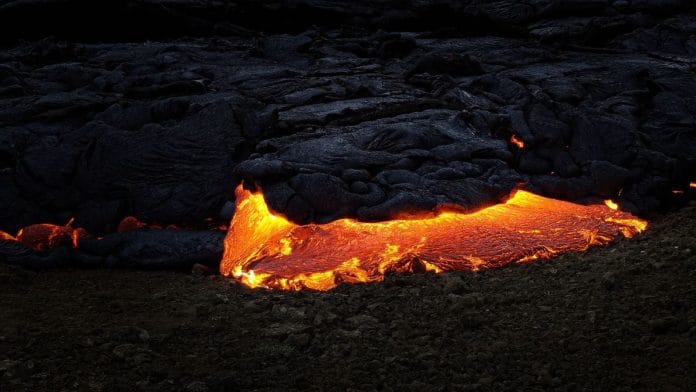


New Delhi: The ocean often comes apart at its ridges, spewing lava into the sea, but for the first time scientists have managed to witness this geological phenomenon using over 20 ocean measuring stations along a 100-km stretch of the Indian Ocean.
The process was described in a Nature article published on 8 July titled “Anatomy of a seafloor spreading event captured by in situ seismogeodesy”. Geophysicists, primarily from the University of Brest, Ifremer, in France, saw that in a span of days the oceanic crust along a section of the ridge spread apart by nearly 2 metres and released around 160 million cubic metres of lava onto the sea floor.
Researchers made these observations at the Southeast Indian Ridge which falls in the boundary between the Australian and Antarctic tectonic plates in the Indian ocean. Along the ridge, researchers had installed a permanent underwater observatory where they had set up seismometers, pressure sensors, and high resolution mapping equipment.
Also read: AI models to predict stroke, diabetes were built on unverifiable data, says study
A two week eruption
The findings go back to a seismic event which began on 26 April 2024 barely two months after the observatory and the instruments had been set up. Scientists explain that it began first with a series of small earthquakes along the ridge where the rift valley eventually sank by 4 metres and its two sides moved apart. In the next 16 days, 160 million cubic metres of lava poured onto the sea floor.
Two-thirds of the earth is covered in oceanic crust, and undersea mid-oceanic ridges like the one mentioned in the study are responsible for creating this crust. The study highlights that the spread of tectonic plates is far better understood on land than on the ocean floor because it is harder to observe seismic events within the ocean.
However, the study also suggests that it might be wrong to assume that seafloor spreads in a slow and continuous process. The recent observations contradict that notion by showing that seismic activity, even in a span of two weeks can alter parts of the sea floor significantly and even lead to a chain of minor quakes along the tectonic plates.