



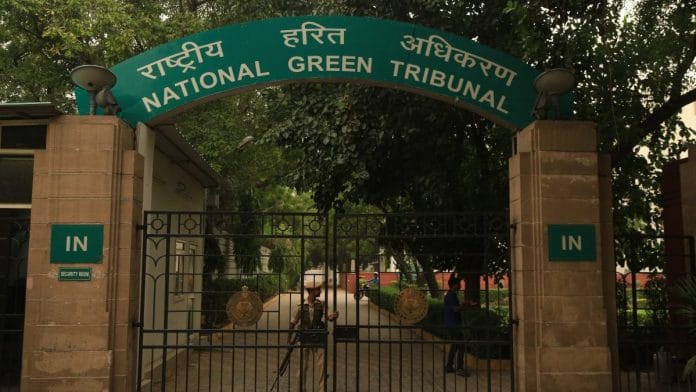
New Delhi: The National Green Tribunal last week asked the Centre to respond to a plea challenging the new amendments made to the River Ganga Rejuvenation, Protection and Management Authorities Order, 2016.
The plea, filed by environmentalist Amit Kumar on 14 August, said that the amendment changed the definition of the Ganga River’s active floodplain zone, while also removing the mandatory requirements that declared the area a “no-construction zone”.
“This executive dilution constitutes an existential threat to the River Ganga, the sacred ecological lifeline sustaining over 500 million citizens and violates… the Environment (Protection) Act, 1986,” Kumar’s petition read.
On 19 August, the NGT’s principal bench heard the application. Kumar argued that the new amendments issued by the Ministry of Jal Shakti were contrary to earlier judgments of the NGT and Delhi High Court. He added that the changes ran counter to Section 3 of the Environment Protection Act, 1986, which deals with the government’s responsibility to protect the environment and stop pollution.
Earlier this month, on 7 August, a gazette notification was issued by the ministry that amended three segments of the original 2016 Ganga protection order — the active floodplain definition, the structure of the floodplains, and the mandatory ban on construction in the floodplain.
Kumar, in his application, stated that while the 2016 order broadly defined the floodplain as all areas inundated during the highest flow or a 1-in-100-year flood event, the 2026 amendment changed that. Instead, the Ganga’s floodplains were now divided into three zones: an active floodplain (floods every five years), a regulatory floodplain (floods every five to 25 years), and a warning zone, (floods every 25 to 100 years).
Moreover, the amendment changed Paragraph 4(1)(ix) of the original order, which said that all riverbanks and floodplains of the river and its tributaries will be a “no-construction” zone. The new amendment removed the words “no-construction zone”, instead saying that the floodplains will be “maintained” to reduce pollution pressure.
“The absolute, mandatory requirement of maintaining a ‘construction-free zone’ on the banks and floodplains has been deleted,” read the application.
These amendments, said Kumar, counter the original objectives of the 2016 Ganga Rejuvenation, Protection and Management) Authorities Order, 2016, by removing the no-construction ban with ‘vague terms,’ and also diluting the definition of the active floodplains.
Contrary to previous NGT orders
Kumar’s application also maintained that the new amendment was contrary to previous orders passed by the NGT itself regarding river floodplains and construction activities.
“This Hon’ble Tribunal in 2015, 2016 and subsequent orders… explicitly held that floodplains are integral to the dynamic equilibrium of the river and directed that demarcated floodplains must strictly remain ‘no-construction zones’,” said Kumar.
Not just the Tribunal, but other courts, including the Supreme Court of India, have in different judgements upheld the construction ban along the Ganga’s floodplains. The Allahabad High Court in 2006 prohibited construction within 500m of the highest flood level of the Ganga River. IN 2013, the Uttarakhand High Court said that no construction would be allowed within 200m from the bank of any river that flows in the state.
The NGT, after hearing the application, issued notice to the respondents in the case, including the Ministry of Jal Shakti, National Mission for a Clean Ganga, and Union Ministry of Environment, Forests and Climate Change.
The NGT has listed the matter for another hearing on 27 October.
(Edited by Insha Jalil Waziri)