






New Delhi: As India reels from one of its driest Junes in almost two decades, weather experts have drawn parallels to two other years this century when India saw low rainfall in June—2009 and 2014.
The data from these years provides crucial insights into the agricultural and economic impacts of the monsoon, and could serve as a roadmap for this year as the country and the world braces for a strong El Nino phenomenon.
This year the country saw 39 per cent less rain than its long-period average in June, in 2009 it was 47 per cent, and in 2014 it was 44 per cent.
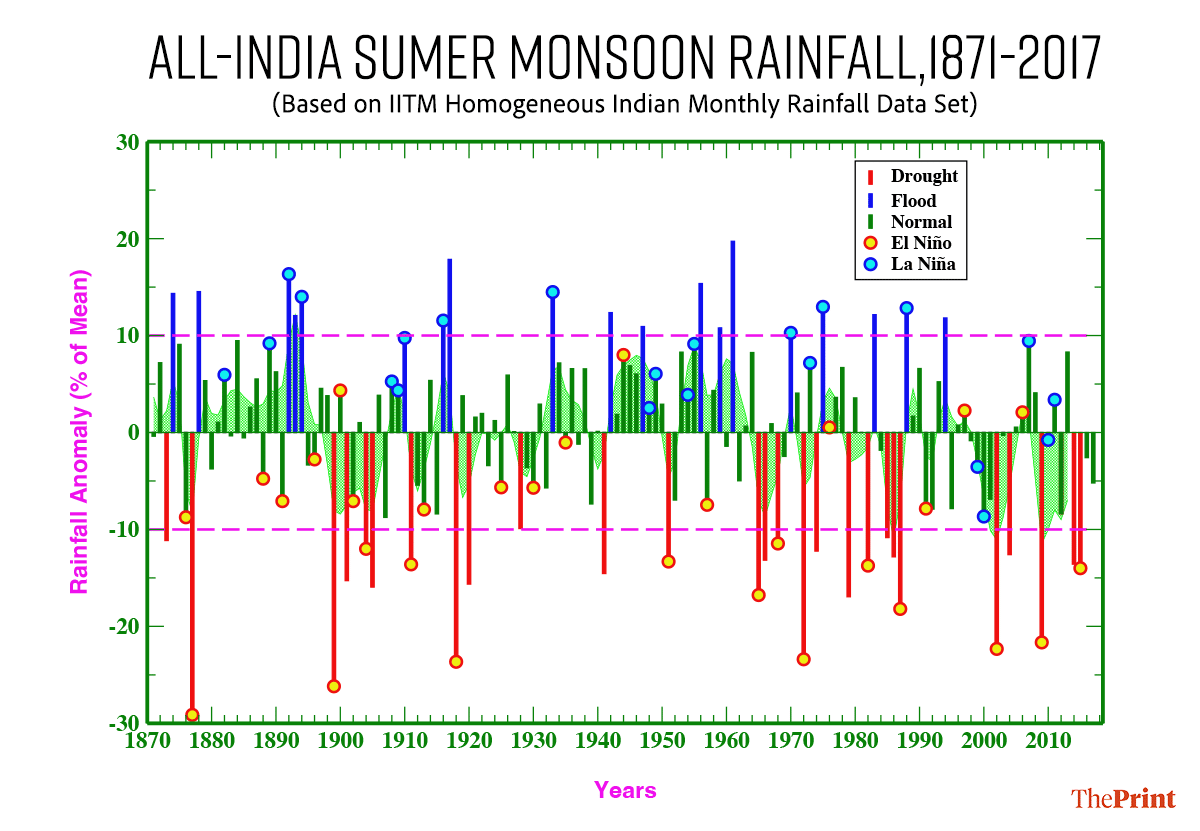
Both 2009 and 2014 were categorised as moderate El Niño years according to the US-based National Oceanic and Atmospheric Administration (NOAA). However, an analysis of the India Meteorological Department’s monsoon reports from those years shows the other factors responsible for low rainfall—delayed onset, monsoon breaks, and the lack of low-pressure systems.
Moreover, the data show that in both years, the overall monsoon was deficient, meaning rains didn’t pick up in the later months. In 2009, India saw 77 per cent of its long-period average rainfall, while in 2014 it was 88 per cent. This year, the IMD estimates that India will see 90 per cent of its long-period average monsoon rainfall.
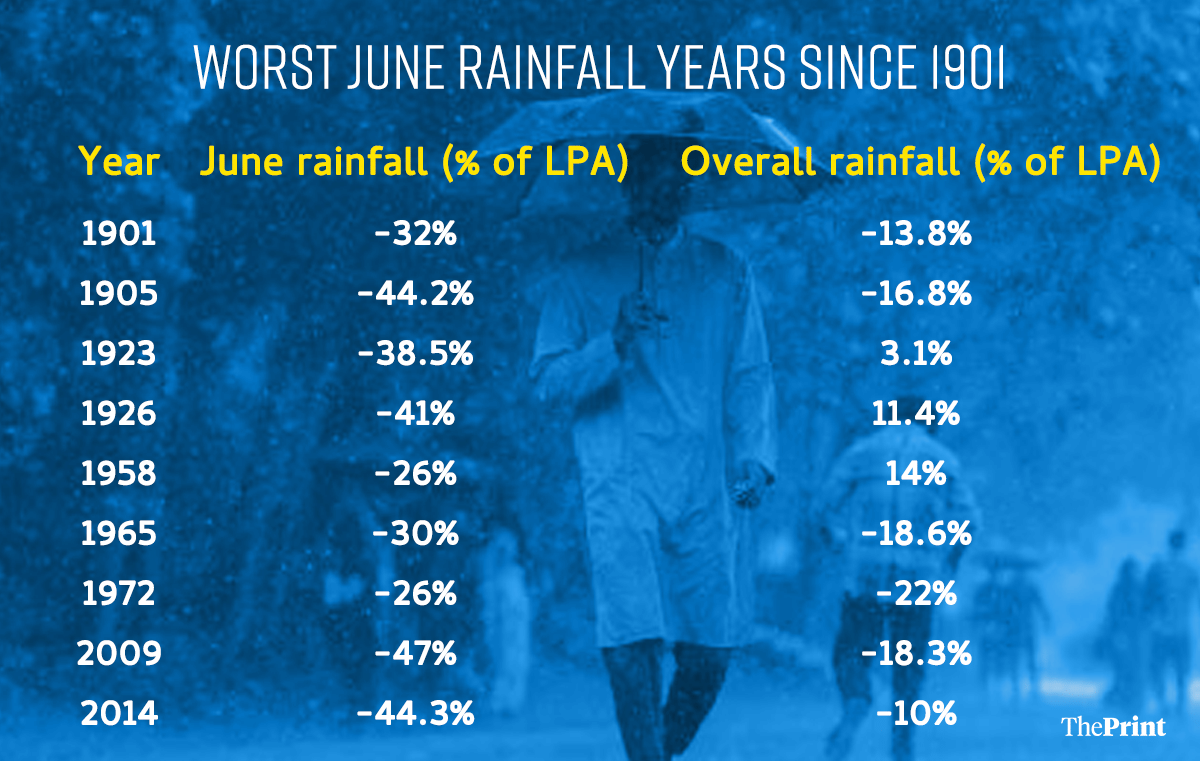
As the IMD’s archives show, low rainfall in June does not guarantee that the entire season will see deficient rainfall. In years like 1923, 1926, and 1958, even though India saw deficient June rainfall, the overall monsoon season had higher than average rainfall.
But in 2009 and 2014, India’s overall monsoon rains were lower than average too.
This deficit rainfall also had a larger impact on agriculture and crop output, with overall foodgrain production declining by 7 per cent in 2009-10, and by 4.6 per cent in 2014-15, as compared to the previous years.
Archival documents from the IMD, the Reserve Bank of India and newspaper reports from those years show how the monsoon affected the kharif crop season from June to October, and also had some spillover into the rabi crops of October to March.
The 2009 monsoon
The year 2009 was especially bad for the southwest monsoon in India, with the RBI report pegging its performance as the weakest since 1972. A deficiency of 23 per cent in the overall rainfall led to droughts being declared in 352 districts in 15 Indian states, said the RBI’s annual report of 2009-10.
Overall, the country produced 218 million tonnes of food grains in 2009-10, down from 234 million tonnes in 2008-09. This was a reduction of 6.9 per cent.
June rain played a major role in this deficiency. Even though the southwest monsoon started on time in Kerala on 23 May, there was a break in its advance over the rest of the subcontinent. Between 8 to 20 June, the southwest monsoon did not move toward Mumbai, similar to this year’s monsoon.
“In June, large rainfall deficiency was observed over most parts of the country due to prolonged hiatus in the monsoon advancement,” said the IMD’s report on the 2009 monsoon.
There were also other features in the 2009 monsoon, such as a shallow trough and weak monsoon pressure, which generally contribute to poor rainfall overall, explained the IMD.
A delay or deficiency in monsoon in June essentially leads to a delay in the sowing of kharif crops, mainly rice. The five main rice-growing states are West Bengal, UP, Punjab, Tamil Nadu, and Andhra Pradesh. Except for Punjab, most of these states saw reduction in rice production in 2009-10.
Since Punjab relied largely on groundwater for paddy irrigation, the state managed to evade the impacts of the deficient monsoon, according to a report by Columbia University’s Climate School from September 2009.
The RBI report from the year also explained the different measures taken by the Union and state governments to mitigate the agricultural crisis brought on by the weak monsoon. These measures include increasing agricultural input provision such as fertilisers, credit, and pest control equipment, to zonal meetings across states and even holding a ‘Rabi Campaign Programme’ to ensure the winter sowing season was not impacted. These measures, said the RBI, ensured that the agricultural sector’s contribution to the growth of the GDP in 2009 was still positive, at a rate of 0.2 per cent.
Also read: Delhi monsoon is here, says IMD. Parts of the city get 2 or 5 mm rain
The 2014 monsoon
Compared to 2009, the cumulative impact of the 2014 monsoon rainfall on agriculture was much lower; partly due to normal rainfall in July and August, and above-normal in September. However, the initial progress of the monsoon in June 2014 was similar to June 2009 — sluggish, and only covering the entire country by 17 July.
“This year’s monsoon is quoted as being the worst in 5 years, with only the late surge in early September helping to avoid a widespread drought,” said Charlie Williams, research fellow at the Department of Meteorology, University of Reading, in a 2014 article.
The features of the 2014 monsoon included an anticyclonic circulation throughout much of June, which hampered the southwest monsoon from progressing beyond Kerala toward the rest of the subcontinent, according to an analysis by the Indian Institute of Tropical Meteorology (IITM) Pune. Broadly, these features were connected to a developing El Nino, similar to the 2026 monsoon forecast.
The overall food grain production in 2014-15 was 252.7 million tonnes, as compared to 265 million tonnes the previous year. This reduction of 4.6 per cent was still seen as an improvement compared to the last deficient monsoon season i.e. 2009, according to the RBI reports.
“Area sown under kharif crops (in 2014) was 2.3 per cent lower than the normal and was 8.9 per cent higher than the 2009 drought year,” said the RBI report for 2014-15.
Also, the report mentioned that despite lower production of foodgrains, the country still had a grain buffer of about 55 million tonnes, which helped alleviate the pressure.
The Indian Council of Agricultural Research (ICAR) in June 2014 held a ‘brainstorming session’ to prepare for the monsoon, with experts from IMD, ICAR, and different state governments in participation. Reports from the meeting reveal that states like Andhra Pradesh, Maharashtra and Karnataka, and Odisha had prepared contingency plans for each district to ensure that the monsoon season variability would not impact agriculture too much.
“Availability of early maturing varieties, change of crops, timely availability of various inputs, farm machinery to complete sowing operation in limited sowing window available were discussed,” said the meeting report.
(Edited by Theres Sudeep)