



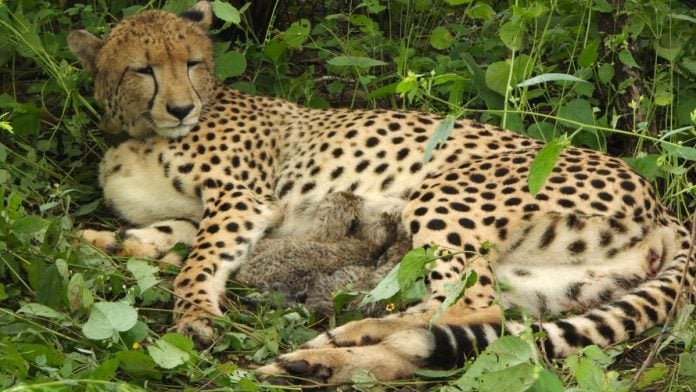
New Delhi: Four cheetah cubs were born to Indian-born female cheetah KGP12 at the Kuno National Park a day after Project Cheetah completed four years.
“A truly historic and joyous moment for Project Cheetah! A day after India’s Cheetah Project completed four years, KGP12, an Indian-born female cheetah, has given birth to four cubs in Kuno. Four years, four new lives—a beautiful symbol of hope, resilience and the growing success of cheetah conservation in India,” Union Environment Minister Bhupender Yadav wrote in a post on X.
The new births come just a day after the cheetah reintroduction project turned four years old. To mark the occasion, the Kuno National Park had released a four-year status review that highlighted that India’s Cheetah population has increased to 52, including 32 cheetahs born in the country. Of these, 49 currently live in Kuno National Park and three in the Gandhi Sagar Sanctuary.
“Out of the 49 cheetahs in Kuno National Park, 17 cheetahs, including 10 males and seven females, are in the wild, while 32 cheetahs, including five males, eight females and 19 cubs below one year of age, are inside Soft Release Bomas,” read the review.
Also read: India faces drier reservoirs from rainfall deficit. Super El Niño means warmer winter
Project Cheetah
India’s Project Cheetah began in September 2022, with the first batch of eight cheetahs, five females and three males, being flown in from Namibia. In February 2023, another batch of 12 cheetahs were brought to India from South Africa under a memorandum of understanding (MoU) signed between MoEFCC and the government of South Africa. However, the death toll has risen to 23 cheetahs since 2022.
According to the report, the first year of the Cheetah Project was a phase of “learning, adaptation, setbacks, and recovery”. In the second year the breeding and survival rates improved and 13 cubs survived for over a year. During the third year, the cheetahs were released into the wild as the project’s team kept a constant eye on them across a landscape stretching 12 districts. The report described the fourth year as a “phase of establishment” where the cheetahs were beginning to display a natural ecological behaviour.
Reviewing the project on 13 September Yadav noted that the protected habitat for cheetahs had been expanded to 3,428 square kilometres and the authorities are eyeing the Banni Grasslands in Gujarat and the Nauradehi Wildlife Sanctuary in Madhya Pradesh as future release sites.
He said the programme is moving towards “landscape-level management, ensuring adequate habitat, prey base and ecological connectivity for the long-term recovery of the species”.
Even as Yadav congratulates the entire Kuno and Project Cheetah family, these are not the first cheetah births in India this year. In April, the Cheetah Reintroduction Project in Kuno recorded its first-ever wild birth as an Indian-born female cheetah gave birth to four cubs. However, barely a month later, the cubs were found dead and partially-eaten near the forests of Kuno National Park.