







New Delhi: The A23a iceberg, which was double the size of London at one point and weighed nearly a trillion tonnes, is now no longer visible to satellites. Last seen in April, the iceberg’s last pieces have now broken away and melted.
A23a was the world’s largest and one of the longest-standing icebergs in Antarctica, “living” for almost 40 years after it first broke off from the Filchner Ice Shelf in 1986. At its peak, it spanned around 3,500 square kilometres in size, which is double the size of London and triple that of New York City.
It travelled 2,300 kilometres across the Antarctic coast and the Antarctic Ocean. But warm ocean currents and surface air melted away the frozen mass, leading to a slow, decaying death – almost like a star.
In April 2026, NASA’s NOAA-21 satellite captured an image of the last moments of the mighty iceberg, reduced to pieces in the South Atlantic Ocean. By then, it had become too small and fragmented to capture a real-size image. However, observations in March 2026 had pegged the dwindling iceberg’s size at 170 sq kms, 5 per cent of its original size, indicating that its end was near.
“You have to understand that we’re not talking about a recent event, but about an iceberg that broke off decades ago,” said Thamban Meloth, Director, National Centre for Polar and Oceanic Research (NCPOR). “And it was larger than the entire state of Goa at the time.”
Adventures of A23a
The origin story of the A23a iceberg lies in the Filchner-Ronne ice shelf on the Western coast of Antarctica. It calved off — a process of ice splitting — from its mother in 1986, and was named A23a based on the Antarctic quadrant it was found in.
Keeping aside the sheer size of A23a, the reason this iceberg remained the centre of interest for meteorologists, marine biologists, and scientists was that it was one of the first massive icebergs discovered in the world.
“Iceberg A-23A ‘came of age’ during a period of advances in Earth observation. The Landsat program captured detailed images throughout the iceberg’s life,” said a NASA report from 2026.
The iceberg’s first 30 years were spent stuck to the ocean floor near the Weddell Sea, the place where it first split from the ice shelf.
This is the case with many icebergs, Meloth said, because they remained grounded to the seabed and are often too massive to move merely due to drift by ocean currents.
However, in 2022, the A23a iceberg began to shift – and the world began noticing.
NASA’s MODIS satellite tracked A23a’s initial movement beyond the Wendell Sea, following its path to the South Atlantic Ocean, as other Antarctic icebergs do. A23a had multiple adventures before it reached its inevitable end. Once, it almost collided with a penguin sanctuary on South Georgia Island.
Also read: Purple Himalayan flower makes a comeback after 158 years — for the first time in Arunachal
Why is A23a important?
At many points in A23a’s three-year journey, ocean scientists closely watched its movement and studied it up close. In May 2026, a French production company even released a 1.5-hour-long film titled Ice Nomads, on the life of the A23a iceberg and its ‘odyssey’ across the ocean.
This interest in A23a’s life isn’t driven purely by the curious nature of the iceberg.
“Icebergs are very important subjects — for logistical and scientific reasons. We study the movement of icebergs and ice shelves because that is what the entire Antarctic ice sheet is dependent on,” said Meloth.
He added that the A23a iceberg was only discovered in 1986 because a USSR research station, the Druzhnaya 1, was situated on the iceberg and got swept away when the berg broke off. Meloth pointed out that the same has happened to Indian research stations, too. The Dakshin Gangotri station, which was India’s first Antarctic station, was also situated on an ice shelf and eventually got buried in snow in the late 1980s.
“Now, we have developed earth observation enough to tell when glaciers and icebergs are moving. But back in the 80s, the only landmark you had in Antarctica was your station,” said Meloth. “If one day you turn up and it’s gone, you’re lost. You’re stuck in a sea of ice.”
Moreover, icebergs are made entirely of freshwater deposits in Antarctica. When these huge masses of freshwater ice start melting into the saline ocean, they change the ocean chemistry, release nutrients and even alter marine biodiversity.
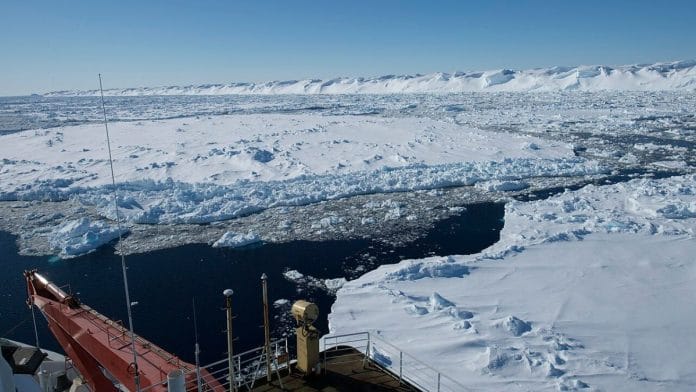
In December 2023, the British research ship named RRS Sir David Attenborough reached the A23a and even collected samples from its meltwater to study the impact of icebergs’ freshwater on the marine environment.
“With all the images and data that A-23A and other bergs have left behind, scientists now have even more questions about the factors driving iceberg motion, from ocean currents to the shape of the seafloor,” reads a NASA report.
A23a has left a legacy of polar and oceanic studies that match the berg’s monumental being. Meanwhile, scientists are tracking the other large icebergs floating around the Antarctic, such as the D15a, which took A23a’s title of the world’s largest iceberg after its “demise” in April last year.
(Edited by Saptak Datta)