



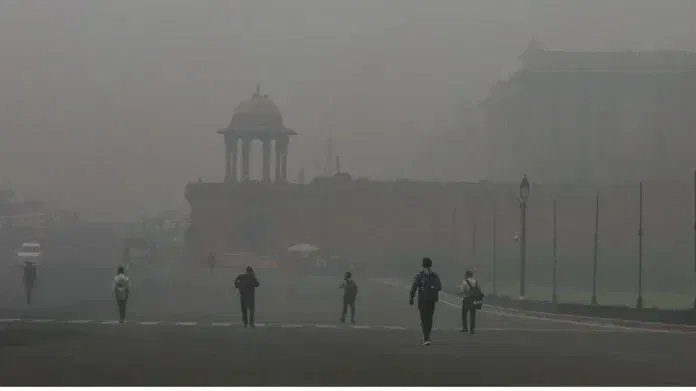
New Delhi: With the monsoon starting to retreat from many parts of the country and the harvest season commencing, stubble fires will once again start clouding the skies of Delhi-NCR with thick smoke and pollution. But this year, the peaking El Niño is expected to significantly worsen pollution levels and reduce winter rain spells, which offer intermittent relief.
Mahesh Palawat, vice-president of meteorology and climate change at private weather forecasting service Skymet Weather, told ThePrint that a stronger El Niño during the winter months would mean a drier season. This in turn would lead to more accumulation of pollutants in the atmosphere.
“El Niño tends to weaken western disturbances, which bring non-monsoonal rains in parts of northwest and central India. Every season these rains tend to bring respite from the intense pollution. They switch the wind direction, and if the western disturbance is strong, it brings rain, which washes away the pollution,” Palawat explained.
According to India Meteorological Department (IMD) data, December and January will witness an average of around three to four western disturbances each.
The winds change direction
After the southwest monsoon withdraws, northwest and central India gradually shift from moist southwesterly to relatively dry northwesterly winds. This happens because the land cools and the summer low-pressure area weakens.
With decreasing solar heating in October and November, air over the Indian landmass becomes cooler and denser, causing surface pressure to rise and a continental high-pressure area to develop over northwest India.
This switch to northwestern winds brings cooler and drier winds from parts of Pakistan, Punjab and Haryana toward Delhi.
Incidentally, this is also the time when the states falling on the northwest side of Delhi harvest their paddy crops. When the wind flows from these states, it tends to carry the plumes of smoke from the stubble they set ablaze.
Also Read: How ‘Super El Niño’ adds fuel to the climate fire
Impact of El Niño
The El Niño Southern Oscillation is a climate phenomenon in which trade winds and surface temperatures over the Pacific Ocean change course, leading to large-scale disruptions in weather patterns across the world.
In Asia, including India, Indonesia, Sri Lanka and even Australia, El Niño conditions are typically associated with weaker monsoons, and sometimes even droughts.
Experts explained that El Niño was typically associated with suppressed monsoon circulation, because it does not allow the production of enough rain-bearing systems. November and December are when most global forecasting models signal El Niño to be intensifying.
“We could also be staring at a warmer winter,” Palawat said.
Stubble fires
Government data shows a year-on-year trend of decreasing stubble burning cases in Punjab and Haryana.
In 2025, between 15 September and 30 November, 6080 fires were recorded.
Punjab, which is the epicentre for these fires, recorded 5,114 such incidents. This reflects a reduction of 53 per cent over 2024, 86 per cent over 2023, 90 per cent over 2022, and 93 per cent over 2021. Haryana logged 662 farm fire incidents last year, which was a 53 per cent reduction from 2024, a 71 per cent reduction from 2023, an 81 per cent reduction from 2022 and 91 per cent from 2021.
While the data shows a decreasing trend, the Supreme Court found that there was still a reluctance among officials in Punjab and Haryana to take action against farmers for indulging in stubble burning.
(Edited by Insha Jalil Waziri)