


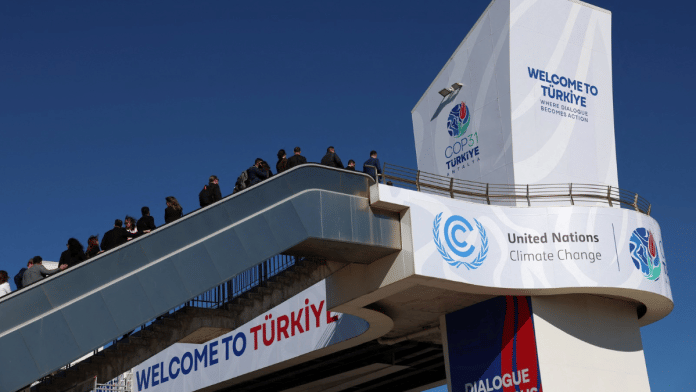
New Delhi: The 31st edition of the United Nations Framework Convention on Climate Change Conference of the Parties will commence in Turkey’s Antalya on 9 November amid intensifying climate-change impacts and geopolitical tensions.
UN Climate Change Executive Secretary Simon Stiell showed optimism ahead of the climate summit.
“No single COP is a silver bullet that can stop climate change overnight. But every recent COP has made essential progress. COP31 in Antalya will, too,” Stiell said in a statement.
The statement further read: “In the face of stiff geopolitical headwinds, nations must once again come together and drive real-world progress to protect more people and ensure they benefit from climate action.”
The COP statement said that the two-week summit will focus on translating climate commitments into tangible action, with climate finance, adaptation, emission reduction, technology transfer and a just transition likely to dominate the discussions.
The Antalya conference, held from 9-20 November, will also see an unusual hosting arrangement. While Turkey will host the conference and hold the COP presidency, Australia will lead the negotiations.
India will also participate in COP31, under the leadership of Union Minister of Environment, Forests and Climate Change Bhupender Yadav.
“The delegation will reach by November 9, but the Minister will be joining from the second week,” a senior official from MoEFCC told ThePrint, on the condition of anonymity.
Speaking to ThePrint ahead of COP31, India’s environment minister Yadav said that India’s primary aim during the negotiations will be to become a strong representative of the Global South.
“India has always been one of the strongest propagators of equitable development, with the environment at the centre. All of our policies and climate goals have been proof of that commitment. We will be the voice of the Global South, while also making sure that India’s interests are also tabled with utmost clarity,” Yadav said.
‘COP of action’
This year, COP 31 is being touted as the “COP of action”. In multiple statements leading up to the summit, UN representatives said that this COP will provide an important opportunity to assess whether countries are turning their climate commitments into action–from expanding clean electricity and reducing dependence on fossil fuels to halting deforestation and preparing for climate shocks.
Advancing preparations for the Second Global Stocktake, expected to conclude in 2028, is also likely to be a key priority. Turkey’s presidency has put forward voluntary targets designed to lower greenhouse emissions. The targets include increasing the global electrification rate to 35 per cent and reducing energy intensity in the building sector by at least 25 per cent by 2035.
In September 2026, Turkish environment minister Murat Kurum introduced Turkey’s Action Agenda for COP31 at the UN ECOSOC in New York.
Kurum said that Turkey had 10 priority themes which were central to their agenda, including food security, clean energy, oceans and seas and zero-waste implementation. He added that the COP this time will focus on moving from deciding climate targets to implementing solutions.
“For us, implementation is not simply about announcing many more commitments. We already have enough commitments and projects that have been announced. Now it is about translating existing commitments into measurable results on the ground,” Kurum said in his speech.
Also Read: Istanbul floods put climate risks in focus ahead of Turkey’s COP31
The ‘Super El Niño’ year
But another factor will be making the latest climate negotiations unique this year. The conference comes when countries across the world are facing one of the worst El Niño years since record-keeping.
The latest forecast issued by the Copernicus Climate Change Service (C3S), implemented by the European Centre for Medium-Range Weather Forecasts (ECMWF), warned that 2026 was now virtually certain to exceed 1.5 degrees Celsius above pre-industrial levels, becoming the second calendar year to do so after 2024, according to a statistical prediction based on ERA5 data.
“2026 is most likely to be the second-warmest year on record, with about a 20 per cent chance of tying or exceeding 2024, currently the warmest year on record. The four-year average global temperature over 2023–2026 is also expected to exceed 1.5 degrees Celsius above pre-industrial levels,” the report read.
Under these circumstances, one of the most important issues at COP 31 will be how countries respond to rising temperatures in the coming months.
Discussions will test whether governments are prepared to align policies and investments in a way that limits overshoot and brings the temperatures back below 1.5 degrees Celsius as quickly as possible.
This year was also marked by the catastrophic flash floods in Nepal, which killed over 1500 people. The heatwave in Europe also led to over 50,000 deaths. These recent climate events have made this year’s negotiations even more pressing.
India’s position
The Indian delegation has already stated its stand ahead of COP31. India will push for climate justice, equitable access to climate finance and stress that technology transfer is the responsibility of developed nations. It has also opposed any attempt to impose uniform emission-reduction targets on countries with different developmental needs.
Yadav said that India’s priorities would be to pursue solution-oriented and equitable climate action, working closely with the G77 and China, the Like-Minded Developing Countries (LMDC) and the BASIC groupings.
On mitigation, India maintained its stand that the implementation of Nationally Determined Contributions (NDCs) must remain country-driven, facilitative and non-punitive. India also remains strongly opposed to the introduction of new top-down targets.
The delegation also stressed that India supports the Just Transition Work Programme through a party-driven mechanism, emphasising climate justice, the right to development and affordable energy access.
“India has maintained that we will always be a part of the solution and never the problem,” Yadav said.
(This story was supported by Informed Earth)
(Edited by Insha Jalil Waziri)