



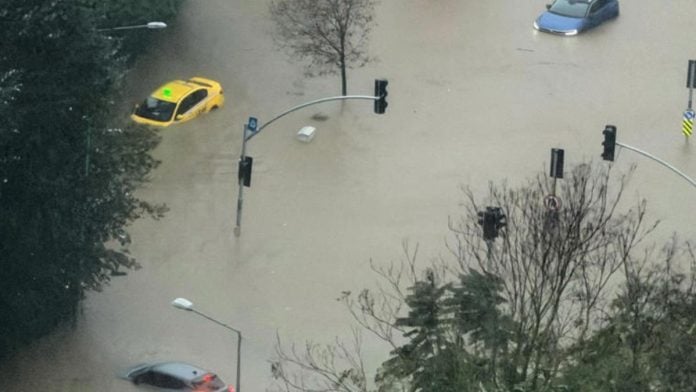
New Delhi: Weeks before it hosts the UNFCCC COP31, Turkey has been hit by catastrophic floods caused by heavy rainfall. A new study by ClimaMeter, a global research organisation, attributed the Istanbul floods to human-driven climate change, as well as natural weather variability.
The floods, which began on 14 October, have already led to 8 deaths, while bodies continue to be recovered. Mustafa Ciftci, Turkey’s interior minister, said that these were the worst floods to hit Istanbul in the last 80 years.
“We are trying our best to help our citizens, but we are also experiencing the biggest flood disaster since 1942,” Mustafa Ciftci said during a visit to one of the areas hit hardest by Wednesday night’s downpour, as reported by AP.
Floods in Turkey
After torrential rains struck the city, with over 194 mm falling in the Ömerli region, 1,227 flooding events and 15 landslides were reported across Istanbul. The government estimated that Istanbul received more rain in 48 hours than its October and September average rainfall.
Meanwhile, the Climameter analysis said the weather systems that caused these floods had 7 per cent heavier rainfall, 9 per cent stronger winds, and 1.5 degrees Celsius higher temperatures than they would have had in the past.
While direct attribution of these systems to climate change is not possible, the study did say that 3 per cent of all rain-linked damages in the city were due to climate change.
Also Read: 99% of flood assessments got sea levels wrong, says study. Indo-Pacific faces worst risk
UNFCCC COP31
Turkey’s Antalya is set to host the United Nations Framework Convention on Climate Change (UNFCCC) Conference of the Parties (COP31) from November 9 to 20, where more than 190 countries will come together to discuss issues of climate change, adaptation and mitigation.
This year, the COP is expected to be an ‘Implementation COP’, where countries will decide to act on climate commitments and chart out implementation pathways.
While the Istanbul floods don’t directly threaten the COP31 in Antalya, which is more than 600 kms away, they do highlight the issue of increasing climate-driven extreme weather events. The world recently witnessed the devastating floods in Nepal, which killed over 2000 people, with more than 5000 still missing.
“Climate change does not have to create a storm to make its impacts worse. The key question is how much the risk changes in a warming climate,” said Hasou Tang, a professor at the University of Sheffield, in a press release.
Climameter’s analysis found that over 14 million people were exposed to the rainfall-hazard area in the Istanbul floods, while over $550 billion worth of economic activity was threatened.
Their findings about increased rainfall and stronger winds during these floods were also consistent with the Intergovernmental Panel on Climate Change’s (IPCC) reports on how heavy precipitation has become more frequent and intense over most land regions as the atmosphere warms and holds more moisture.
(Edited by Maryam Hassan)