





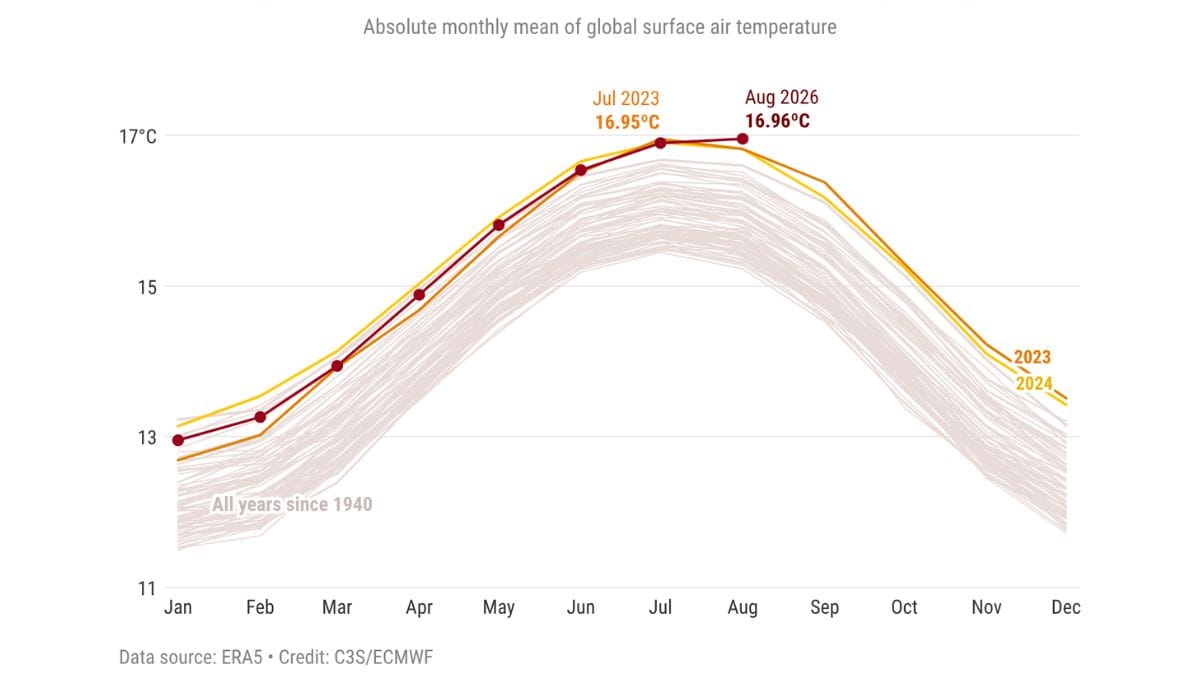
New Delhi: August 2026 is now tied with July 2023 for being the hottest month ever recorded globally, according to the Copernicus Climate Change Service. The global average surface air temperature was 16.96 degrees Celsius, nearly 1.65 degrees Celsius higher than pre-industrial levels.
The findings were reported on Thursday by the Copernicus Climate Change Service (C3S) and the World Meteorological Organisation (WMO). They highlighted that in August, average sea surface temperature also reached a record high due to global warming and an unusually powerful El Niño.
“August 2026 was a remarkable month in the global climate record. It was both the warmest August and the warmest month ever recorded. Combined with record global sea surface temperatures and the warmest summer on record for Western Europe, these observations show how climate change is driving extremes across both the atmosphere and the oceans,” said Samantha Burgess climate researchers at the European Centre for Medium-Range Weather Forecasts (ECMWF) in a press release.
Also read: 70% of seabirds can be wiped out in UK by climate change, finds new report
A very dry summer
The C3S report also highlighted that Europe had a very dry summer contributing to the higher temperatures. From June to August, most of western and central Europe, and southern Scandinavia received far less rain than usual.
While August itself wasn’t extremely dry, the months before it had left the soil parched. The dry conditions combined with the heat led to droughts and wildfires, while water levels in major rivers like the Danube and Rhine fell significantly. Satellite records even showed that August had the 12th lowest Arctic sea-ice coverage for the month.
Meanwhile, the high August temperatures coincided with extreme weather events across the globe, including the deadly flash floods in Nepal, severe wildfires in Indonesia, Greece, and Belgium, droughts in Romania, and heatwaves across western Europe.
The C3S’s findings come at a time when the United Nations Environment Programme too had recently released a report saying that global temperatures are likely to rise over 1.5 degrees Celsius above pre-industrial levels.
“We’ve really seen the impact across Europe of how maladapted we are, with roads melting, train lines buckling, schools closing, hospitals completely overwhelmed, and record wildfires for the time of year,” Burgess told Reuters. “The narrative around climate change has really transitioned from being quite an abstract concept that happens in a faraway place to disrupting our daily lives.”