







New Delhi: For several generations, one distinctive voice comes to mind when people think of nature documentaries—British conservationist and natural historian David Attenborough.
As he turns 100 years old on 8 May, here are five times he changed people’s perception of the world.
1) Animals became characters and not just specimens
Before Attenborough began his career at the BBC in the 1950s, wildlife documentaries were filmed like encyclopedias turned into films. With the entry of the calm-voiced nature-lover, animal behaviour was as dramatised for the public. Birds, chimpanzees, whales, and other animals were introduced as intelligent creatures, filled with emotion, strategising life, and cooperating when needed.
Attenborough’s narration turned the study of wildlife from a museum tour into a peek behind the curtain of animal societies, families, and inner lives.
In The Life of Birds (1998), he changed people’s perception of the creatures from just pretty little whistlers to master engineers. Their courtship dances became iconic for revealing complex mating rituals.
Even insects that disgust so many people were filmed as if they were architects and warriors, burrowing through the ground. As their struggles were highlighted through macro photography, the miniature world too was sensationalised through Attenborough’s soulful narration.
2) Evolution became a lived reality, not just an abstract theory
Charles Darwin’s theory of evolution, as revolutionary as it is, is no thriller of a novel. Written in dense Victorian style, it remains a laborious read. But with Attenborough’s 1997 BBC series Life on Earth, Darwin’s theories suddenly became relatable and not just a required reading.
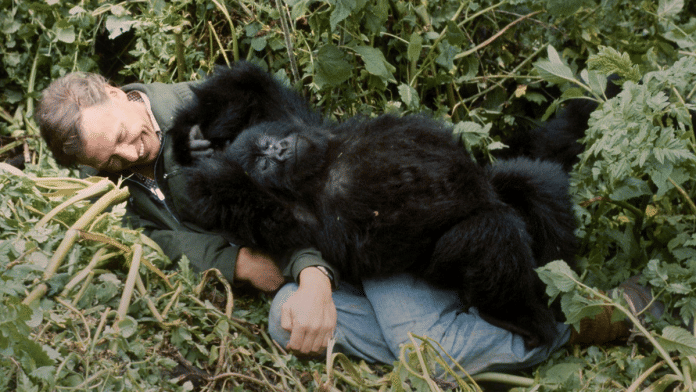
Attenborough did not lecture viewers about evolution; he made them feel a kinship to the animals. While filming the 12th episode of Life on Earth (1979) Attenborough travelled to Rwanda to film gorillas. He recalls his time with the Gorillas as one of the most privileged and extraordinary moments of his life.
“It seems really very unfair that man should have chosen the gorilla to symbolise all that is aggressive and violent, when that is the one thing the gorilla is not,” Attenborough says in the documentary, lying on the grassy floor next to a gorilla.
As he was speaking, two baby gorillas came and sat on him, rolling around playfully.For generations, that moment has become a symbol of human and animal kinship.
3) The vast ocean became a living world
For several decades, the mysterious ocean was just an empty blue wilderness to most. But as the camera dove in followed by Attenborough’s narration, viewers saw killer whales creating underwater shockwaves, giant trevallies leaping out of the water to catch birds, large reef systems, and extreme close-ups of minute sea creatures.
In the two-part series The Blue Planet (2001, 2017), he first unveiled the mysteries of the ocean and then showed viewers what they were doing to the seas.
As he recounted the story of albatrosses dying and a mother walrus searching for ice, he brought plastic pollution into the spotlight.
4) Climate change stopped being a future problem
One of Attenborough’s classic traits was the characteristic calm of his voice. But when that calm voice grew urgent, audiences sat up. He first spoke of climate change in a 2006 documentary called The Truth about Climate Change. However, it was not until the 2019 documentary, Climate Change: The Facts, that audiences saw the crisis.
In a voice filled with grief, he told his viewers that the biodiversity crisis is real, the planet is warming faster than anticipated. Not only did the documentary describe climate change, but it also showed audiences the tangible consequences of the change.
As the program concluded, Attenborough and other climate activists, such as Greta Thunberg, pleaded for immediate action.
He brought a certain legitimacy to the crisis, because here was someone who had been observing nature since the 1950s. He was no longer just an observer, but a witness to all that had changed.
5) Attenborough changed our perception of television
For the longest time, TV meant entertainment, and educational documentaries were still dry and academic endeavours. Once Attenborough entered the stage, nature documentaries turned into cinematic experiences.
His Planet Earth series was wildlife cinematography filmed in ultra HD. When audiences tuned into the episodes, they were ready for an emotional story, for a visual bonanza. One might even go as far as to say that nature filmmaking entered pop culture for the first time with Attenborough’s documentaries.
The modern era has seen several non-fiction documentaries filmed in cinematic and gripping ways, much like Formula 1: Drive to Survive (2019), which has greatly popularised the sport. In all likelihood, it was David Attenborough who taught cinema that even non-fiction can be captured and recounted as high drama. And after all, who doesn’t love drama?
(Edited by Insha Jalil Waziri)