





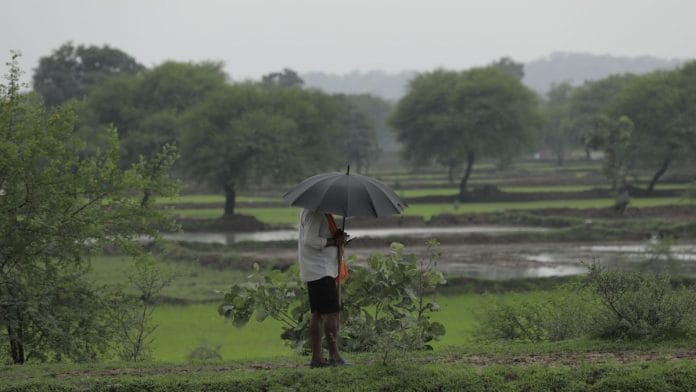


New Delhi: With India’s monsoon already at a 38 per cent deficit, and a forecast of a dry season ahead, government agencies are putting their heads together in an attempt to soften the blow on farmers and vulnerable sections. The Union Ministry of Agriculture and Farmers Welfare has placed around 200 vulnerable districts on a priority watch list and asked its research centres to prepare an updated contingency plan to prepare for the deficit monsoon, which could be worsened by the El Niño.
A senior agriculture ministry official told ThePrint that the department has already conducted several rounds of meetings with states likely to be hit the hardest by the rainfall deficiency. The ministry has directed the Indian Council of Agricultural Research (ICAR) to draft an updated contingency plan with these states, keeping in mind the challenges posed by global El Niño years.
“We have directed that these plans be prepared in coordination with states. The updated plan is expected to be submitted by July 20,” the official told ThePrint.
According to India Meteorological Department (IMD) data, India currently is at a 38 per cent rainfall deficit for this monsoon, with central India facing the highest deficit of 62 per cent. The weather department had earlier forecast a below normal monsoon, estimating seasonal rainfall at 90 per cent of the long-period average. The forecasters had said there was a 60 per cent chance of a deficient season.
The situation is further complicated by El Niño, or the El Niño Southern Oscillation (ENSO), a climate phenomenon in which trade winds and surface temperatures over the Pacific Ocean change course, leading to large-scale disruptions in weather patterns across the world.
In Asia, including India, Indonesia, Sri Lanka and even Australia, El Niño conditions are typically associated with weaker monsoons and, in severe cases, even droughts.
The Ministry of Earth Sciences (MoES), which oversees the IMD, said it has implemented early warning systems to ensure farmers receive timely alerts.
“We have informed the concerned agencies and the states of the forecasts. Our teams will be available to advance forecasting in any way necessary,” a senior MoES official said.
Also read: 4 days late at onset, monsoon is now stuck halfway to Mumbai. Meteorologists explain why
Governments preparing
Officials told ThePrint that a multi-agency taskforce, led by the agriculture ministry, was formed immediately after the IMD forecast warned of a possible monsoon deficit. Around 200 districts were identified in the ‘red zone’, where below-normal rains can impact crop yields.
The 15-member committee has been tasked with assessing the scale of the impact on the Kharif crops and the alternatives that the government can push for during possible drought periods.
“El Nino is expected to intensify towards July and August. If dry conditions continue for a long period, then we will need to plan for the entire year, because the impact of this could spillover to the next crop cycle,” the official said.
The official added that the US-Iran war had already impacted India’s pesticide and fertiliser supply chains and a dry year might complicate things further.
“There is no reason to panic, but there is no denying that we have a tough few months ahead. However, we are doing everything to soften the monsoon blow,” the official said.
(Edited by Janaki Pande)