



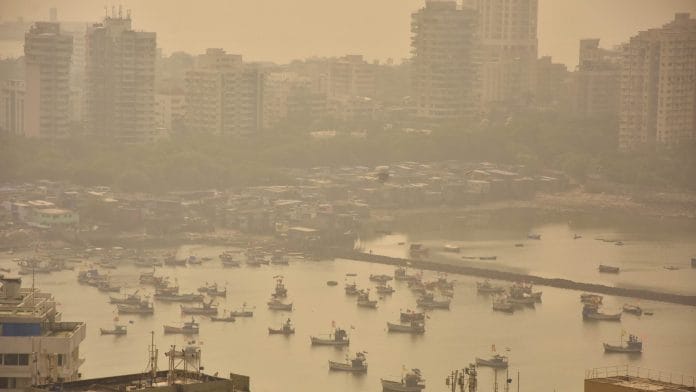

New Delhi: After a four-day delay in its onset, the southwest monsoon stopped in its tracks halfway towards Mumbai – and it hasn’t moved since. While the typical date for the monsoon’s arrival in Mumbai is 11 June, meteorologists say it won’t be reaching before 25 June this year.
This slow onset of the monsoon has left India with a rainfall deficit of 38 per cent this month. After the southwest monsoon first arrived in Kerala on 4 June, the India Meteorological Department said that conditions favoured the monsoon advancing towards Karnataka, Maharashtra and Goa in the next two days.
While it advanced over much of southwest India by 8 June, it has still not progressed towards Mumbai. The eastern parts of the country, such as Telangana, Andhra Pradesh, Odisha and the northeastern states, too saw the monsoon progress, but it was slow and limited. Except for northwest India, rainfall for June is in an overall deficit across the country.
With monsoon rains already predicted to be only 90 per cent of the long-period average in 2026, this delay adds to the concerns raised by farmers and meteorologists.
“We could see that the monsoon clouds covered southern Maharashtra, and got very close to Mumbai too. But there it stalled,” said a senior official of the IMD. “There are both local and global factors influencing it.”
El Niño conditions prevailing across the world are responsible for India’s overall monsoon deficit. However, the current situation is due to several local factors, including a weakened monsoon surge, the lack of low-pressure systems over the Bay of Bengal, and a weak Somali jet stream.
This isn’t the first time Mumbai has faced a delayed monsoon. In 2023, the monsoon reached Kerala only on 8 June, and reached Mumbai in the last week of that month. IMD officials said this late onset is not always indicative of the overall health of the monsoon season.
“Monsoon is a pulsatory phenomenon after all; it comes in bursts and phases,” an official said. “These kinds of delays are common, and often a late onset monsoon has still been a strong one.”
Reasons for delay in monsoon
As the monsoon clouds moved towards Mumbai, two factors were key in stopping them from advancing further: dry air at mid-atmospheric levels, and a weak Somali jet stream.
Also called the Findlater Jet, the Somali jet is a low-level air current that travels from the Southern Hemisphere, especially in June and July, and helps advance monsoon winds to cover the northern and inland parts of India. This year, meteorologists said that the jet was weakened, meaning it could not help Mumbai’s monsoons.
“Either the jet will get stronger over time or a low-pressure area will develop over the Bay of Bengal. Both will help pull the monsoon winds towards the rest of India,” said Mahesh Palawat, vice-president of Meteorology and Climate Change at SkyMet Weather.
ThePrint analysed IMD’s reports from the last five years and found that almost every year, the monsoon’s onset across the country has been a little fractured or delayed.
In 2020, the monsoon arrived in Kerala by 1 June and covered the entire subcontinent by 25 June, which was 12 days before normal. The country received 109 per cent of its long-period average rainfall that year.
Meanwhile, in 2021, even though the monsoon arrived on time in Kerala and covered most of India by 19 June, it took a ‘hiatus’ of three weeks before advancing further on 11 July. This year was characterised by ‘monsoon breaks’, which are defined as periods when the monsoon comes in bursts of activity and then pauses.
Similarly, in 2022, the monsoon reached Kerala by 29 May and advanced towards southern and peninsular India by 20 June. However, the IMD report mentions that it was after a break of a week that the monsoon advanced further to Mumbai and the Arabian Sea, reaching only by 27 June.
In 2023, the monsoon was delayed from its onset, reaching Kerala only on 8 June. It was delayed in reaching Mumbai until the end of June, but still managed to cover the rest of the country by 2 July, while the normal date was 8 July.
The monsoon in 2024 was normal, with a timely onset in Kerala and a normal progression afterwards, reaching Rajasthan by 25 June. However, this year also displayed variation in the monthly monsoon rainfall — while June only received 67 per cent of its long-period average rainfall, August received 130 per cent.
In 2025, however, the monsoon arrived early in Kerala by 24 May, and covered the entire country by 29 June. This early onset was combined with excess rainfall throughout the monsoon season, with each month seeing more than 100 per cent of its long-period average.
“We really cannot say whether a delayed onset this year will impact the rest of the season,” explained Palawat. “It depends on the weather systems in July and August, but of course, the El Niño’s impact will be felt, and a deficit is expected.”
(Edited by Prashant Dixit)