



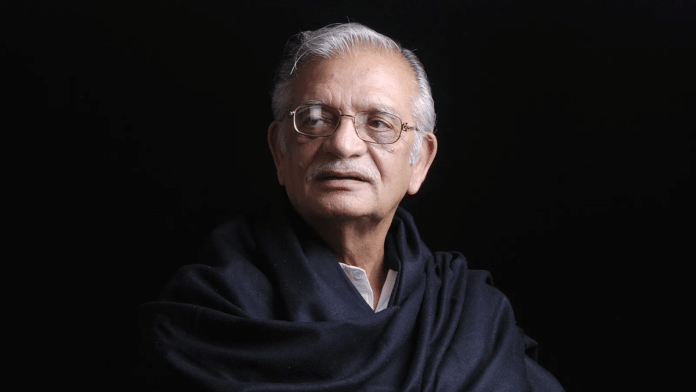
New Delhi: Poet and lyricist Gulzar said that over the years he has become more selective about writing songs for films. He now considers requests from only a couple of directors who understand poetry and give him the freedom to write the way he wants.
Gulzar, 92, who stopped directing films in 1999, spoke to The New York Times about writing, Partition and what his life looks like now, away from filmmaking.
Born Sampooran Singh Kalra in Dina, now in Pakistan, Gulzar moved to Delhi with his father as a child. He slept in the storeroom of his father’s fabric shop and read detective novels in Urdu by lantern light. The bookstall across the road also introduced him to writers from India and elsewhere through Urdu translations. He repeatedly rented Rabindranath Tagore’s The Gardener (1913) before eventually stealing it.
At school, a literature teacher made him memorise poetry.
“The couplets that you memorise, when their meaning starts getting into you, that is how the learning comes into you, that is how education comes in,” Gulzar said.
The article then highlights Gulzar’s life during the Partition, when the remainder of Gulzar’s family fled to Delhi, and relatives arriving from refugee camps crowded into the family home. He recalled seeing bodies on the streets during the violence and added that he had nightmares for nearly two decades.
“The writing becomes your shelter — to express yourself and relieve yourself, to purge it out,” he shared.
His father eventually sent him to Mumbai, where the young poet continued his studies while working at a car garage. He spent years mixing paint to match the exact shade needed to touch up cars damaged in accidents. He also became part of the city’s leftist literary circles, where a friend introduced him to filmmaker Bimal Roy.
Gulzar wrote his first film song, ‘Mora Gora Ang Lai Le’, for Roy’s Bandini in 1963. He went on to write lyrics for more than 150 films and direct more than a dozen.
Cinema also brought Rakhee into his life. Gulzar married the acclaimed Hindi film actor, but the two separated soon afterwards. He described their marriage as “the longest short story of my life”. But they remained friends and even raised their daughter, Meghna, also a filmmaker, together.
Throughout all of it, he never stopped writing.
“A poem is your own commitment, your own thought, and it germinates within you,” he said.
After Hu Tu Tu in 1999, he stopped directing and turned largely to writing. His latest book, Aamchi Mumbai, is a collection of stories and poems about the city he has called home for decades.
Gulzar returned to Dina in 2013, more than 70 years after leaving. In a note to residents, he wrote: “All I wanted was a moment of solitude, so I could sit and weep.”
At 92, he still wakes at dawn and usually goes to bed around 10 pm. He spends much of the day reading, writing and alone. Rakhee, told the NYT, has a line he likes to repeat: “If you weren’t a poet, you would be quite an ordinary man.”
Author Rakhshanda Jalil, who has translated several of Gulzar’s books into English, recalled an instance of Gulzar finding poetry around him. On a flight to Canada in 2019, she was working beside him when he began repeating: “The sheep, the sheep. They are fighting among each other.”
Jalil looked up, confused. Gulzar was watching the clouds, she said. He asked her: “Don’t these clouds look like sheep that are getting entangled among themselves?”
It happened again during the interview, the translator shared, when a falling leaf caught the poet’s attention. He began wondering why it had left its branch and where it was going.
Gulzar said: “I find a poem in it, in that leaf falling down. You may not. But I can make you aware.”
(Edited by Insha Jalil Waziri)