





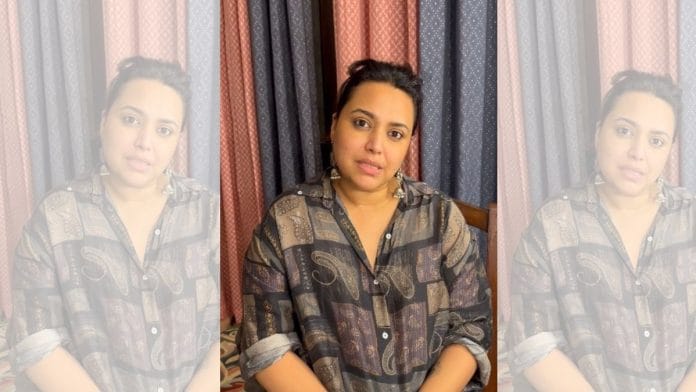

New Delhi: Actor Swara Bhaskar has responded after a media organisation allegedly misquoted and mistranslated her remarks about Maharani Padmavati and the practice of jauhar depicted in the climax of Sanjay Leela Bhansali’s Padmaavat.
“I clearly want to state, I absolutely did not say that Queen Padmavati was a coward, or that the other women and queens of the palace who committed Jauhar were cowards,” Bhaskar said in a video posted on X.
What Swara Bhaskar said about Padmaavat
The remarks were made at an event organised by the India International Centre on August 31. At the event, Bhaskar argued that the jauhar scene in Bhansali’s Padmaavat could send a troubling message to rape survivors.
“I thought that if, God forbid, I was a rape survivor, what is this film telling me? I would feel like a coward if I didn’t commit suicide to save my honour,” she said at the event.
Bhaskar added that she questioned whether films should send survivors the message that their lives are no longer worth living after heinous crimes like rape. She challenged the idea that a woman’s honour or bravery should be linked to taking her own life, calling the scene deeply problematic.
“Are we saying that rape is the end of a woman’s life? This scene was so problematic,” she said, referring to the climax of Padmaavat.
Also Read: Swara Bhaskar wrote a letter to Sanjay Leela Bhansali. Says it ruined her career
Bhaskar’s clarification
On Tuesday, Bhaskar posted a clarification video claiming that a clip from the event had been mistranslated, creating a false narrative about her remarks on Maharani Padmavati.
She pointed out that her original remarks at the event were in English and said she would translate them herself into Hindi to explain exactly what she meant.
“Because when you don’t understand a language, you should ask or verify. You shouldn’t fabricate lies, spread them, and incite people. And those who want to hurl abuses at me, please do, but do it for the right reasons,” she said.
Further into the video, Bhaskar translated her comments sentence by sentence into Hindi. She said her argument was not that Padmavati or the women who committed jauhar were cowards, but that suicide should not be presented as the expected response to sexual violence.
Bhaskar said her message was about how rape in Indian society has spread like an “epidemic”, and argued that the country was living amid a rape culture.
“Just yesterday in Delhi, a very barbaric and violent gang rape occurred, where a girl was gang-raped for 46 kilometres inside a car. This is the reality of our country,” she said.
Bhaskar said that films like Padmaavat should not be made in a way where a woman’s physical purity is more valuable than her life.
“Should we send this message to our rape survivors, that it would have been better if they had just lost their lives? That if they survived, it is a bad thing? Should a woman’s life end with rape? That is my question,” she said.
She added that people should never underestimate a woman’s will and desire to live. Recalling the 2012 Delhi gang rape case, popularly known as the Nirbhaya case, Bhaskar said the victim fought her attackers until her last breath.
“She fought her six rapists until her dying breath. She had such a fierce desire to live. Six men tortured her with unimaginable barbarity; the poor girl died, but she fought until her very last breath,” she said.
(Edited by Maryam Hassan)