


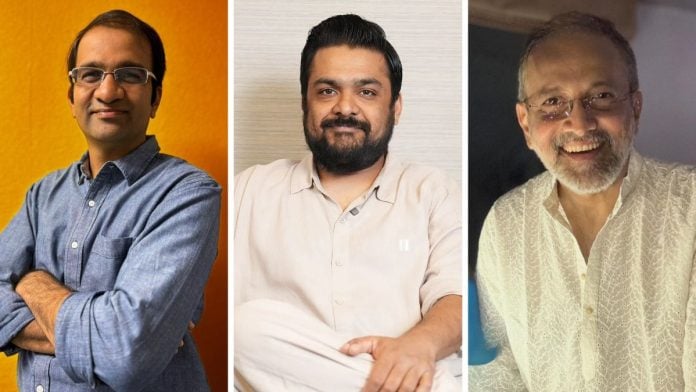
Mumbai: When producer Vikram Malhotra asked Rajesh Mapuskar to direct a film on Hanuman, the filmmaker had one question: Why me? He wasn’t a bhakt or a devotee. Malhotra told him that was exactly why he’d called. He wanted someone who would approach Hanuman as a character and find the story behind him.
There was another complication. Chiranjeevi Hanuman: The Eternal would be made with artificial intelligence (AI), without actors or physical sets. Mapuskar had spent years directing, but AI was an entirely different proposition.
“I’m such a tech handicap, and I’m making an AI film,” he told ThePrint.
Behind the film is Collective Artists Network, the talent agency that represents top Indian stars, including Deepika Padukone, Ranveer Singh and Rashmika Mandanna. Now it’s making films and shows without actors, using AI to cut production costs.
Vijay Subramaniam, Collective’s founder and group CEO, wants the company to do more than just “manage” the careers of its stars. He believes owning original IP will create opportunities for his talent.
“Fundamentally, the way to serve your client ecosystem in the long run is via ownership and not service,” he said.
Early examples of these opportunities already exist. He pointed to Lavanya Agrawal, who made her first television show at 24 and now, two years later, is show-running six shows for HistoryVerse.
But producing the stories he had in mind would require enormous sets and thousands of performers.
“If I have to construct Hastinapur on a set, or if I have to go traditional VFX on it, it’s going to cost me a kidney,” he said.
The company calls the slate HistoryVerse. Its subjects range from the Mahabharata to Bhagat Singh and Khudiram Bose. Subramaniam, the son of a retired Army colonel, calls himself “extremely proud of the nation”. He wants children, including his own, to know these stories, and believes India’s historical and mythological characters can rival Western superheroes.
From myth to machine
In July 2024, Collective acquired Galleri5, a Bengaluru technology company founded by Rahul Regulapati. The firm moved from catalogue images and advertisements to short videos and the AI-generated series Mahabharat: Ek Dharmayudh.
The series caught flak for artificial-looking performances and visual mistakes. In one scene set in ancient Hastinapur, viewers spotted a modern-looking bedside table. Regulapati accepts the criticism.
“Are there flaws in it? Yes. Have the flaws reduced over time? When we did Mahabharat season one versus now season two, there’s dramatic improvement,” he told ThePrint.
Mapuskar, meanwhile, began his film the traditional way. He brought the writers together, wove the story and worked with them to find its emotional core. Then he travelled to Bengaluru, where Galleri5 is. His cinematographer had planned the shots, his production designer the sets and his costume designer the characters’ clothes. But instead of a crew building and shooting them, engineers would generate the images.
He began holding workshops. The engineers knew the technology; they needed to understand filmmaking. What a director meant by a close-up, a camera movement or a character crossing the frame in a particular direction. He needed them to understand why a shot was designed that way before they could generate it.
Regulapati was trying to make that process easier. Making an AI film would otherwise mean using different tools to write scripts, design characters, create images and generate video. Each requires its own instructions, or prompts, and someone who knows how to work with it. Galleri5 developed Miro to bring those tasks together. The platform uses more than 200 AI models, choosing which ones to use for each job, so filmmakers can concentrate on what they want to make rather than learning how to operate each tool.
Regulapati demonstrated the process by asking Miro to create a one-minute mythological film set in Maharashtra. The platform offered him four legends to choose from. After he picked one, it began researching, writing a script, dividing it into scenes, establishing characters and locations, and generating shots, voices and music. Each process resulted in a few options to choose from, and Regulapati could review the result and ask for changes at any step. The whole process from legend selection to watching the final video took about five minutes.
“The moment I enter it, it doesn’t just start creating a video; it starts creating an entire plan around it,” he said.
But being able to tell Miro what you want isn’t the same as knowing whether the result is any good.
“It’s like saying that I have a very expensive camera, but I’m giving it to somebody who doesn’t know how to shoot,” Regulapati said. “I think more than descriptions. You need to have the right taste.”
An AI model can propose several costumes for a character. A costume designer decides which one suits that character and the world of the film. The cinematographer and production designer make similar choices about shots and locations.
“AI is like your really smart assistant who is giving you tons of options,” Regulapati said.
But demonstrating the technology on a one-minute film is one thing; sustaining it through a feature-length production is a different ball game. On a film running two or three hours, faces, clothes and locations have to remain consistent across a much longer time. Ordinary AI video generators can return different-looking characters even when given the same prompt. Miro builds character sheets and visual references that future shots must draw on.
Also read: Who owns Sidhu Moose Wala’s unreleased music? ‘Phantom’ release triggers legal row
‘I feel more in control with my actors’
Mapuskar had a more unusual problem. He wanted Hanuman’s tail to act.
“It’s like how our hands behave. A hand has specific gestures, which you unknowingly do. While I’m talking to you, my hand is moving,” he said.
He watched documentaries of monkeys, studying what their tails did when they were excited, sad or resting. He decided Hanuman’s tail would rise with a wiggle when he was happy and curl differently when he challenged someone. The engineers had to make those gestures repeatable and consistent across all the shots.
Some shots were still beyond the technology. Mapuskar and his cinematographer could specify an angle, a movement or the lighting they wanted. The engineers would generate a version, and the filmmakers reviewed it. They could ask for another version of the image. But if the machine wasn’t yet equipped to deliver this particular demand, another attempt wouldn’t help.
The engineers then had to develop and test a way of making that shot possible. Mapuskar would move on to other scenes while they worked on it. Once solved, the movement or effect became something the team could use again.
During the first half of production, Mapuskar often had to adjust his ideas to what the system was capable of producing.
“I’m a person who likes to work with humans, and I feel more in control instructing my actors exactly what I want,” he said.
On a set, an actor could try something different, and it might work better than the performance Mapuskar had asked for. He missed that exchange. Gradually, the technology improved and so did his understanding of it.
“We were drinking together. We were buddies,” he said.
The system surprised him with the visual treatment it suggested for the climactic battle between Ram and Ravan.
“It came up with something which was absolutely overwhelming. I never thought about that.”
But this trial and error costs money. Generating video requires computing power, and Regulapati acknowledges that those costs are rising. Galleri5 is trying to get more shots right in fewer attempts by establishing their details before generating them.
But AI isn’t cheaper for every kind of scene. Regulapati estimated that a scene of two people talking in an office might cost about as much to generate as to shoot conventionally. A battle involving thousands of soldiers, sets, armour and costumes is quite different.
“If I’m doing a one-minute war sequence of a period drama, my cost saving between AI and live action could be a factor of a hundred,” he said.
Also read: ‘Bandit Queen’ gets a sequel. To explore Phoolan Devi’s life after prison
A cheaper kind of spectacle
For Subramaniam, the appeal is being able to make more of those large-scale films. Given a hypothetical Rs 300 crore, he would rather spread the money across ten films than spend it on one.
“Capital will be redeployed to produce more scale,” he said.
This kind of scale also changes who works on a film. Mapuskar still works with a cinematographer, costume designer and production designer, but the sets aren’t physically built, there are no costumes stitched for performers and no cameras or lighting rigs like on a conventional shoot.
Subramaniam agrees that some production jobs will change or disappear, while arguing that new work is opening up for engineers and filmmakers who couldn’t previously afford to make films on this scale.
For a man who has been called the “AI man of the Indian media industry”, Subramaniam doesn’t like calling these AI films. His argument is that AI is already being used across the industry, including in films that audiences wouldn’t necessarily think of as AI-generated.
“They’re all using AI. They might be using it under a tarpaulin, but they’re using it,” he said.
Collective is openly committed to using the technology on a much larger scale, but Subramaniam doesn’t see it as a departure from filmmaking itself. The writers, directors and designers are still making the creative decisions. What has changed is how those decisions are carried out.
“The medium of execution has changed. That’s not the creative medium; it’s the execution medium,” he said.
Regulapati echoes this thought. Miro is “AI native”, but he’s building it from the ground up to be “creatively native” as well. The technology generates the material, but the process is driven by the filmmaker’s creative choices.
Chiranjeevi Hanuman is now in the final stages of post-production, with an expected 2027 release. Mapuskar came to Bengaluru knowing very little about the technology and spent months teaching engineers how to translate his ideas into shots. He wants to use Miro on his future films too, particularly for elaborate sequences and locations that would otherwise be difficult or expensive to create.
For now, he’s looking forward to “going home”. To working on sets with actors.
(Edited by Saptak Datta)