





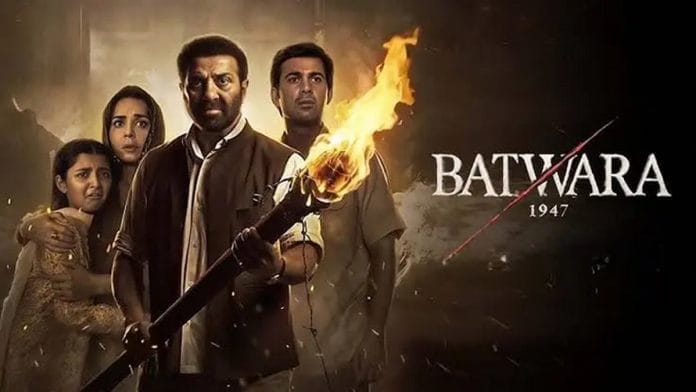


New Delhi: Nearly eight decades after Partition tore the subcontinent apart on 14 August 1947, Indian cinema keeps picking at the scars. The latest entry, the Sunny Deol-starrer Batwara 1947, hit theatres this Friday, joining a long line of films that have tackled the subject from different angles.
Filmmakers over the years have explored displacement, communal violence, fractured families, lost love and patriotism— from Garm Hava, which depicted the futility of communal hatred, to the angry, macho nationalism of Gadar.
On the anniversary of Partition, ThePrint looks at some of the films that have told the story of 1947.
Also Read: Main Vaapas Aaunga is the movie India needs but doesn’t want
Chinnamul (1950)
One of the earliest Indian films to confront Partition was Nemai Ghosh’s Chinnamul. The Bengali-language movie revolves around a group of farmers who are forced to leave their village in East Pakistan (now Bangladesh) and migrate to Calcutta. The film depicts the physical and emotional pain families went through at the time as they were uprooted from their homes and became refugees in what was once their own country. The film also featured Ritwik Ghatak in a small role, years before he himself made some of Indian cinema’s most powerful films about Partition.
Ritwik Ghatak’s Partition trilogy (1960-1965)
The Dhaka-born filmmaker Ritwik Ghatak was himself deeply affected by Partition, and it became a recurring theme in his work. His Partition trilogy began with Meghe Dhaka Tara (1960), based on Shaktipada Rajguru’s novel of the same name. The plot revolves around Nita, a young refugee from East Pakistan living with her family in the suburbs of Calcutta. She self-sacrifices endlessly and develops TB, yet in the famous climax of the movie she cries out to her brother: “Dada, ami bachte chai” — Elder brother, I want to live.
Ghatak followed it with Komal Gandhar (1961), which is about Partition refugees in a Bengali theatre group and considered the more optimistic film of the trilogy. The third film, Subarnarekha (1965), is about two siblings trying to rebuild their lives after being uprooted from East Bengal.
Dharmputra (1961)
Long before he graduated to NRI romances and mustard fields, Yash Chopra had a short-lived stint with political filmmaking. His second film, Dharmputra, starred Shashi Kapoor and Mala Sinha and took on communalism and religious fundamentalism in the backdrop of Partition.
The central irony of the film is that Kapoor’s character is Muslim by birth but is adopted by a Hindu family and grows up to develop fiercely anti-Muslim views — until the blinkers finally fall from his eyes. Dharmputra flopped at the box office but won a National Film Award and has been praised for its sensitive handling of communalism.
Garm Hava (1973)
MS Sathyu’s classic Garm Hava, based on an unpublished story by Ismat Chughtai, looked at Partition from the perspective of Muslims who chose to stay in India. Balraj Sahni stars as Salim Mirza, an Agra shoe manufacturer watching his family slowly split apart as one relative after another leaves for Pakistan. The film initially ran into trouble with the Censor Board but went on to win two National Film Awards. It was also India’s entry for the Academy Award for Best Foreign Language Film and was selected for Cannes in 1974.
Tamas (1988)
As the parallel cinema wave was gaining strength, adaptations of novels became a trend. In 1988, Govind Nihalani came up with Tamas, based on Bhisham Sahni’s Hindi novel of the same name. Starring Om Puri, Deepa Sahi and Surekha Sikri, it was made as a six-part series and telecast on Doordarshan rather than getting a conventional theatrical release.
Set against the backdrop of riot-stricken Punjab at the time of Partition, the film follows families from different communities as they deal with the violence and uncertainty, particularly those living in areas close to the border. Acclaimed though it was, Tamas caused a storm when it aired. Protesters demanded that it be taken off television and the battle reached the Supreme Court, which allowed the telecast to continue.
Earth (1998)
A Partition film with more interiority than most is Deepa Mehta’s Earth, which looks at 1947 through love and betrayal. Based on Bapsi Sidhwa’s novel Cracking India, the story is seen largely through Lenny, a young Parsi girl in Lahore. At its centre is her Hindu ayah Shanta (Nandita Das) and the two Muslim men in love with her, played by Aamir Khan and Rahul Khanna. As Partition unfolds, their close-knit circle becomes fractured along religious lines.
Gadar: Ek Prem Katha (2001)
Directed by Anil Sharma, Gadar gave Partition the full-blown Bollywood blockbuster treatment. Loosely inspired by the real-life story of former Sikh soldier Boota Singh, it stars Sunny Deol as Tara Singh, a Sikh truck driver who falls in love with a Muslim woman. When she later ends up in Pakistan, Tara crosses the border to bring her home.
The film cemented Deol’s image as the angry patriot taking on Pakistan, complete with roaring speeches and the famous scene in which he rips a handpump out of the ground. It became one of the highest-grossing Hindi films of its time.
Pinjar (2003)
Chandraprakash Dwivedi’s Pinjar moves beyond the political history of Partition to explore the violence faced by women and the loss of identity during the period. It is based on Amrita Pritam’s Punjabi novel of the same name. Urmila Matondkar plays a young Hindu woman abducted by a Muslim man (Manoj Bajpayee) because of an old family feud. When she escapes and returns home, her family refuses to accept her, leaving her to return to the man who abducted her.
Main Vaapas Aaunga (2026)
Imtiaz Ali’s Main Vaapas Aaunga deals with how Partition still ripples through lives even as memory fades. In this sleeper hit, Naseeruddin Shah plays 95-year-old Ishar Singh, who has dementia but still remembers the home and the woman he left behind in 1947. Now, he wants to return to undivided India.
Batwara 1947 (2026)
Sunny Deol returns to familiar territory in Rajkumar Santoshi’s Batwara 1947. This time, though, it isn’t quite as clearly explained what he is so angry about — and the film is far less chest-thumping than Gadar. Deol plays a Muslim man who moves with his family from Lucknow to Lahore after Partition and is allotted a haveli, only to find its elderly Hindu owner (Shabana Azmi) still living there.
(Edited by Asavari Singh)