



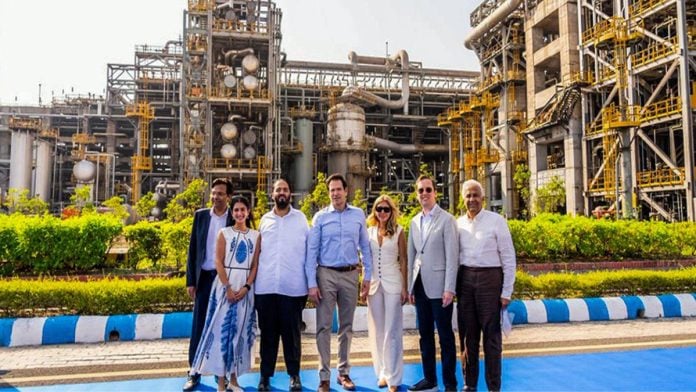
New Delhi: US Secretary of State Marco Rubio’s visit to the Reliance Industries refinery in Jamnagar Wednesday has put India’s growing refining strength in the spotlight as the country enters another major expansion cycle.
Rubio arrived in Mumbai Tuesday and travelled to Jamnagar a day later, where he visited Reliance’s refining complex which has the capacity of 1.4 million barrels per day (mbd). His trip came after he described India as a crude-refining “superpower”, and said the country could play a role in processing more Venezuelan crude.
India is currently the world’s fourth-largest refining country after China, the US and Russia, with a capacity of about 5.7 mbd. This is expected to rise to around 6.66 mbd by 2032, with nearly 1 mbd of additional capacity, as “the country is undergoing another significant expansion cycle”, Sumit Ritolia, manager for Modelling and Refining at trade intelligence firm Kpler, told ThePrint.
A large part of the new capacity is expected to come through 2026-27, with a mix of new refineries and expansion of existing plants. Key additions include Indian Oil Corporation’s 220,000 bpd (barrels per day) expansion at its Panipat refinery and a 66,000 bpd expansion at Barauni, besides Numaligarh Refinery Limited’s 132,000 bpd expansion in Assam. Hindustan Petroleum Corporation’s 180,000 bpd Barmer refinery in Rajasthan began operations in July this year.
Further additions are expected from Bharat Petroleum Corporation Limited’s Bina refinery, which is projected to add around 70,000 bpd by 2029, and Chennai Petroleum Corporation’s Nagapattinam project, expected to add around 198,000 bpd by 2032.
The expansion is significant because India’s refining industry is focused not just on meeting domestic fuel demand. Indian refiners are also major exporters of diesel, gasoline and other petroleum products, supplying to markets across Asia, Africa, Europe, Australia and the US.
Ritolia said the new projects would “not only increase India’s crude processing capacity, but also strengthen its petrochemical integration, and flexibility to process a wider range of crude grades”.
That flexibility has become increasingly important as crude supply, prices and trade flows are being reshaped by geopolitics.
Also Read: Trump’s Russian oil waiver may boost India’s winter supplies, but crude prices unlikely to fall
Why Jamnagar matters to Washington
Reliance’s Jamnagar complex is at the centre of this story. With a combined capacity of around 1.4 mbd, it is one of the world’s largest and most complex refining hubs. Its configuration allows Reliance to process a wide range of crude, including lighter US grades, and heavier Russian and Venezuelan barrels.
“Jamnagar is, therefore, not just a major crude importer, but an important supplier of refined products to global markets,” Ritolia said.
The refinery’s ability to process different crude grades gives Reliance flexibility to change its crude basket based on discounts, freight costs, availability and refining margins.
That also is why Jamnagar is relevant to Washington. The US has an interest in expanding energy trade with India, including increasing US crude sales and encouraging greater processing of Venezuelan crude. Reliance’s ability to handle heavy crude makes it particularly relevant.
But greater US engagement does not automatically mean Reliance will move away from Russian crude. “Reliance’s crude purchasing decisions remain largely commercial,” Ritolia said. Russian crude has remained attractive because of its discounts, while Venezuelan barrels provide another option for complex refineries such as Jamnagar.
US crude remains an alternative, but its generally lighter quality and freight costs can make it less competitive against Middle Eastern or discounted Russian barrels.
For Washington, Jamnagar could be a way to influence India’s crude purchases, but any shift will depend on the economics of buying different grades of crude as much as geopolitical pressure.
However, Washington also has an interest in keeping Jamnagar running smoothly as the refinery supplies fuel to international markets, including the US itself. Any major disruption could reduce product supplies and push up prices.
More refining does not mean energy independence
India’s expanding refining capacity will strengthen its role in global oil markets, but will not make the country self-sufficient in crude. Instead, it could make India an even more important buyer of crude from multiple suppliers. The ability to process different grades allows refiners to adjust purchases as prices, availability, freight costs and geopolitical conditions change.
“Additional refining capacity will help meet rising local consumption, while supporting India’s role as a major supplier to international markets,” Ritolia said.
However, he cautioned, “the extent of incremental exports will depend on domestic demand growth, refinery utilisation and global refining margins”.
The next phase of India’s refining story is, therefore, not simply about adding capacity. It is about building more flexible and integrated refineries that can process a wider range of crude and produce higher-value fuels and petrochemicals.
Rubio’s Jamnagar visit has highlighted India’s growing refining strength. With capacity set to approach 6.7 mbd, India is set to become an even bigger player in global crude and refined fuel markets.
(Edited by Mannat Chugh)