



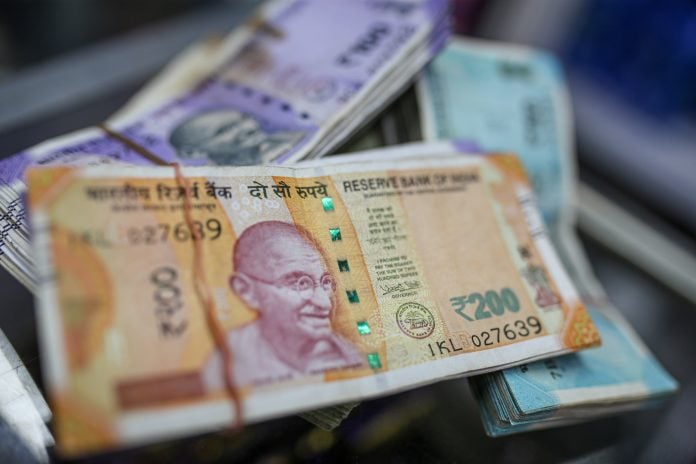
India’s most aggressive currency defense in more than a decade is telling market watchers that the central bank is prepared to pull out all the stops to keep the rupee from weakening beyond 97 per dollar.
The Reserve Bank of India on Saturday announced sweeping measures to support the currency, among its toughest since the 2013 taper tantrum. The rupee surged more than 1% on Monday, pulling away from the 97 level — which has emerged as a key marker for currency traders as it sits just beyond the record low of 96.9650 reached in May.
“It is absolutely evident now that 97 per dollar is the RBI’s line in the sand for the rupee,” said Abhishek Upadhyay, an economist at ICICI Securities Primary Dealership Ltd. in Mumbai. The RBI’s message is that the rupee’s fall has been too sharp and the central bank is willing to do whatever it takes to prevent a new record low, he said.
The forceful intervention follows the RBI’s first interest-rate increase in nearly four years and hawkish commentary last week, which did little to alter the currency’s course. It also shows that elevated oil prices and persistent foreign outflows from local stocks are keeping policymakers on guard against further depreciation.
The RBI wants to curb speculative bets by pushing market participants to pare positions in the forwards market and prohibit trades without real demand, according to people with knowledge of the matter, who asked not to be identified as the discussions are private.
The rupee rose to 95.5938 a dollar on Monday. It is still down about 6% this year, one of the worst performers in Asia. RBI Governor Sanjay Malhotra said last week the currency was undervalued on some gauges, and that markets can be irrational in the short term.
The central bank again intervened in the onshore market on Monday to support the rupee, traders familiar with the matter said.
‘Bad Optics’
Australia & New Zealand Banking Corp., Crédit Agricole SA and Malayan Banking Bhd also view 97 as a crucial level for the rupee. The RBI did not immediately respond to an email seeking comment on the matter.
Given its proximity to the rupee’s record low, 97 has become a key level for hedging and trading decisions, said Sajal Gupta, head of forex and commodities at Nuvama Institutional desk. “I think 97-98 levels should be protected because 100 would be like bad optics.”
The RBI’s new measures include a special window to meet state-run oil companies’ dollar needs and a reserve requirement on certain foreign-exchange derivatives. Banks and other Indian foreign-exchange market participants asked the central bank to relax these and delay their implementation, according to people familiar with the developments.
Meanwhile, bonds slumped on Monday, with the benchmark 10-year yield rising to the highest level since March 2023, after the RBI also asked banks to put aside more cash as part of a reserve requirement on a daily basis, and announced an open-market sale, where it sells bonds it already owns.
“The reputational risk is not so much a weaker rupee, but the perception that investors cannot rely on efficient and predictable access to currency hedging,” said Rajeev De Mello, global macro portfolio manager at Gama Asset Management SA. “Over the medium term, that could prove more damaging to foreign investors’ appetite for Indian bonds than allowing the rupee to adjust to the global energy shock.”
The measures introduced are the latest attempt by RBI to support the rupee. Earlier this year, it limited daily net open positions for banks at $100 million and barred lenders from offering clients non-deliverable rupee contracts, a restriction it later rolled back. It also removed taxes on bond investments by global funds later.
Then, in June, the RBI sought to bring in capital flows through a diaspora deposit program. That raised a record $133 billion, swelling its foreign exchange reserves to nearly $800 billion in early September. Since then, the stockpile has fallen $51 billion, partly due to its efforts to support the rupee.
While the oil window will remove some dollar demand from companies in the market, it will further drain the RBI’s reserves, said Dhiraj Nim, FX strategist at ANZ in Mumbai.
What Bloomberg Strategists say:
“The Indian rupee needs more than a series of stop-gap measures to fundamentally put it on a more resilient trajectory. The more-than-40% surge in Brent crude since the start of the Iran war and a 5% loss in the value of the rupee since then have raised India’s import bill. So, unless the country can address the trade deficit, the rupee will continue to stay under pressure beyond today’s gains.”
— Ven Ram, cross-asset strategist.
The latest steps target demand in the foreign-exchange derivatives market. For the first time, the RBI introduced a FX risk reserve, requiring lenders to hold with the central bank the rupee equivalent of 20% of the notional value of each derivative transaction above $2 million. The People’s Bank of China has a similar tool to manage pressures on the yuan by varying the reserve requirement on forward contracts.
“The RBI still has a lot of policy measures it can introduce to prevent the rupee from falling past 97,” said Eugenia Victorino, head of Asia strategy at Skandinaviska Enskilda Banken in Singapore. “It is likely hoping that these measures buy them time until oil prices pull back yet again.”
–With assistance from Bhaskar Dutta.
Authors: Pratigya Vajpayee, Ruchi Bhatia and Anup Roy
Disclaimer: This report is auto generated from the Bloomberg news service. ThePrint holds no responsibility for its content.
Also Read: The rupee does not need a defender. It needs an economy worth defending