





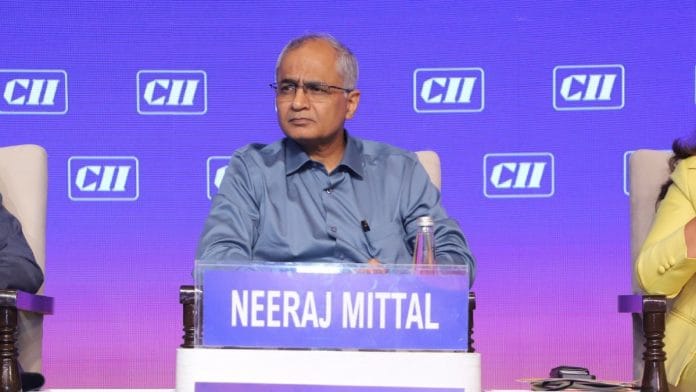


New Delhi: Petroleum Secretary Neeraj Mittal Monday refused to speculate on any possibility of a hike in petrol and diesel prices, even as crude oil prices continue to hover around $100 a barrel amid the deepening West Asia crisis and disruptions in the Strait of Hormuz.
Mittal’s comments came on the sidelines of the Annual Business Summit 2026 organised by Confederation of Indian Industry (CII), where he was a speaker at a session Monday on “Imperatives of Energy Security in a Fragmented World”.
Mittal said the government’s immediate focus was on ensuring uninterrupted fuel supplies and insulating consumers from global price shocks.
His remarks come a day after Prime Minister Narendra Modi appealed to citizens at a public gathering in Hyderabad to voluntarily reduce fuel consumption and avoid unnecessary foreign expenditure to conserve India’s foreign exchange reserves. The Prime Minister urged people to use public transport, adopt car-pooling and reconsider discretionary spending such as destination weddings abroad and excessive gold purchases for a year.
On Sunday, Petroleum Minister Hardeep Singh Puri also flagged the rising stress on oil marketing companies (OMCs), saying public sector OMCs could incur losses of up to Rs 1 lakh crore due to the West Asia conflict.
PM Sh @narendramodi Ji appeals to the citizens to curtail use of petrol and diesel, use public transport where possible, and car pool as much as possible.
Measures such these will help the nation conserve energy, save on the energy import bill and overcome the challenges arising… pic.twitter.com/D20ItaWFTo
— Hardeep Singh Puri (@HardeepSPuri) May 10, 2026
On the Prime Minister’s appeal to citizens, Mittal said Modi’s remarks were aimed at encouraging responsible consumption at a time when imported fuel costs are exerting pressure on the economy.
“If we can save even a dollar, that money saved can go into some development programme. I think that is the spirit in which this reminder from Prime Minister should be received by all of us,” Mittal said, urging citizens and industry to follow the advice “to the extent possible, to the extent practicable”.
At the summit, Mittal repeatedly stressed that India had managed the crisis without resorting to any panic measures despite severe supply side disruptions over the past two months.
“We have maintained almost 60 days of stock for our products and a month-and-a-half of energy,” Mittal said, describing the government’s response as a combination of diplomatic outreach, diversified sourcing and stock management.
He also said that supply constraints continue to remain unchanged since the conflict in West Asia began and have gotten worse. “Supply constraint has not changed at all, in fact, it is a little worse than what it was,” he said.
However, he credited the government’s diplomatic engagement under Modi for helping India secure alternative supplies at short notice.
“Over the last 60-70 days, every day we have kept this stock forward, which means we have procured from other sources, procured from other countries, increased procurement from existing countries and that is what kept us going,” he said.
Also Read: Fire that engulfed Rajasthan refinery ahead of Modi launch unlikely to hit fuel supply—Kpler analyst
‘Creative ways’ of building reserves
Another major focus of the secretary’s remarks was the government’s evolving strategy on strategic petroleum reserves (SPR).
Responding to questions on whether India would expand its reserves, Mittal said comparisons with economies such as Japan and South Korea are misleading because of India’s much larger daily crude consumption of around 5 million barrels.
“For a country like India which consumes 5 million barrels a day, to have a 90-day reserve would mean putting a lot of money in a box without using it at all,” he said.
Instead, the government is exploring “creative ways” of building reserves while ensuring the crude inventory generates returns rather than remaining idle. “We are looking at many ways of doing it,” Mittal said, hinting at possible partnerships and trading arrangements linked to strategic storage.
On the longer-term energy security front, Mittal spoke about exploration and production roadmap aimed at reducing India’s import dependence.
He said the government was pushing ahead with Open Acreage Licensing Policy (OALP) rounds 10 and 11 while simultaneously expanding geological data acquisition for unexplored sedimentary basins.
Open Acreage Licensing Policy is a government of India initiative to accelerate exploration of domestic oil and gas. “As we speak, OALP 10 and 11 are out,” he said, adding that new 2D and 3D seismic data acquisition programmes had been initiated for areas previously not permitted for exploration.
The secretary said the Centre had introduced a “slew of reforms” to improve ease of doing business in the upstream oil and gas sector and mitigate investment risk in exploration. “We are seeing early signs of renewed participation,” he said, pointing to growing investor interest in exploration blocks. Mittal also indicated that the government is looking into high-risk exploration activities based on international models where states absorb part of the exploratory risk to encourage private investment.
(Edited by Amrtansh Arora)
Also Read: New empowered groups, focus on self-reliance—Modi in RS on India’s preparedness amid energy crisis