





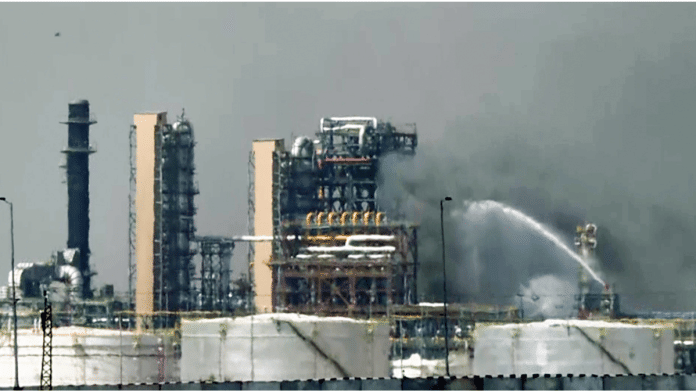


New Delhi: The massive fire that broke out at the HPCL Rajasthan Refinery Ltd (HRRL) complex Monday in the state’s Balotra district—a marquee project of the Centre—has caused a temporary disruption but is unlikely to have any major impact on fuel supply, as the plant had not yet become commercially productive.
“From a market perspective, the impact remains limited,” said Sumit Ritolia, manager for oil markets and refinery at Kpler. “The refinery was not yet contributing to the product pool, and any meaningful output had only been expected from Q3 2026 onwards.”
Ritolia said the refinery was still in the commissioning phase and not producing any meaningful volumes of finished products. “The crude distillation unit had been started and was under commissioning along with some secondary units, with output limited to intermediate streams rather than gasoline, ATF (Aviation Turbine Fuel), or diesel.”
HRRL is one of the largest greenfield refinery-cum-petrochemical complexes in India after Indian Oil Corporation’s Paradip refinery (which was commissioned in 2016). A greenfield refinery is a new facility built from scratch on undeveloped land allowing modern design and new technology.
With a capacity of 9 million metric tonnes per annum (MMTPA), the refinery is strategically located near the Barmer oil fields. It is expected to lower logistics costs, enhance petrochemical production, and reduce import dependence.
The government had earlier indicated that commercial operations would commence on 1 July.
The fire also came at an awkward time for the Centre, as Prime Minister Narendra Modi was scheduled to inaugurate the refinery the day after the incident. The visit has now been postponed indefinitely.
What triggered the fire
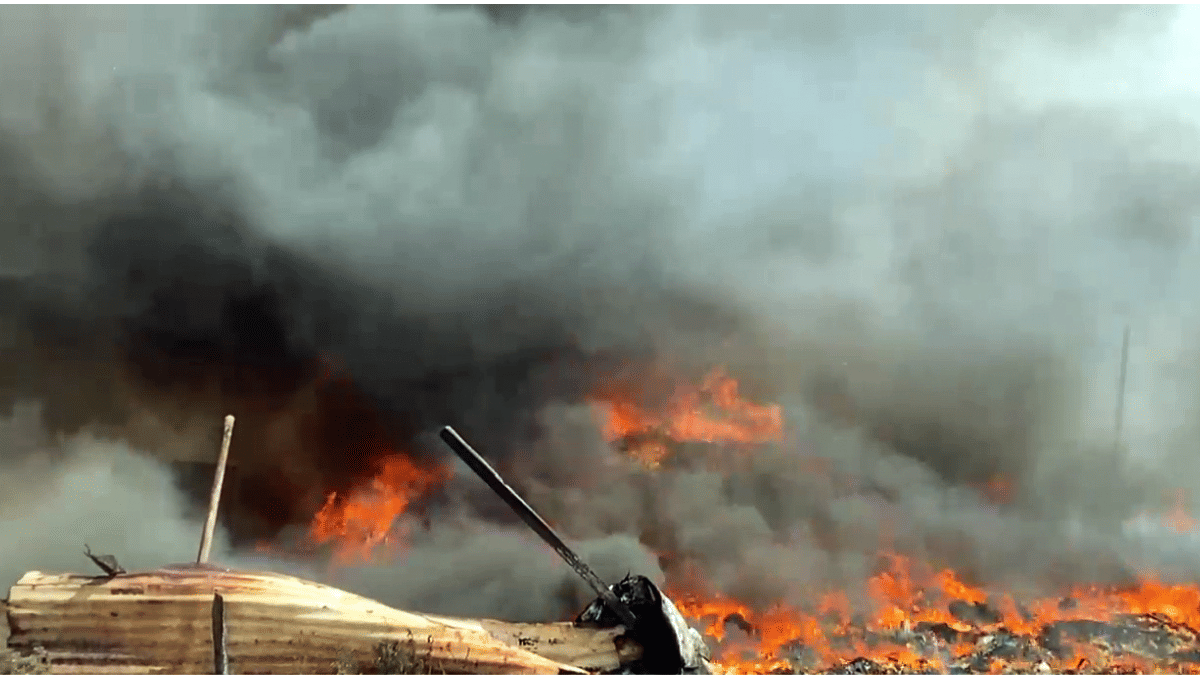
The fire broke out on 20 April in the crude distillation unit (CDU), the primary processing unit where crude oil is heated and separated into different components.
“There was a fire in the CDU section of the refinery complex. Prima facie, it appears that leakage of hydrocarbons through one of the valves/flanges in the heat exchanger circuit caused the fire,” Hindustan Petroleum Corporation Limited (HPCL) said in a social media post Monday.
An unfortunate accident occurred today at around 1.55 pm at HPCL Rajasthan Refinery Ltd. (HRRL) at Pachpadra, Balotra. There was a fire in the Crude Distillation Unit (CDU) section of the refinery complex. Prima facie, it appears that leakage of hydrocarbons through one of the…
— Hindustan Petroleum Corporation Limited (@HPCL) April 20, 2026
The blaze began in the afternoon and triggered an emergency response, with multiple fire tenders deployed to bring it under control. No casualties were reported.
However, the incident has prompted a detailed investigation and raised concerns over safety preparedness during a critical phase of the project.
“The ministry has already constituted a team, which has reached Barmer. They are investigating the incident. Only after they submit the report, we will be able to know what happened, how it happened and how much time it will take to repair,” Sujata Sharma, joint secretary, ministry of petroleum and natural gas, told the media Tuesday.
Commissioning phase and supply cushion
Experts underline that the refinery was still undergoing commissioning—a phased process where different units are tested and stabilised before full-scale production begins.
“Moving from CDU startup to stable production of refined products typically takes a few months, with full ramp-up taking significantly longer,” Ritolia said, noting that such incidents are not uncommon in large, complex refineries at this stage.
The refinery had procured around 6.34 million barrels of crude oil since December 2025 for commissioning. Of this, about 1.8 million barrels had already been redirected to other refineries such as Mumbai and Visakhapatnam for processing, ensuring that supply to the market remained unaffected.
This redistribution has helped cushion any potential disruption, especially at a time when global supply chains are under pressure due to disruptions around the Strait of Hormuz.
India’s crude supply remains stable, supported by imports from Venezuela and West Africa, along with continued access to Russian crude under a US sanctions waiver, Ritolia noted.
A long-delayed project
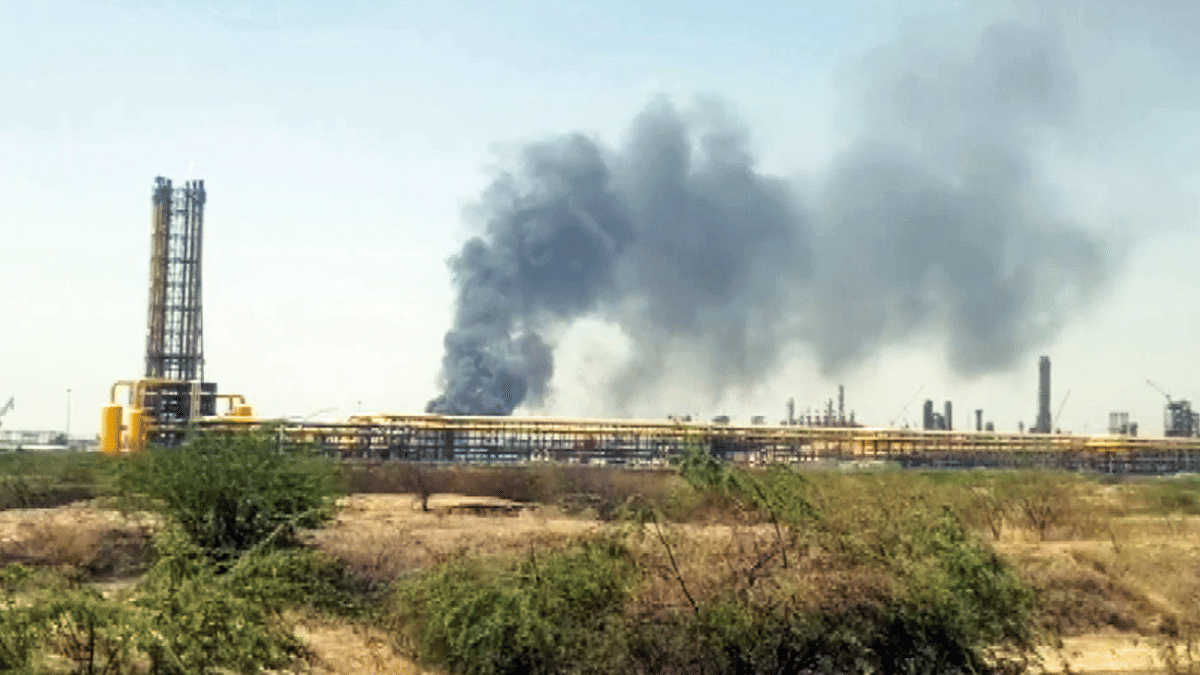
The nearly Rs 80,000 crore refinery has had a long and delayed journey. First announced in 2013 during the UPA 2 era, with Sonia Gandhi laying the foundation stone, the project faced multiple hurdles, including cost escalations and logistical challenges.
It was later revived by the BJP-led Vasundra Raje government in Rajasthan in 2017, with Prime Minister Modi laying the foundation stone again in 2018.
ThePrint had done a detailed ground report on issues pertaining to the refinery.
The refinery is a joint venture of the HPCL and the Rajasthan government, with HPCL holding a 74 per cent stake and the state government the remaining 26 per cent.
With a refining capacity of 9 MMTPA, the project is among the largest greenfield refineries in India. It is designed to produce petrol, diesel, polypropylene, HDPE (high-density polyethylene), benzene, toluene and butadiene.
Despite its size, the refinery is smaller than several existing facilities. HPCL’s Visakhapatnam refinery has a capacity of 15 MMTPA, Mumbai refinery 9.5 MMTPA, and HPCL-Mittal Energy Limited 11.3 MMTPA. In comparison, Reliance’s Jamnagar refinery exceeds 60 MMTPA, while Nayara Energy’s Vadinar refinery has a capacity of around 20 MMTPA.
(Edited by Viny Mishra)
Also read: India’s strategic oil reserves tell a tale of structural constraints & stalled expansion. Here’s why