







New Delhi: Public sector oil marketing companies (OMCs) are incurring under-recoveries of Rs 650 on every domestic LPG cylinder and Rs 30 per litre on domestic aviation turbine fuel (ATF), the government said Monday.
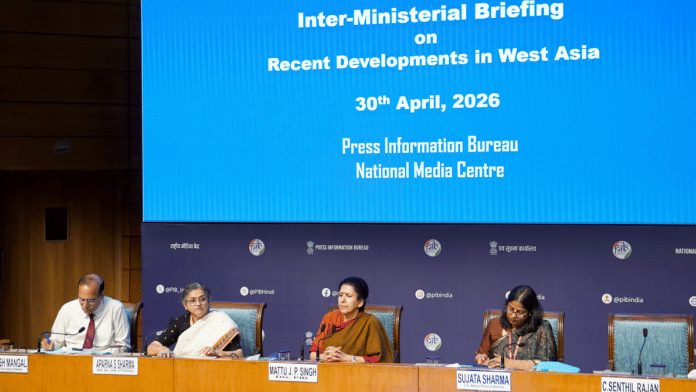
“Presently, under-recovery for domestic LPG stands at Rs 650 per cylinder, while under-recovery on domestic ATF stands at Rs 30 per litre,” Sujata Sharma, Joint Secretary, Ministry of Petroleum and Natural Gas (MoPNG), said at an inter-ministerial briefing on the West Asia conflict.
A 14.2-kg domestic LPG cylinder is currently priced at Rs 913 in Delhi and Rs 912.50 in Mumbai.
Sharma said the government has been compensating OMCs—Indian Oil Corporation (IOC), Bharat Petroleum Corporation Ltd (BPCL) and Hindustan Petroleum Corporation Ltd (HPCL)—for losses incurred on LPG sales to protect domestic consumers. To cover LPG under-recoveries, the Centre paid Rs 22,000 crore to OMCs in 2023 and Rs 30,000 crore last year.
The briefing came on a day the government kept domestic ATF prices unchanged. Domestic airlines will continue to pay Rs 104,927.18 per kilolitre for ATF, the rate that came into effect on 1 April.
However, jet fuel prices for international flights were reduced 27 percent. International ATF prices fell by around $400 per kilolitre to about $1,100 per kilolitre.
Amid Prime Minister Narendra Modi’s call for citizens to use public transport and carpool wherever possible, Sharma said the government has not observed any significant change in petrol and diesel consumption patterns so far.
However, she said domestic LPG demand has witnessed a slight decline due to the government’s efforts to encourage households to shift from LPG to piped natural gas (PNG).
Shipping traffic shifts amid West Asia tensions
The Ministry of Ports, Shipping and Waterways said shipping traffic patterns have shifted significantly since the onset of the West Asia conflict.
Mukesh Mangal, Additional Secretary in the ministry, said shipping services operating to and from the Red Sea and areas east of the Strait of Hormuz have nearly doubled in recent months.
According to Mangal, shipping services from the Red Sea and east of Hormuz stood at 127 in February 2026, rising to 205 in March, 257 in April and 245 in May.
Of the 245 services recorded in May, 202 were from East of Hormuz and 43 from the Red Sea region.
In contrast, shipping services operating west of the Strait of Hormuz—covering the Persian Gulf and its bordering countries—declined sharply from 145 in February to just 15 in May.
However, officials clarified that these shipping services comprise not only energy cargoes but also container shipments carrying goods, chemicals and other commodities.
The Strait of Hormuz remains a key area of concern amid the ongoing blockade linked to the West Asia conflict.
The Abu Dhabi Crude Oil Pipeline (ADCOP), also known as the Habshan–Fujairah pipeline, transports crude oil from onshore oil fields in Habshan to the port of Fujairah on the Gulf of Oman, East of the Hormuz.
Similarly, Saudi Arabia’s East-West pipeline carries crude oil from the Abqaiq processing hub in the kingdom’s Eastern Province to export terminals at Yanbu on the Red Sea coast.
However, officials clarified that these shipping services comprise not only energy cargoes but also container shipments carrying goods, chemicals and other commodities.
Foodgrain, fertiliser stocks adequate
The government also sought to reassure markets on food and fertiliser availability, saying India has sufficient stocks to meet domestic requirements despite the ongoing conflict in West Asia.
C. Shikha, Joint Secretary, Department of Food and Public Distribution, said foodgrain stocks in the central pool are comfortably above prescribed buffer norms.
According to Shikha, the wheat stock norm for 1 July 2026 is 275 lakh metric tonnes (LMT), against which the central pool currently holds 513 LMT. Similarly, rice stocks stand at 397 LMT, nearly three times the prescribed buffer norm of 135 LMT.
“India maintains comfortable foodgrain stocks to meet any requirements,” she said.
Providing an update on fertiliser availability ahead of the Kharif season, Aparna Sharma, Additional Secretary, Department of Fertilisers, said inventories remain well above conventional levels.
“Fertiliser stocks are currently maintained at 51 percent, significantly higher than the conventional level of 33 percent,” Sharma said.
She added that domestic production of urea, NPK (nitrogen, phosphorus and potassium) and DAP (Di-Ammonium Phosphate) fertilisers has reached 104.81 lakh metric tonnes since the onset of the West Asia conflict, while 22.6 lakh metric tonnes of imported fertilisers have already arrived in the country.
“We have also issued a new global tender to procure 17 lakh tonnes of urea, which is currently under progress,” Sharma said.
Referring to the India Meteorological Department’s forecast of below-normal rainfall this year, Sharma said the department has reassessed fertiliser demand for 2026.
“We have been informed that demand for urea now stands at 190 lakh tonnes from earlier prediction of 194 lakh tonne, whereas for DAP there has been reduction from 66 lakh metric tonnes to 60 lakh metric tonnes,” she said.
(Edited by Viny Mishra)
Also read: Govt asks oil marketing companies to build 30 days’ LPG reserves as West Asia crisis persists