



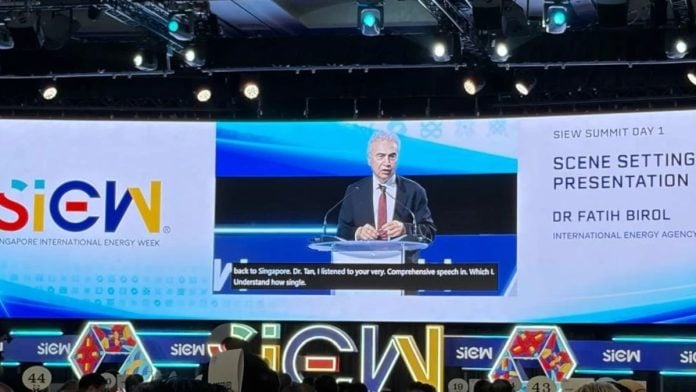
Singapore: Nuclear power is making a comeback as countries seek greater energy security and diversify their energy sources amid the crisis triggered by the conflict between US-Israel and Iran since that began in February, International Energy Agency (IEA) Executive Director Fatih Birol said Monday. He warned that the global energy markets may not return to pre-war conditions in 2027.
Speaking at the opening session of Singapore International Energy Week (SIEW) 2026, Birol said that the conflict and the resultant disruption to energy supplies accelerated countries’ efforts to reduce their dependence on vulnerable sources and supply routes.
“Nuclear power is coming back,” he said, adding that the revival was being driven by both traditional nuclear and newer technologies.
Birol further said that IEA estimates that around 90 GW of nuclear power capacity is currently under construction globally—the highest level of nuclear construction in four decades.
The renewed interest in nuclear power comes as governments seek more dependable domestic or diversified sources of electricity, attempting to reduce their exposure to geopolitical disruptions.
“Some two years ago, I said the world is entering the age of electricity [electrification]. Now, I can assure you, this energy crisis will even accelerate our entering the age of electricity,” Birol remarked.
He said the growth in electricity demand was being driven not only by electric vehicles, but also by the rapidly increasing use of air conditioners and other electricity-intensive technologies.
While solar, hydropower and natural gas would continue to play important roles, Birol said, nuclear power was increasingly being considered as part of the response to energy-security concerns.
He added that the global energy system faced a major security challenge since the US and Israel first struck Iran in February, with two important energy arteries effectively disrupted—Russian energy flows to Europe, and energy shipments through the Strait of Hormuz.
For Asian countries, the disruption to Hormuz has been particularly significant, he said. More than 60 percent of the oil coming into the region passes through the narrow waterway, with a significant share of LNG supplies also coming through the route.
Against this backdrop, Birol said, diversification has become the most important response for governments and businesses.
“If you ask me in today’s energy world, everything included, what is the most scarce commodity? Is it oil? No. Is it natural gas? No. The most scarce commodity today in the energy world is trust,” he said. Energy importers are increasingly looking for reliable and trusted suppliers, while exporters risk reputational damage if they use energy supplies as political leverage.
Birol highlighted how Saudi Arabia, United Arab Emirates and other countries have responded to disruptions by rerouting energy supplies and developing alternative pipelines to bypass vulnerable routes.
Looking ahead to 2027, Birol struck a cautious note on energy markets. Asked whether markets could return to conditions that prevailed before the war, he said he did not see a credible path for that to happen next year.
“I’m afraid I don’t see any credible path back that the markets will go next year where we were before this war started,” Birol said, urging governments and businesses to prepare for the possibility that the global energy system would remain structurally different from the pre-war period.
For countries like Singapore, he said, the response would need to combine diversification, stronger energy-security arrangements and investment in reliable sources of electricity, including nuclear power.
Birol also described regional electricity-grid cooperation, describing cross-border power-grid connections as a “no brainer” from both an energy-security and carbon-reduction perspective.
He added that the IEA is working with countries in the region to strengthen energy resilience, including via oil-stock arrangements and other energy-security measures.
The broader message, Birol said, is that the crisis following the war should not be viewed as a temporary disruption—it is a signal for countries to rethink how they secure energy supplies, build resilient infrastructure and reduce their exposure to geopolitical shocks.
The reporter is in Singapore for the 11th India Journalist Visit Programme at the invitation of Singapore High Commission in Delhi.
(Edited by Mannat Chugh)