



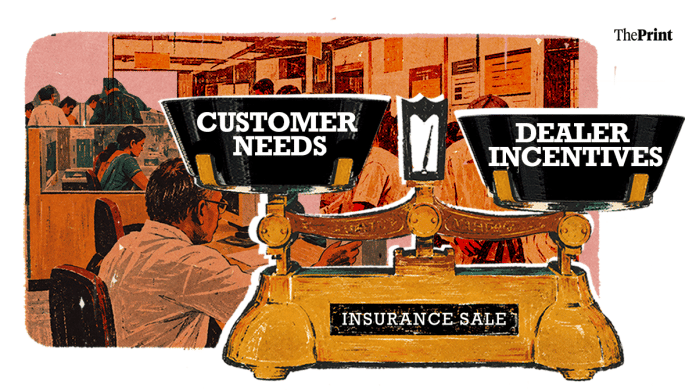
New Delhi: A person walks into a bank to open a fixed deposit and leaves with an insurance policy. A borrower is told insurance is mandatory to get a loan. A new car buyer is offered an insurance policy by the dealer, often unaware how much the dealer earns from the sale.
Unfortunately, these scenarios are far from hypothetical and extremely common. In fact, according to the Insurance Regulatory and Development Authority of India (IRDAI), the country’s insurance sector regulator, they point to a larger problem with how insurance is distributed in India—where the incentives of insurers and distributors can sometimes take precedence over what is suitable for the customer.
IRDAI’s latest consultation paper, ‘Recalibrating Economics of Insurance Distribution’, released on 23 September, has put the spotlight on the opaqueness surrounding insurance policies sold to gullible consumers, be it high commissions, ‘mis-selling’, compulsory bundling, poor transparency and weak accountability.
The regulator’s concern is not that intermediaries should not be paid. Rather, the economics of distribution should not encourage a policy to be sold simply because it generates a high commission.
The paper says distributor remuneration grew four to five times faster than insurance premium between FY23 and FY25. In general insurance, broker-sourced premium increased 37 percent between FY23 and FY25, while commissions rose 173 percent.
The average broker commissions increased from 8.5 percent to 17 percent, while retail health insurance commissions increased from around 10 percent to 30 percent during the same period.
The sharp rise in commissions has also brought renewed scrutiny on regulatory changes introduced in 2023, when IRDAI removed product-level commission caps and gave insurers greater flexibility under the Expenses of Management (EoM) framework.
EoM refers to the total expenses incurred by an insurer to run its business, including distribution commissions, operating expenses and other administrative costs.
The new consultation paper proposes bringing back specific commission limits, tightening EoM norms and making the person selling a policy more accountable.
For Monika Halan, author, financial educator and a member of the Insurance Advisory Committee, the significance of the paper goes beyond the proposed commission limits.
“The biggest thing in this consultation paper is not really the limits. It is a change in the stance of the regulator,” Halan told ThePrint.
How insurance became an incentive-driven business
Unlike other financial products, insurance is unusual because customers often cannot judge its value when they buy it.
A car can be driven and a mobile phone can be used immediately. Insurance, however, may only be tested years later—when a policyholder makes a claim, retires or suffers a financial loss.
“A financial product is invisible,” Halan said. “It is described by the person selling it.”
This creates an information gap between the seller and the customer. If the seller’s biggest incentive is to complete the sale rather than ensure that the policy remains suitable over time, the incentive can favour aggressive selling.
Halan said the problem became particularly pronounced with the expansion of bank-led insurance distribution. “When private sector insurance came in and things like corporate agencies started and especially when banks started, that’s where the game went up a whole notch,” she said.
Customers approaching banks for one financial product could instead be directed towards insurance because of the commission available to the bank or its employees.
“If somebody is coming in to make a fixed deposit, they would steer the person towards an insurance product to harvest the commissions,” Halan said.
Nagaraja Sarma, former Chairman and Managing Director of United India Insurance Company and former Secretary General of the General Insurance Council also linked high incentives to ‘mis-selling’.
He told ThePrint that higher sales-linked incentives can encourage distributors to prioritise volumes over the customer’s needs, resulting in policies being sold “more in the interest of the distributor rather than the interest of the customer”.
IRDAI’s data offers another indication of the problem. The 61st-month persistency rate—the share of life insurance policies that remain active after 61 months—is only 48 percent. For policies sold online, the persistency rate is 71 percent.
The regulator says the difference indicates that more conscious and informed purchases tend to have better continuation.
The regulator also points to rising grievances. General insurance complaints on the Bima Bharosa portal increased from 78,347 in FY23 to 1,37,361 in FY25, with nearly 69 percent relating to claims.
What changed in 2023 and why IRDAI is revisiting it
In 2023, IRDAI changed how insurers could pay commissions to agents and other distributors. Under the IRDAI (Payment of Commission) Regulations, 2023, it removed product-level commission limits and shifted to an overall ceiling on an insurer’s EoM.
The change gave insurers greater flexibility in deciding distribution spending within the overall EoM limits and their board-approved policies. The expectation was that this would support new products and distribution models, improve customer-centricity and expand insurance coverage.
But data collected over the following three years showed a sharp rise in distribution costs. IRDAI says commission payouts increased significantly in both life and general insurance, while board approval of commission policies was often only a formality.
Deepak Sood, Member (Non-Life) at IRDAI, said the flexibility introduced in 2023 had not translated into sufficient cost discipline. “Commission growth outpaced premium growth,” Sood told ThePrint, adding that the regulator saw cases where higher distribution costs were not adequately linked to the effort involved or value delivered to policyholders.
“The approach became distribution-led and commission-led,” Sood said.
Between FY23 and FY25, motor insurance premium grew around 34 percent, while commissions paid to distributors surged 259 percent.
Original Equipment Manufacturers (OEM)-linked brokers and Motor Insurance Service Providers generated around Rs 29,000 crore of premium in FY25 and received almost Rs 7,050 crore in commissions.
Sarma said insurers with relatively lower operating costs were able to use the flexibility given in 2023 to spend more on distribution.
“Those whose expenses were low to start with, like the new generation companies, which have come with better technology and low manpower… the whole thing went into distribution,” he said.
The increase was particularly visible in motor insurance, where payments to auto dealers became a significant distribution cost. In some cases, insurers were paying dealers as much as 60 percent of the premium paid by the customer, according to Sarma.
Bundling of products and ‘mis-selling’
High commissions are only one part of the problem. IRDAI has also focused on situations where insurance is sold alongside another financial product, particularly loans.
Sarma said customers can be pressured into purchasing insurance even when they already have adequate cover. “If the housing loan giver or vehicle loan giver insists that along with the loan, you have to compulsorily take a policy from me, then it is akin to pressurising the customer, making him take what he doesn’t exactly need,” he said.
The 23 September IRDAI consultation paper proposes to prohibit compulsory bundling of insurance with credit or loans, while allowing combinations where there is a legitimate benefit and the customer retains a choice.
Sood said a customer should not be required to buy insurance as a condition for obtaining a loan. The proposed framework would also require customers to be shown loan terms with and without insurance and allow them to buy insurance from another provider. The premium should be paid separately by the customer rather than being built into the loan, he said.
“The objective is therefore not to limit bancassurance (sale of insurance products through banks), but to ensure that it operates on choice, transparency and suitability,” Sood said.
Sarma said bundling itself should not be banned, citing travel insurance sold with a railway or flight ticket as an example. “But when bundling is done, there should still be a choice for the customer to avail the bundled product or not,” he said.
The consultation paper also seeks to address the issue of knowing who actually sold a policy and whether that person has a history of ‘mis-selling’.
IRDAI proposes tagging the identity of the salesperson, agent or point of sales person to the policy. Information on mis-selling incidents could then be placed in the public domain through the proposed Public Insurance Registry. The paper also calls for commission clawbacks in cases of ‘mis-selling’.
Sood said the regulator also wants to reduce the incentive for ‘mis-selling’ by linking more of the commission to policy persistency rather than paying a large amount upfront.
“Commission should be lower in the first year, with more being paid as the policy persists into renewal,” he said. Customers should also be able to know their supplier by accessing information on distributor conduct.
Halan supports the broader accountability principle but argues that responsibility cannot stop at the individual salesperson. “Why are you catching the individual at the branch? He’s just trying to meet his targets,” she said. “You have to make the board of directors and the top management who have set these targets responsible for practices.”
Making insurance sector more customer-friendly
IRDAI’s proposed solution is therefore broader than simply reducing commissions.
The regulator proposes product and channel-specific commission ceilings, with payouts linked to the complexity and effort involved in selling a policy. All direct and indirect payments, including monetary and non-monetary incentives, would also be brought under the commission’s framework.
The EoM framework would also be tightened through a glide path. For life insurers, IRDAI proposes reducing EoM to 15 percent of premium in two years and 12.5 percent in five years. For general insurers, the corresponding limits are 25 percent in two years and 20 percent in five years.
A senior executive at a private insurance company, who spoke to ThePrint on condition of anonymity, said the proposed expense limits could favour larger insurers by making it harder for smaller players to absorb distribution and operating costs, potentially reducing competition.
He also argued that greater comparison of insurance products and prices would benefit customers by giving them more choices and keeping prices competitive, but larger insurers may not want such comparison. “There are certain oligarchies that do not want price comparison,” he said.
IRDAI proposals have also drawn concern from the Insurance Brokers Association of India (IBAI), which represents 798 licensed insurance brokers.
In a press statement released on 29 September, IBAI supported measures such as the ban on compulsory bundling and clawbacks for mis-selling, but opposed the proposed commission caps and lower expense limits.
It said the measures could reduce insurance distribution in smaller towns and affect customer servicing. IBAI will submit its detailed response to the regulator.
Sood said IRDAI does not want to reduce costs at the expense of insurance coverage. “Our objective is certainly not to pursue cost efficiency at the expense of penetration,” he said. The proposed framework provides for additional commission for insurance sold in rural areas and smaller towns and cities, where distribution involves higher last-mile costs.
IRDAI also proposes strengthening Bima Sugam as a common digital platform for insurance, allowing customers to compare and access products from different insurers.
The consultation paper seeks to move the sector towards a model where insurance is not merely “sold” through agents and distributors, but is also actively “purchased” by informed customers.
For Halan, the immediate priorities are clear.
“I think commission caps and expense management are two things and the responsibility of the seller,” she said. “These three things are key. They are at the heart of change.”
She believes the consultation paper represents a broader shift in the regulator’s approach to consumer protection.
“This consultation paper is pathbreaking because it signals a shift in the thinking of the regulator, where the consumer is put at the heart of regulation,” Halan said. “I don’t think this regulator or anyone subsequently can walk back from this paper.”
Sarma, meanwhile, cautions against treating distributors as the problem itself.
“It’s neither in IRDAI’s interest nor anybody’s interest here to cut down the commissions. They need to be paid reasonably, depending on the kind of effort they put in,” he said.
But Halan believes the consumer protection debate is far from over.
“There are no voices speaking on behalf of consumers. There are only brokers, banks and lobbyists,” she said. “This game is not over.”
She is particularly concerned that the same distribution channels could take the problem beyond urban consumers and into smaller towns and villages as banking networks expand.
“My fear is, this poison is spreading to the villages through Jan Dhan accounts. They are the really vulnerable people,” Halan said.
IRDAI’s consultation paper is only a proposal at this stage. The final rules will determine how much of it survives the 25 October deadline for comments, as well as the consultations that will follow.
For customers, however, the desired change is simple—an insurance policy should be sold because it provides the protection the customer needs—not because it provides the biggest reward to the person selling it.
(Edited by Viny Mishra)
Also read: Why IRDAI should not back off now from its fight against insurance commissions