


New Delhi: India’s textile and apparel exports have remained largely unchanged at around $37 billion over the past decade, while competitors such as Bangladesh and Vietnam have significantly increased their global market share. The industry now aims to raise exports to $100 billion by FY31, a target that would require annual growth of more than 20 percent, according to a report released Monday.
The report, ‘Winning the Global Wardrobe: India’s Roadmap to Textile and Apparel Leadership’, jointly prepared by the Confederation of Indian Industry (CII) and Boston Consulting Group (BCG), said India has yet to capitalise on the shift in global apparel sourcing away from China, despite having a strong domestic textile manufacturing base.
India’s textile and apparel industry is estimated at $190-200 billion, with domestic consumption accounting for around 80 percent of the market or approximately $157 billion, whereas exports contribute the remaining 20 percent.
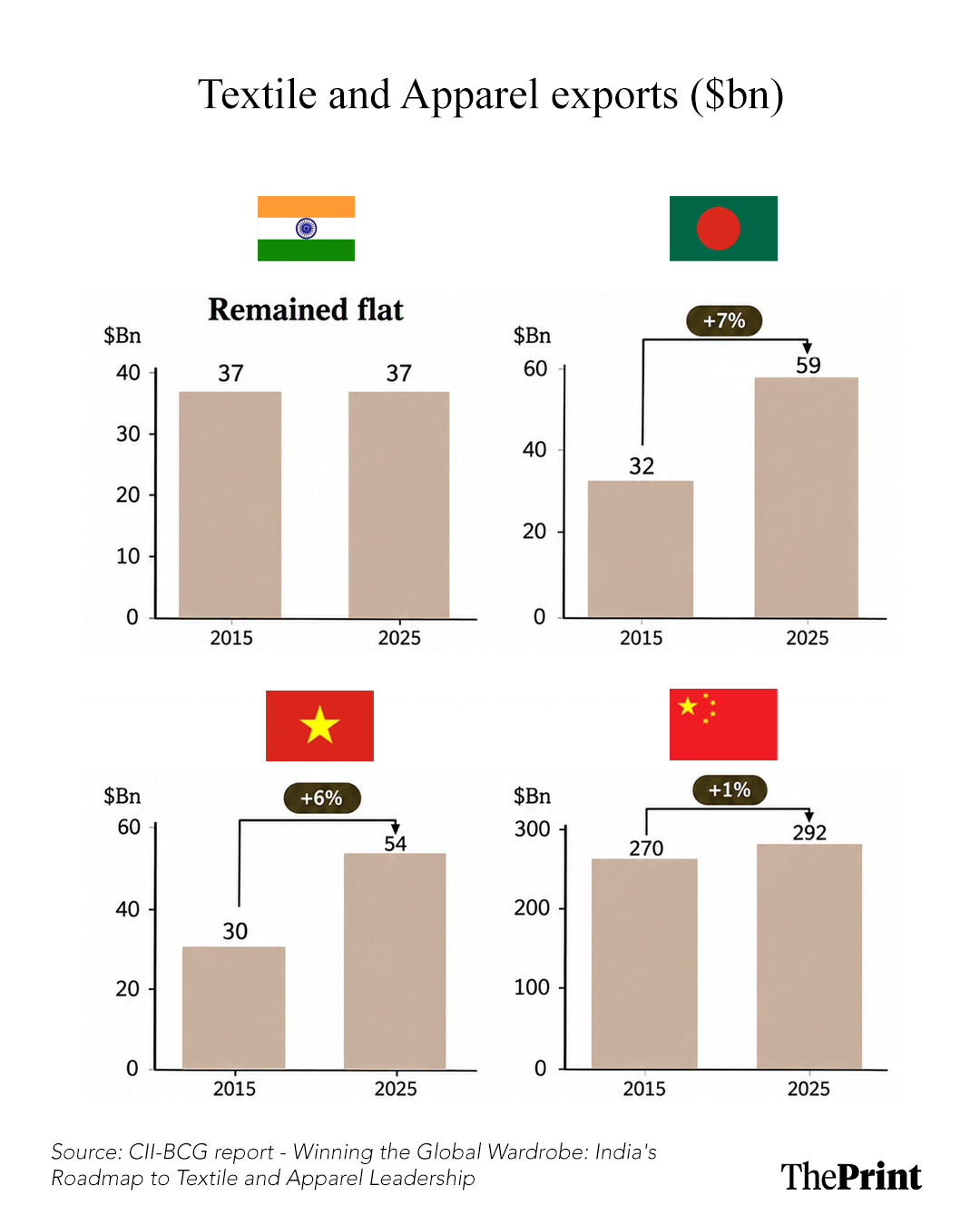
The report said India’s total textile and apparel exports stood at $37 billion in both 2015 and 2025. In comparison, Bangladesh’s exports increased from $32 billion to $59 billion, while Vietnam’s grew from $30 billion to $54 billion during the same period. China too saw growth from $270 billion to $292 billion.
“Exports, however, have remained largely stagnant at $37 billion over the past decade,” the report said, adding that achieving exports of $100 billion or more by FY31 would require growth of over 20 percent annually.
The industry has set an overall ambition of building a $350 billion textile and apparel sector by FY31 including $100 billion in exports. This would increase the share of exports in the industry’s total market from around 20 percent currently to approximately 30 percent.
The report said the global textile and apparel market is estimated at $2-2.5 trillion, with global trade of around $900 billion. Apparel accounts for nearly $540 billion of this trade, offering significant room for Indian manufacturers to expand in this segment.
India yet to benefit from China’s declining share
The report highlighted that India has not been able to benefit significantly from changing global sourcing patterns, even as China has lost ground to other manufacturing destinations.
China’s share of global apparel exports declined from 37 percent in 2015 to 27 percent in 2025. Whereas, Bangladesh gained four percentage points and Vietnam three percentage points during the same period. India, meanwhile, holds only around 3 percent of global apparel exports.
Global buyers are increasingly diversifying away from China and looking for manufacturers that can offer scale, specialised product capabilities, consistent quality and reliable delivery, the report cited.
India is the world’s second-largest producer of cotton and has a spinning capacity of more than 60 million spindles. Its textile and apparel industry employs over 45 million people, making it the country’s second-largest employer after agriculture.
However, the country has struggled to translate its strength in upstream manufacturing, including fibre, yarn and fabric into greater garment exports. Its share in global exports is stronger in these products than in finished garments.
The report also identified a significant gap in synthetic-fibre-based products. While India has an established position in cotton-oriented categories such as T-shirts, shirts and dresses, its share in global exports of synthetic based products such as outerwear, sportswear and knitwear is less than 1 percent.
In their book, ‘Stitching India’s Apparel Export Strategy: From Farm to Foreign’, agriculture economist Ashok Gulati, ICRIER senior fellow Sulakshana Rao and former additional secretary in the Ministry of Textiles Rohit Kansal have written about this mismatch between India’s fibre mix and global demand, a major structural weakness.
The book, released earlier this year, focusses on the 5F value chain—farm, fibre, factory, fashion and foreign—tracing the journey from raw material production to the manufacture, design and export of finished products.
“This fibre mismatch between what India produces and what the world buys is perhaps one of the most consequential structural handicaps in the entire 5F chain,” the authors have said.
The book also points to policy-related cost disadvantages that affected the man-made fibre segment. The higher goods and services tax (GST) on inputs and quality control orders (QCOs) on polyester and viscose raw materials had pushed raw material prices above global levels.
While the removal of Quality Control Orders in November 2025 and GST rationalisation in October 2025 have addressed some cost disadvantages, the processing and finishing ecosystem needed to translate these changes into export gains remains a work in progress.
Manufacturing costs, productivity remain key challenges
The CII-BCG report identified fragmented manufacturing, lower labour productivity and inadequate integration across the textile value chain as major factors affecting India’s competitiveness.
In China, spinning, fabric production, processing and garment manufacturing are often located within a distance of 30-50 km, allowing materials to move between production stages more quickly.
“China delivers orders 1.5-2 times faster than India,” the report said. It added that China’s logistics costs are 30-40 percent lower than India’s because of shorter transportation distances. The documentation for exports is also simpler, with shipments requiring two documents in China compared with 17-18 in India.
Bangladesh, meanwhile, has 20 percent higher labour productivity than India and 1.5 times greater factory automation, with labour costs also being lower by 10-15 percent. The report attributes this advantage to a more skilled and stable workforce, newer machinery and lower downtime.
The authors of ‘Stitching India’s Apparel Export Strategy: From Farm to Foreign’ have also described the “missing middle” as a key weakness in India’s garment sector, saying, “the transition from small informal units to integrated, export-ready factories has stalled”. The fragmented production units result in higher lead times and costs, thereby making it harder to handle large orders and meet delivery deadlines.
Access to affordable finance is another constraint, particularly for smaller manufacturers. Investment in machinery, automation and capacity, along with delayed buyer payments, creates significant working capital requirements. The book says existing financing arrangements do not meet these requirements, thereby limiting the ability of smaller companies to expand and modernise.
Building competitiveness & using trade opportunities
The CII-BCG report outlined six priorities for the industry: Focusing on key market segments, building long-term buyer relationships, scaling integrated manufacturing, improving factory productivity, expanding AI and automation, and strengthening the wider manufacturing ecosystem.
It recommended that Indian manufacturers build on their strengths in cotton while expanding into segments such as outerwear, sportswear and synthetic-based products. Stronger partnerships with international buyers through joint ventures and technology collaborations could also help companies expand capacity and access global sourcing networks.
The report called for replacing ageing machinery and adopting automation in production planning, cutting, material handling and quality checks to reduce costs and improve efficiency.
Trade agreements with the UK and the European Union offer another opportunity. The India-UK trade agreement came into force in July 2026, while the India-EU agreement, concluded in January 2026, was awaiting approval. Together, the two markets account for around $140 billion or 26 percent of global apparel trade, and the agreements could reduce India’s tariff disadvantage by 10-12 percentage points in some categories.
However, better market access alone will not guarantee higher exports, the report cited. Manufacturers must also meet requirements on quality, delivery timelines, sustainability and traceability. The report called for shared infrastructure, predictable policy support, and affordable finance, particularly for smaller businesses.
“India has the industrial foundation to become a much larger player in global apparel sourcing,” the report said, adding that this would require sustained investment and coordinated action by industry and government.
(Edited by Viny Mishra)
Also read: Bangladesh strikes trade deal with US, gets exemption on textile exports made with American cotton