


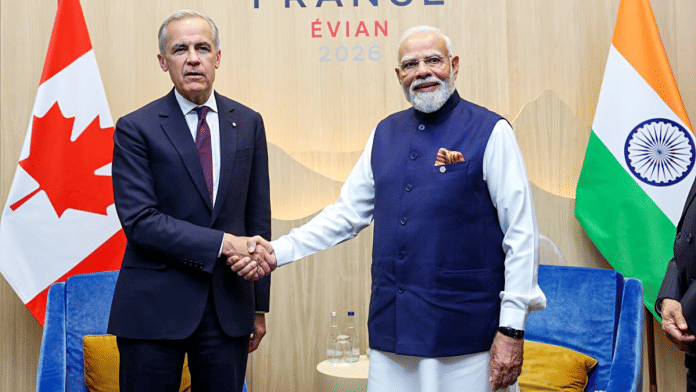
New Delhi: India and Canada have concluded negotiations in three chapters relating to services under the Comprehensive Economic Partnership Agreement (CEPA), with the two countries aiming to finalise the remaining chapters by the end of this year, government sources said.
The sixth round of negotiations between the two countries is currently underway in New Delhi, with talks scheduled from 11–20 November. The CEPA negotiations are a key pillar of the reset in India-Canada relations, for which the terms of reference were signed on 2 March during Canadian Prime Minister Mark Carney’s visit to New Delhi.
Government sources highlighted that five rounds of negotiations have been completed in the seven months since, with the fifth round held in Ottawa in early October. Another round is planned for December, as the two countries seek to conclude the agreement in nearly record time, before the end of the year.
Another source said the two countries are also focusing on finalising language that would facilitate the flow of goods, particularly potash from Canada to India.
Under CEPA, the two countries are negotiating 16 policy sectors, covering areas such as market access in goods and services, rules of origin, trade remedies, intellectual property rights, investment promotion, customs and trade facilitation, and dispute resolution.
As part of the agreement, India and Canada are also discussing ways to promote Canadian investment in the Indian economy, particularly by the Maple Eight, a group of Canadian pension funds. The Maple Eight have been long-term investors in India, having invested more than $80 billion in sectors such as real estate and infrastructure over the past decade.
New Delhi and Ottawa are also negotiating a Financial Investment Promotion and Protection Agreement (FIPA), which is independent of the CEPA.
Diversifying export destinations
For India, the CEPA negotiations come as it seeks to diversify its exports to North America. The US remains the largest market in the continent for Indian merchandise. Indian merchandise exports to the US touched $59 billion between April and October 2026. In comparison, exports to Canada stood at $2.67 billion between April and September 2026.
Indian merchandise exports to Canada grew by 18 percent in the first half of the current financial year compared with the corresponding period last year. However, it pales in comparison to goods exported to the US.
For Canada too, the CEPA is a key part of its efforts to diversify exports away from the US. Ottawa and Washington are currently embroiled in a trade dispute following the collapse of trade talks between the two governments.
Canadian Prime Minister Carney stormed to an electoral victory in April 2025, largely due to the impact of US trade policies on Ottawa’s economy. For decades, Ottawa and Washington had focused on integrating their supply chains and deepening bilateral trade.
However, US President Donald Trump has sought to impose tariffs on Canadian imports. The US accounts for roughly a third of all Canadian exports. In September, Canada’s total merchandise exports stood at CAD 78.5 billion, of which approximately CAD 55 billion went to the US.
Carney has sought closer economic ties with the European Union, while Ottawa continues negotiations with New Delhi to conclude CEPA.
India-Canada ties
Prime Minister Narendra Modi is likely to travel to Ottawa and Toronto in early December to further strengthen political and economic ties between the two countries.
India-Canada relations deteriorated sharply in September 2023 following allegations by then Canadian Prime Minister Justin Trudeau of links between Indian officials and the killing of Hardeep Singh Nijjar. Nijjar, who is designated a terrorist by India, was killed outside a gurdwara in Surrey, British Columbia, in June 2023.
Until Carney took over the leadership of the Liberal Party in March 2025, ties between the two countries remained largely frozen. Modi and Carney met on the sidelines of the G7 summit in Alberta, Canada, in June 2025, paving the way for a stabilisation of bilateral relations.
Carney visited India at the end of February 2026 as both countries sought to deepen economic engagement. Since then, the two sides have institutionalised several dialogue mechanisms, including security talks between their respective national security advisers to to deal with all facets of the relationship.
Modi’s likely visit to Canada, his first standalone bilateral visit to the country in more than a decade, is expected to focus on a range of issues, including greater Canadian investment in the Indian economy, the ongoing CEPA negotiations, and potential expansion of trade in minerals and energy products.
(Edited by Chingkheinganbi Mayengbam)
Also Read: How Punjab’s Canada dream came crashing down
Canada must hand over terrorists like Pannun and others. And it must commit to crack down on Khalistani gangs and terror outfits. It must commit on not letting it’s territory to be used for anti-India activities.
Unless it agrees on these points, India must not sign any trade deal with it.