





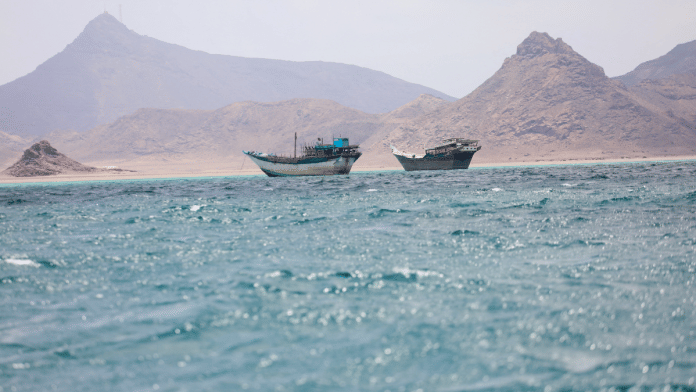


New Delhi: Two Saudi crude tankers headed to India and China have turned back in the Red Sea after Yemen’s Iran-aligned Houthis threatened to block Saudi-linked shipping through the Bab el-Mandeb Strait, which connects the Red Sea to the Arabian Sea through the Gulf of Aden.
The diversions have renewed concerns over another major global oil chokepoint after the Strait of Hormuz, with analysts warning that any disruption at Bab el-Mandeb could delay crude supplies to Asia, raise freight and insurance costs, and tighten the availability of crude cargoes.
Yemen’s Houthi rebels on Monday threatened a ban on Saudi-linked shipping through the Bab el-Mandeb Strait, the narrow waterway linking the Red Sea with the Gulf of Aden. Although there has been no complete closure, vessel operators have already begun altering routes, highlighting the growing importance of the corridor for global oil trade.
According to a Reuters report, the Houthis have completed preparations to attack shipping by deploying missiles and drones near Bab el-Mandeb strait, the gateway to the Red Sea, in Yemen’s highlands overlooking Hodeidah and the Gulf of Aden and was awaiting the order to begin.
According to Kpler, around 6-7 million barrels per day (mbpd) of crude currently transits Bab el-Mandeb. Roughly half of these volumes are Saudi crude loaded from Yanbu on the Red Sea coast, while most of the remainder comprises Russian cargoes bound for India, with other smaller shipments heading to China.
“The Red Sea has emerged as a strategic chokepoint on par with the Strait of Hormuz for Asian refiners,” Sumit Ritolia, the Manager for Oil Markets and Refineries at Kpler, a global trade data analytics firm, told ThePrint.
He added, “Any escalation would directly threaten refinery runs, crude availability, freight costs and regional product supply.”
Saudi Arabia has increasingly relied on its East-West pipeline to move crude from its eastern oilfields to Yanbu, allowing exports to bypass the Strait of Hormuz. Yanbu exports reached 4.14 mbpd in June, effectively rerouting around 64 percent of the volumes that were traditionally shipped from Ras Tanura, a major oil terminal for Saudi Arabia on its eastern coast. Oil shipped directly from Ras Tanura by sea to destinations outside the Persian Gulf must pass through the Strait of Hormuz.
Saudi Arabia’s strategy to move crude from the eastern to west coast has made the Red Sea route critical for Saudi exports to Asia.
Also Read: Russian crude continues to make up 50% of India’s oil imports in July as Hormuz risks persist
Higher costs, not immediate supply crunch
Natalia Katona, a commodity analyst based in Abu Dhabi, said the latest developments do not amount to a full closure of Bab el-Mandeb, they have already started disrupting shipping decisions.
“Unlike Hormuz, Saudi Arabia still has an escape route,” she said, noting that tankers can sail north through the Suez Canal before travelling around the Cape of Good Hope to reach Asia. “But it is an extraordinarily long detour.”
If ships were to take that route, the time taken to reach from Yanbu to India’s west coast would increase from about eight days to nearly 39 days, while a shipment would take 52 days to reach Japan, more than double the 24 days it takes now, according to Katona.
For India, she said, the disruption is likely to be “primarily a price and logistics shock rather than an immediate supply crisis.”
Saudi Arabia was India’s third biggest supplier of crude in June after Russia and United Arab Emirates (UAE). with around 3,00,000 barrels per day (bpd). But it was significantly lower than about 1 million bpd in February.
Katona said Saudi crude already booked for late July and August would eventually reach India, but with delays and higher transportation costs.
In the meantime, India could increasingly rely on alternative supplies. Russian crude cargoes may continue to transit the Bab el-Mandeb Strait, as the Houthis have said their threat is primarily aimed at vessels using Saudi ports.
This, Katona said, could encourage Indian refiners to raise purchases of Russian crude beyond the 2.7 million barrels per day (mbpd) imported in June, particularly as Ukrainian attacks on Russian refineries have left more crude oil available for export.
Besides Russia, India can also source crude from the UAE through the Fujairah port and from Oman, both of which are loaded from ports outside the Strait of Hormuz and are only four to five sailing days away.
However, stronger demand could quickly push up prices. According to Katona, the UAE cargoes that recently traded at discounts to the Dubai benchmark could move into premiums if more Indian refiners compete for them.
“In short, India is unlikely to run short of crude, but it will have to pay more to secure it,” she said.
The broader impact, however, could be more severe for the global tanker market. The rerouting 3-4 mbpd of Saudi crude would keep vessels occupied for much longer, effectively reducing available tanker capacity and driving up freight and insurance costs.
Katona said the biggest vulnerability lies with Japan and South Korea, each of which imports around 950,000 bpd of Saudi crude but has fewer alternatives than India or China, both of which have shown greater willingness to buy discounted Russian crude.
“The tightest point may come in September, when today’s diversions begin showing up as delayed arrivals at Northeast Asian refineries,” she said.
With the Strait of Hormuz already under pressure this year, any sustained disruption at the Bab el-Mandeb Strait would expose another weak link in the global oil supply chain, making energy markets, particularly in Asia, more vulnerable to geopolitical shocks.
(Edited by Ajeet Tiwari)