



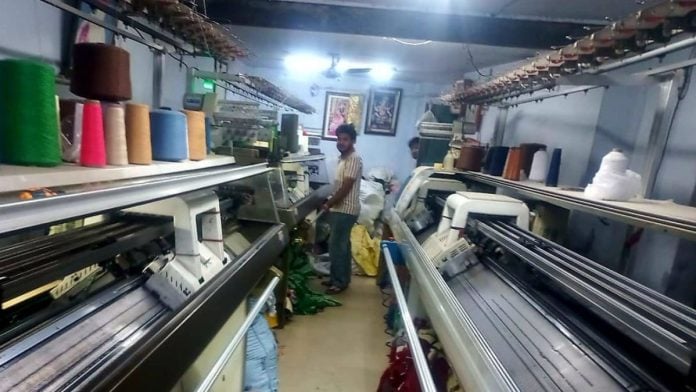
Ludhiana: All is not well in the heartland of hosiery. For Ludhiana’s hosiery, knitwear and garment makers and traders, the festive season is turning out to be rather gloomy as they battle the turbulence triggered by a 40-odd percent hike in raw material costs over the past few months. Dubbed the ‘Manchester of India’, the city in Punjab’s Malwa region accounts for 95 percent of India’s total winterwear production, and supplies up to 90 percent of the domestic demand for it.
There’s also been little chance to pass on the load, with global geopolitical instability having dealt out sharp fluctuations in raw material costs. Driven by the Ukraine war and the one in West Asia—which has now expanded to strangle the Red Sea passage and encompass top producer Saudi Arabia—crude oil prices have chewed a big hole into the profit margins of garment-makers who use synthetic fabric like polyester, nylon, and spandex.
And then, there’s the gorilla in the room: the ‘China factor’. Low-cost manufacture and massive automation in India’s neighbourhood have meant that all components of Ludhiana’s hosiery and fabric ecosystem—machinery, yarn and winterwear—are coming into markets at unbelievably low prices, even as the supply of other crucial material from the same country, mainly chemicals used to make dyes, has dried up.
Data from the Petroleum Planning & Analysis Cell shows that India’s crude-oil basket averaged $90.19 per barrel in August, rising to $116.09 in September. According to CRISIL Ratings, up to four-fifths of manufacturing inputs for synthetic yarn and fibre producers are directly affected by crude oil prices.
Also Read: Ethanol industry backs govt’s procurement tender, but seeks higher prices and more flexibility
Wholesale inflation & supply disruption
The Office of the Economic Adviser says that year-on-year wholesale inflation in manufactured textiles rose from 12.63 percent in August to 13.85 percent in September this year, while inflation in chemical products increased from 14.30 to 16.74 percent. All this is happening in the context of a sudden jump in Wholesale Price Inflation in September.
Amit Dashora, Head of Sales and Marketing at Infinite Fashion India Private Limited, told ThePrint that China is the largest producer of intermediate and direct chemicals used to make dyes for hosiery and garments. Beijing has, however, banned or halted operations at four major chemical suppliers.
China’s Zhejiang, Jiangsu and Shandong provinces are the global sources of chemicals used in the textile industry, producing over 60 percent of the world’s apparel dyes and intermediate agents. The toxic pollution they also create has proved their undoing, as China’s Ministry of Ecology and Environment has strictly enforced its National Environmental Protection Laws. These crackdowns have triggered abrupt operational halts and permanent closures across major chemical parks, instantly choking the raw material pipelines that India’s hosiery mills depend on.
Cotton has its own twisted tale. Dashora noted that global brands have banned Chinese cotton. “Consequently, if they want to manufacture apparel in China, they are mandated by their customers to source cotton from outside the country, making India a natural alternative,” he said.
According to a Reuters investigation, US import restrictions under the Uyghur Forced Labor Prevention Act have effectively banned the import of Chinese cotton and any garments from global brands using these raw materials. For example, when Washington blacklisted the Hong Kong-based textile giant Esquel Group, multinational brands like Muji faced intense supply-chain scrutiny because trade records revealed that millions of dollars in cotton apparel were being routed from China through proxy factories in Vietnam.
“Because so much cotton is being sourced from India, domestic cotton prices have begun to fluctuate heavily,” Dashora explained. “Further, when the global demand for yarn spikes, Indian suppliers prefer exporting to China because it yields better profits in US dollars. This pursuit of higher dollar margins heavily destabilises domestic prices. Taken together, these factors add up to acute cost-push inflation in the hosiery and fabric industries.”
Data from the Union Ministry of Textiles shows that India’s cotton production declined from 297.24 lakh bales in 2024–25 to 290.91 lakh bales in 2025–26. The ministry also reported an approximately 18 percent increase in domestic cotton prices (S-6 variety) during the recent period it assessed. To address supply and price pressures, the Centre exempted raw cotton imports from the 11 percent import duty from 1 June to 31 October this year.
But the impact has lasted, disrupting both wholesale and retail markets.
‘It’s a crisis’
“Due to high raw material costs, the Ludhiana hosiery industry declared a week-long strike as its profitability was shrinking drastically,” said Amit Pandey, Head of Operations at Vardhman Polytex Limited.
“A crisis has been triggered across both natural and synthetic fibre markets,” he remarked, adding: “Not only in Ludhiana, but across India.”
Shifting market dynamics have led to acute scarcity of polyester raw materials like Purified Terephthalic Acid (PTA) and Dimethyl Terephthalate (DMT). “This shortage has caused their prices to shoot up from Rs 105–110 per kg to Rs 145 per kg, impacting industries not only in Ludhiana but across India,” said Pandey.
He explained the natural fibre trouble, too. “Cotton production was already low due to reduced sowing and cultivation last year, leading to an initial cotton shortage. On the other hand, due to an approximately 30 percent price rise in polyester, those users switched over to cotton spinning and garment-making. This combination created a double impact, driving cotton prices exceptionally high. Even after increasing over the last three to four months, cotton prices have not stabilised.”
Data from the Office of the Economic Adviser under the Department for Promotion of Industry and Internal Trade (DPIIT) shows that the Wholesale Price Index for purified terephthalic acid (PTA), a key raw material used in polyester production, rose 49.19 percent year-on-year in September this year, while monoethylene glycol (MEG), another key input, recorded a 34.75 percent increase.
Manufacturing orders are the first direct hit. “Capacity from manufacturers to wholesalers has been slashed by nearly half,” said Vijay Kumar of Nato International. “The upcoming winter and festive seasons look stagnant, with very little chance of immediate recovery,” he predicted.
Small businesses hit hardest
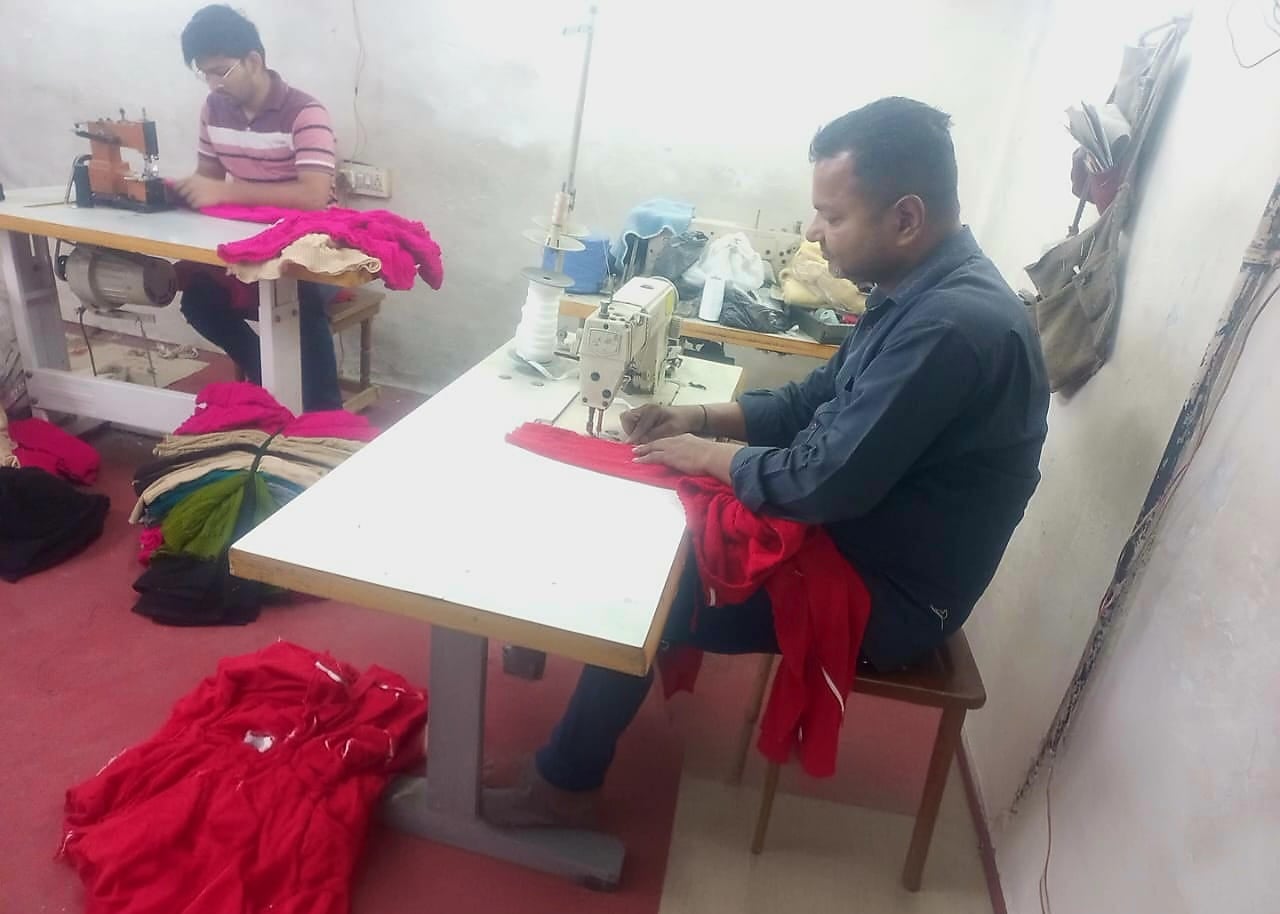
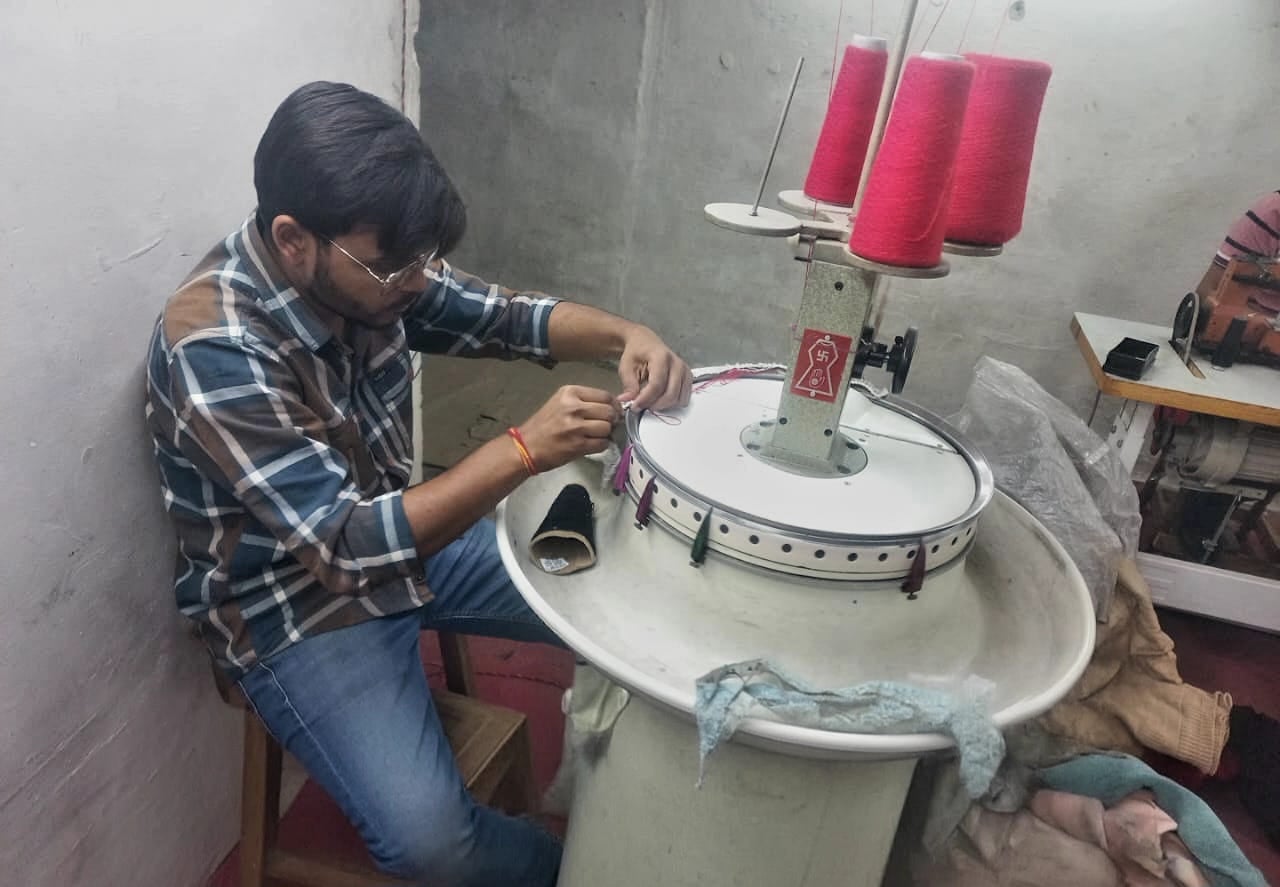
Small-scale manufacturers are among the most impacted. Ludhiana alone houses around 1,40,000 MSMEs (Micro, Small, and Medium Enterprises) making hosiery, knitwear and garments, according to the Union Ministry of MSMEs.
Mohit Jain, a hosiery trader, noted, “Larger units are somehow managing to stay afloat due to heavy capital investments and continuous cash flow cycles. However, smaller units—particularly those with annual sales of Rs 1 crore to Rs 2 crore, and profit margins of just 8 to 10 percent—are facing much greater distress. In fact, many micro-scale units are currently on the verge of closure.”
Overhead costs are up, too. “Due to rising raw material inflation, labour costs have also increased, forcing us to provide wage hikes as well,” said Kapil Joshi, president of the Purana Bazar Hosiery Association. “Yarn rates have surged significantly, leading to an increase in inventory and pushing up the overall product cost. Consequently, incoming customers are finding these items too expensive. The costs of everything from sewing thread to packaging materials have gone up, making them difficult to manage.”
India’s hosiery and fabric industries rely on imported raw materials, adding to manufacturers’ concerns over supply and costs. Joshi told ThePrint that existing measures have not sufficiently eased cost pressures, and called for simpler industrial regulations, including on labour, warning that difficult business conditions could discourage the next generation from continuing in the industry.
“The policies for operating an industry, including labour laws and all related regulations, need to be simplified. Otherwise, under such difficult conditions, the next generation is thinking about either moving to another country or shifting to a completely different line of business,” he said.
Joshi may or may not get his wish just yet, but the government, both at the Centre and in the state, does have Ludhiana in mind.
The first meeting of the Development Council for Textile Industry, held on 6 October, discussed the need to ensure stable and competitive supplies of cotton, man-made fibres, yarn, dyes and chemicals. The council also discussed improving cost competitiveness across the textile value chain, including fabric processing and apparel manufacturing, and strengthening support for micro, small and medium enterprises (MSMEs).
The Punjab government has, meanwhile, highlighted investment, infrastructure and power supply as priorities for the textile sector under its broader industrial development agenda. At Bharat Tex 2026 in July, the Bhagwant Mann government outlined its plans to strengthen the sector. Back in March, the government had enacted the Punjab Textile and Apparel Policy 2026, which involved measures like electricity duty exemptions and net SGST reimbursement for eligible units.
ThePrint attempted to reach Jaspreet Singh, Director (Industries and Commerce); Gurkirat Kirpal Singh, Administrative Secretary (Industries & Commerce); and other officials in the policy implementation unit under Punjab government’s Department of Industries & Commerce for a comment on the current situation via email and calls. The response is awaited.
With inflationary pressure building up in the hosiery and fabric raw material markets, consumers haven’t been spared either.
Rakshit Jain, a Ludhiana-based yarn trader, highlighted this dilemma, saying, “Due to rising garment prices during the festive season, shopkeepers are forced to increase retail prices. This could severely impact sales because, amid the current recession, consumers are unwilling to spend extra on luxury items, preferring to stick to necessities.”
He added, “Shopkeepers may reduce profit margins to protect sales volume, but this will hurt them financially. Every business has fixed overhead expenses that the owner must bear regardless of revenue.”
Jagruti Suri is an intern with ThePrint.
(Edited by Nardeep Singh Dahiya)