








New Delhi: A slowdown in China’s crude oil imports has provided relief to refiners across Asia, including in India, by making more barrels available in a market that is impacted by disruptions in the Strait of Hormuz amid the West Asia conflict, according to trade data intelligence firm Kpler.
Chinese crude imports in May are tracking at around 6.6 million barrels per day (mbd), the lowest since 2016, Kpler said. The decline has freed up Russian, African and American crude for other Asian buyers at a time when concerns around Gulf oil flows have tightened the market.
“China’s sharp decline in crude imports has unintentionally eased feedstock tightness across Asia,” said Sumit Ritolia, manager, oil markets and modelling refinery, at Kpler.
The additional availability of Middle Eastern, Russian, West African and Atlantic Basin crude helped countries such as India, South Korea, Singapore, and Thailand secure more supplies than initially anticipated, added Ritolia.
Arya Roy Bardhan, a junior fellow at Observer Research Foundation (ORF), said China has historically cut oil imports and relied on strategic reserves during major global crises, including the Global Financial Crisis and the Covid-19 pandemic. “Acting as a global shock absorber, China lowers import bills for these nations,” Bardhan told ThePrint. “It relaxes the major binding constraint i.e. supply, by freeing up stocks coming from Africa and Middle East.”
Also Read: China absorbs more Russian crude as India recalibrates with a Middle East pivot
‘China’s strategy – buy when it’s cheap’
According to analysts, China’s buying strategy is closely linked to price movements and its large strategic petroleum reserves.
“China’s strategy is simple — buy when it’s cheap. The current situation does not exactly suit them,” Navin Thakur, Director at Drewry Maritime Research, told ThePrint.
He added, “They have the power to control prices by managing their purchases during a high-price regime, thanks to their massive strategic petroleum reserves, which are in excess of 90 days.”
This development comes at a time when refiners across Asia are grappling with supply disruptions at the Strait of Hormuz, a key global oil transit route.
Outside China, while overall refining activity remains below normal levels, improved access to crude has allowed refineries to recover more strongly than expected.
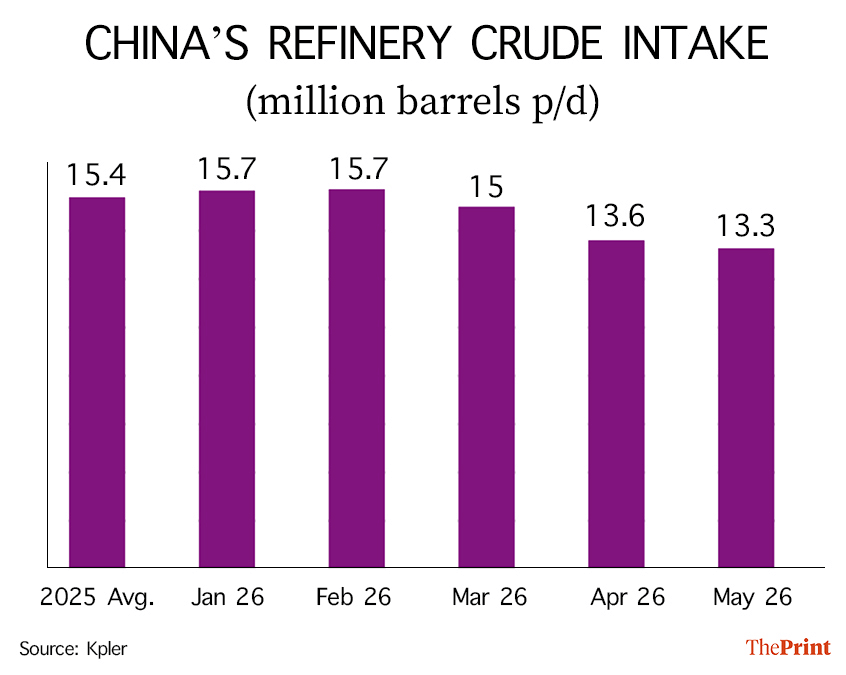
According to Kpler, refineries processing volumes across Asia excluding China are expected to reach around 14.8 mbd in May, up by nearly 900,000 barrels. However, this is still roughly 1.3 mbd lower than last year’s levels. Similar run rates of 14.8–15 mbd are expected in June 2026.
Whereas, China’s crude intake for refineries reduced from 15.7 mbd in February 2026 to 13.3 mbd in May 2026.
India has emerged as one of the beneficiaries of the shifting trade flows. The country’s crude imports are tracking close to 5 mbd in May 2026, compared with an average of around 4.8 mbd in 2025, Kpler data shows. If sustained, it could mark India’s highest crude import level for the month of May.
Ritolia attributed the increase primarily to stronger purchases of Russian and Venezuelan crude. The growth in imports have helped Indian refiners maintain operations despite uncertainty in global supply chains. Like India, several other Asian refiners are seeking alternative crude sources to safeguard feedstock availability amid volatility of Gulf supplies.
The biggest shifts have been visible in imports from the United States and Africa.
Kpler estimates that crude imports from the US into Asia, excluding China, are running at nearly 1.94 mbd in May, close to an all-time high. African crude imports are also tracking near record levels at around 1.7 mbd.
“Regional buyers scrambled to secure barrels from wherever available to manage supply security and offset tighter Gulf availability,” Ritolia said.
South Korea recorded one of the sharpest increases in crude purchases, with imports rising to 2.6 mbd in May, up by roughly 1 mbd from the previous month, largely driven by higher US and African crude arrivals. Singapore and Thailand have also reported stronger imports as American crude shipments into the region surged.
Despite the improvement in supplies, refinery operations across Asia remain significantly disrupted. Kpler estimates cumulative crude processing losses in the region since the onset of Hormuz disruptions to be around 2.7 mbd between March and May.
The impact has extended to fuel production with losses of around 940,000 barrels per day of diesel output, 700,000 barrels per day of gasoline and roughly 300,000 barrels per day of kerosene during the period.
China accounts for a substantial share of refinery cuts because of weaker crude imports and subdued downstream demand.
Looking ahead, China’s oil purchasing patterns will likely remain a key factor shaping Asian refining margins and crude availability.
“If Chinese refinery runs and crude imports remain subdued, Asia ex-China refiners are likely to continue benefiting from relatively improved crude availability and stronger feedstock flows,” Ritolia said.
However, he warned that any meaningful recovery in China’s crude purchases could quickly tighten regional supplies again.
(Edited by Ajeet Tiwari)
Also Read: China insulated itself against energy shocks. India is ‘all talk, no walk’