



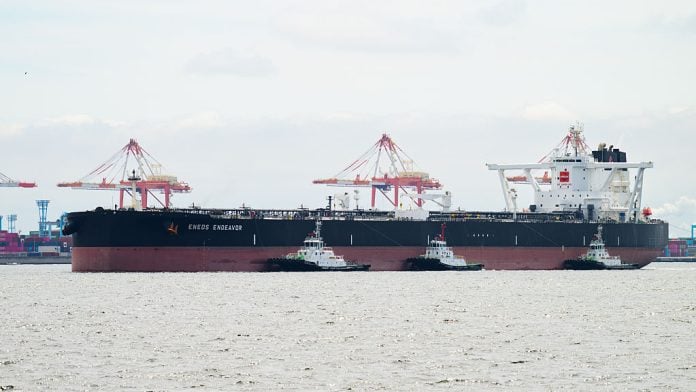
Former President Bill Clinton once said that when a crisis breaks out, the first thing everyone in Washington asks is, “Where is the nearest [aircraft] carrier?” That remains a critical question as the US faces off against Iran in the Strait of Hormuz, but for the shipping industry, it may have been replaced by another: “Where are the nearest oil tankers — and do we have enough?”
The immediate answer to that last bit is “no.” The price of shipping tells the story. The largest tankers, uncreatively known as Very Large Crude Carriers, or VLCCs, are enjoying daily rates that would have made Aristotle Onassis cry tears of joy: The cost of hiring one from the Persian Gulf to Asia — a benchmark route — has risen 12-fold in just a few months to a record high of $1.1 million a day.
Earlier this year, most shipowners would have considered $100,000 a day a superb price and $50,000 a good one. Poten & Partners, a shipbroker that prides itself on being old-fashioned, couldn’t hide its amazement at today’s rates, telling clients recently: “Even seasoned market veterans are looking at current developments in the market and scratching their heads. What’s happening is truly unprecedented.”
Sure, the $1-million-a-day price tag reflects the danger of crossing the Hormuz waterway and the fact that few shipowners are willing to take the risk. But costs elsewhere, even far from the Middle East, have also ballooned. The route from the Gulf of Mexico to Asia is about $338,000 a day, up 400% from a year ago; from West Africa to China stands at about $486,000 a day, an increase of nearly 500%.
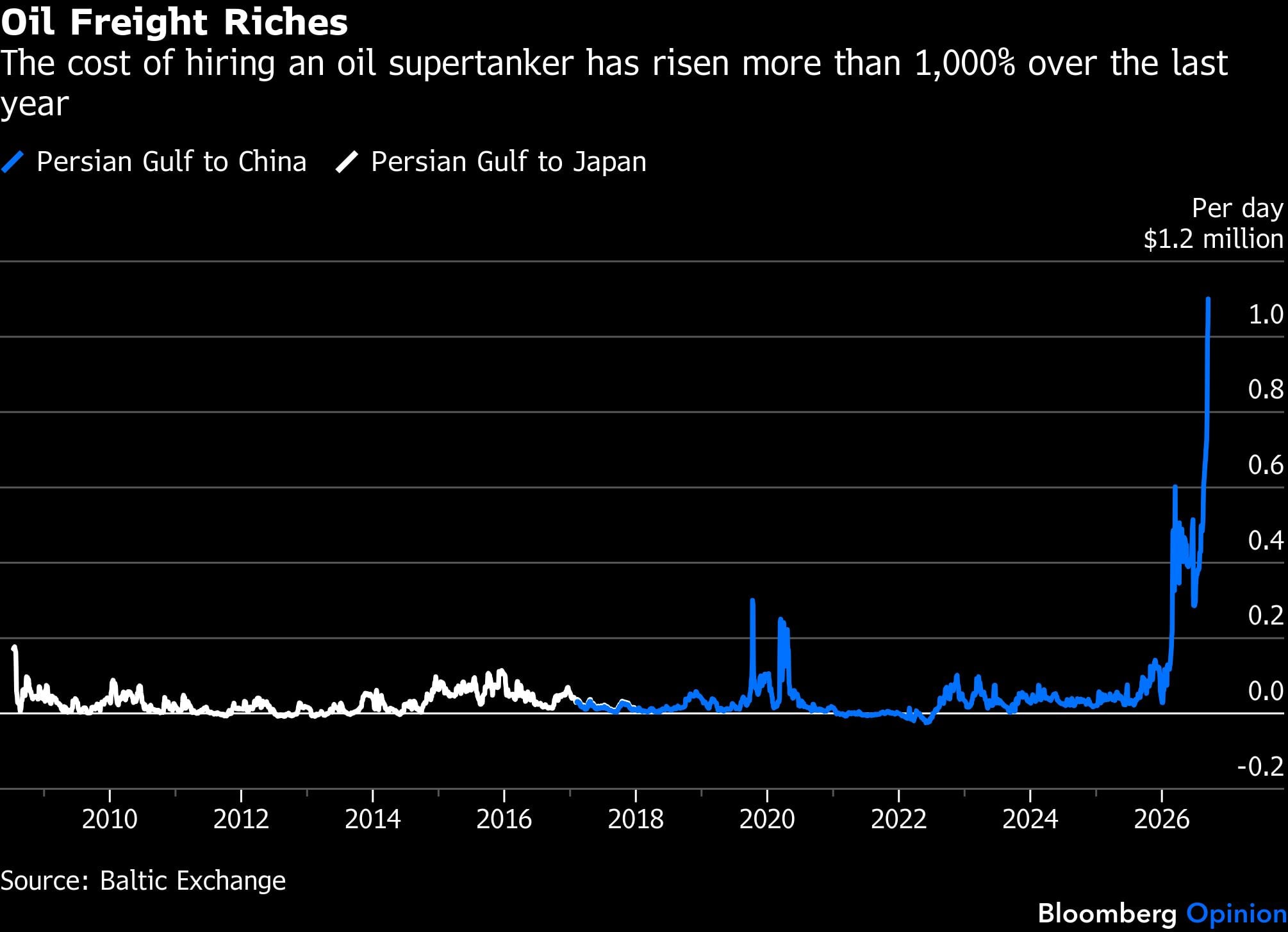
The good news — for consumers and refiners — is that the sky-high oil freight costs aren’t a new normal. The bad news? They may hang around for a while, and there’s a chance the market settles at a higher plateau. Before the Iranian conflict started, the 20-year average VLCC daily rate stood at a modest $29,900 a day.
The world’s VLCC fleet is relatively small: about 925 tankers controlled by a handful of shipping tycoons, including Ga-Hyun Chung, the Korean magnate behind supertanker behemoth Sinokor Group; Norwegian-born billionaire John Fredriksen, the main shareholder in oil tanker group Frontline; and secretive Italian billionaire Gianluigi Aponte, who controls MSC Mediterranean Shipping Co. SA.
To understand how expensive it is to ship oil today, it helps to translate tanker rates into dollars a barrel. On that basis, it now costs more than $22 a barrel to transport crude from inside Hormuz to Asia, up from about $2 a barrel a year ago. In response, oil refiners are trying to buy crude as close to their home base as possible, increasing distortion in the global marketplace. European refiners, for example, are bidding up the North Sea market, trying to save on tanker cost by buying locally.
What’s behind the spike? First, the tanker market was tight even before the first bombs fell on Tehran on Feb. 28. It suffered from years of underinvestment, in part due to unfounded warnings that oil demand was about to peak, which scared some shipowners out of ordering new vessels. Then the pandemic hit, prompting fewer orders and depressing VLCC rates. In 2022, global shipyards delivered the fewest supertankers in three decades. The seeds of crisis were sown.
On top of that, the tanker fleet had split into two factions: the mainstream side, used by most shippers; and a “dark fleet,” accounting for about 25% of the tankers, used by the sanctioned countries Iran, Venezuela and Russia. The division meant that there were fewer tankers than before to conduct above-board business.
Then Washington attacked Tehran, triggering the biggest shakeup the oil market has ever seen. In theory, the war should have depressed tanker rates as it reduced global production and, thus, transportation needs. But the workarounds the industry has devised have boosted tanker demand. For example, Japan is now buying much of its oil from the US, rather than the Middle East, requiring longer voyages that tie up vessels for many more days. Then there are the ship-to-ship oil transfers required to get crude out of Hormuz, which also add time. And whenever Iran hits a tanker, freight costs climb again.
The role of Sinokor is key. The South Korean company has become the largest owner of supertankers, having spent 2025 and early 2026 buying vessels from Greek shipping tycoons. Thanks to its new position as the market’s dominant player, it has been able to push rates higher. Now, demand is so intense that buying a second-hand VLCC, which can be used immediately, is more expensive (about $150 million) than ordering a brand new one and facing a two-year wait (about $130 million).
But the days of tanker owners’ bull market are numbered: The war is its ticking clock. The “current market environment is likely not the new normal,” Lars Barstad, chief executive officer of Frontline, tells me. But he and others in the industry see strong tailwinds that may keep freight rates higher for longer. The most important are the global energy security fears awakened by the war. When the crisis ends, Asian nations are likely to build strategic oil stockpiles and start buying more of their barrels farther away than the Middle East. Both trends will require more shipping, good news for tanker companies.
Yet the shipping industry is even more prone to boom-and-bust episodes than the rest of the notoriously cyclical commodity sector, making a correction likely. The shipyards provide a preview. The industry is “on course for the most VLCC orders in a calendar year in over 50 years,” according to Affinity Shipping, a shipbroker. When that tonnage materializes, starting in 2028-2029, it will push rates down. How much depends on the balance between new ships and decommissioned ones. Because of the lack of orders in recent years, the global tanker fleet has aged. Iran and Russia have kept VLCCs sailing well past their retirement age as part of the dark fleet. Ultimately, those tankers will be sold for scrap, helping the industry absorb the new arrivals. I doubt, however, that will be enough to avoid an oversupply in a few years, considering the size of the current order book.
For now, the tanker industry is sailing into an incredible bonanza. Even if it’s short-lived, the $1 million-plus daily rates are creating new shipping fortunes on top of the old riches built in previous crises. And the cost? That falls on the rest of the global economy.
This column reflects the personal views of the author and does not necessarily reflect the opinion of the editorial board or Bloomberg LP and its owners.
Disclaimer: This report is auto generated from the Bloomberg news service. ThePrint holds no responsibility for its content.