





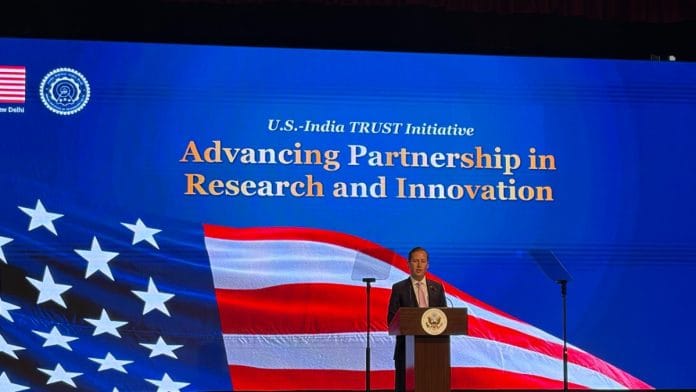

New Delhi: We fully expect that the US-India trade deal will be signed over the next few weeks and months, the United States Ambassador to India, Sergio Gor, said Friday.
Speaking at the Indian Institute of Technology (IIT) Delhi during the US-India TRUST partnership event, Gor said the Trump administration increasingly views the US-India relationship as more than an economic partnership, describing it as central to a broader geopolitical realignment driven by advances in artificial intelligence, semiconductors, pharmaceuticals and space technology.
“Today, the United States is one of India’s largest trading partners, and India is among the top trading partners of the United States,” he added.
For decades, he said, “centers of power” had remained in places that were “frankly outdated”. India, by contrast, represented what he called a “new center of power”—one the White House now considered indispensable to American strategic interests.
Transforming the Relationship Utilizing Strategic Technology (TRUST) builds on and expands the earlier US-India Initiative on Critical and Emerging Technology, or iCET. Announced during PM Modi’s visit to Washington in February 2025, the framework preserves the 2022 iCET’s emphasis on semiconductors, artificial intelligence and quantum technologies, while broadening cooperation into areas such as critical minerals, biotechnology, energy and space.
At the heart of the initiative is an AI Infrastructure Roadmap designed to accelerate the deployment of US-origin AI infrastructure in India through expanded market access, investment flows and digital capacity building. TRUST also seeks to deepen coordination on critical mineral supply chains, including lithium and rare earths, strengthen pharmaceutical and active ingredient manufacturing, and improve supply chain resilience between the two countries.
The initiative is jointly overseen by the national security advisers of India and the United States and is intended to serve as a long-term strategic framework for innovation, advanced manufacturing and technology partnerships.
Throughout the speech, Gor returned repeatedly to a single theme: trust.
India, he said, belonged to a select group of countries with which the United States was prepared to share sensitive technologies and build critical supply chains.
“This is something that’s not expanded to everyone around the world,” he said. “When you look at the initiatives that the United States is offering, we’re looking at partners that frankly are trusted, and India is one of those partners.”
The ambassador pointed to a series of recent investments by American technology companies as evidence that the relationship was already producing results. Amazon, he said, planned to invest $35 billion in India by 2030, while Microsoft had announced a $17.5 billion expansion of cloud infrastructure in the country. Google, he added, had recently begun construction on a subsea cable landing project valued at approximately $15 billion.
“You have a government that is forward-leaning, that has cut and changed rules to accommodate these giant tech companies that we have appreciated in the United States that are now looking to expand in trusted territories such as India,” Gor added.
The address stressed how deeply technology competition with China now shapes American foreign policy. Gor said US-India cooperation in space and critical technologies would help provide a “counterbalance to China’s influence” while strengthening resilient supply chains.
He also described growing collaboration in space exploration, citing the joint NASA-ISRO NISAR satellite mission and India’s participation in the Artemis Accords, the American-led framework for lunar exploration. India, he said, had become “one of the world’s most dynamic bilateral space partners” for the United States.
The ambassador also highlighted cooperation in pharmaceuticals, noting that nearly 40 percent of generic medicines imported by the United States came from India.
“These are literally life-saving ingredients,” he said. “It’s happening here, not in other places around the world, because of that trust.”
The ambassador also praised India’s efforts to modernise export-control rules governing sensitive technologies, including quantum systems and semiconductors, describing regulatory alignment as essential to deeper strategic integration.
“Our cooperation holds strategic importance. It addresses emerging threats, advances peaceful use of space, provides a counterbalance to China’s influence, and drives technological innovation and economic growth. India’s commercial space sector has grown significantly, with ISRO launching 233 satellites with U.S. companies over the last 20 years,” Gor added.
At several points, Gor adopted a markedly personal tone, portraying the relationship as one championed directly by President Trump and Secretary of State Marco Rubio. He stressed that senior American officials were paying increasing attention to India and the broader Indo-Pacific.
“The United States is paying attention,” he said. “The United States is involved, and the United States comes in with an open hand.”
Joining Gor briefly onstage was Sarah Rogers, the Under Secretary for Public Diplomacy who is in India for a day, who argued that India’s demographic and technological rise made it a natural American partner in what she described as a changing post-Cold War order.
“India isn’t afraid of growth, and it isn’t afraid of the future,” Rogers said. “Whether we’re talking about civil nuclear, or quantum, or AI, this is a rising power that wants to race ahead and wants to race ahead with us.”
Echoing Rubio’s repeated use of the term during his maiden visit to India, Gor too hailed the U.S.-India relationship and called it “the defining strategic partnership of the 21st century.”
“At my embassy you will find a willing partner, at our White House you will find a friend in the Oval Office, and together our two countries will achieve things that we’ve only dreamed of in the past,” he concluded.
(Edited by Prakhar Agarwal)
Also Read: The Quad is fading. India must now confront the limits of strategic ambiguity