





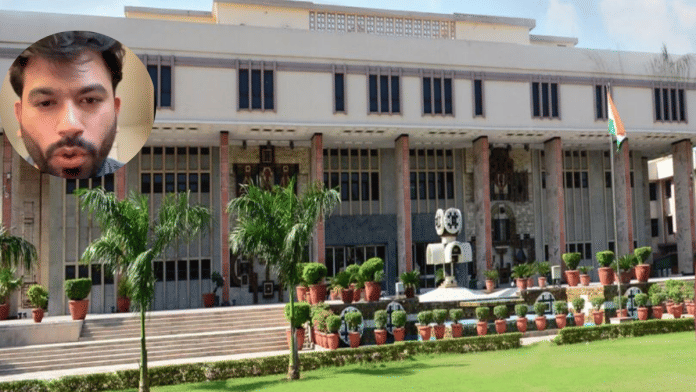

New Delhi: On a plea filed by Cockroach Janta Party’s founder Abhijit Dipke challenging the blocking of his platform’s X account, the Delhi High Court Friday sought responses of the government and the social media giant while simultaneously refusing to restore the account immediately.
The blocking order was given on 21 May under Section 69A of the Information Technology Act, 2000, acting upon inputs from the Intelligence Bureau citing national security concerns, the government said.
Dipke was informed about it via a letter though he has not received the blocking order yet.Justice P.K.Kaurav directed the Review Committee of the IT department to hear Dipke’s plea challenging the blocking order and posted the matter for hearing on 7 July—a week after the HC opens post vacation.
Rule 14 of the IT (Intermediary Guidelines and Digital Media Ethics Code) Rules, 2021 provides that an Inter-Departmental Committee will hear the grievance appeals regarding digital news media and online curated content (like OTT platforms), and makes blocking recommendations to the Ministry of Information and Broadcasting.
If needed, the committee can quash the blocking orders and direct the tweets to be brought back live, the court said.
“They will be considered holistically after hearing the other side. There are far reaching issues. There are wider ramifications,” Justice Kaurav said, directing the review committee to examine Dipke’s concerns.
Launched by political communications strategist Abhijit Dipke on 16 May, the CJP was an immediate response to remarks made a day earlier by the Chief Justice of India, Surya Kant, who compared unemployed youngsters—who take to journalism, social media, or RTI activism—to “cockroaches” and “parasites”.
The CJP exploded in popularity, gathering over 20 million followers on Instagram in just a matter of days, surpassing the follower counts of India’s major parties, the Bharatiya Janata Party (BJP) and the Congress.
Appearing for Dipke, senior advocate Akhil Sibal pressed for the account to be unblocked in the meantime and argued that if there are any posts that the government does not want, those can remain blocked.
He added that this is not the first-of-its-case kind and that there have been cases where such a route has been taken.
Solicitor General Tushar Mehta opposed the suggestion, saying these would amount to passing an order on merits of the case.
The HC differentiated between the previous cases where the accounts were restored immediately and this one, saying that in the previous cases “some tweets might’ve been offending” and in this case “the entire activity may be offending”.
It noted that the law on these cases and actions is “very nascent” as of now and is developing.
Citing Rule 16 of the IT (Procedure and Safeguards for Blocking for Access of Information by Public) Rules, 2009, the court discussed strict confidentiality regarding all requests, complaints, and government actions taken to block online content. The rule allows authorities to block access to online information without notifying or hearing the content creator.
Sibal asserted that they have never asked X to supply a copy of the blocking order, but the court should be apprised of the same. He also requested the court to allow Dipke to appear via video conferencing and authorise someone to appear on his behalf.
In its order, the court allowed Dipke to appear via VC in the next hearing and asked the review committee to examine the blocking order and place its report on record.
(Edited by Tony Rai)
Also Read: There’s never just one cockroach. Abhijeet Dipke only turned on the light
When courts act as HR department for government, you know you have no rights.