



New Delhi: Bangladesh and the United States signed a memorandum of understanding last week to deepen cooperation in the energy sector amid growing concerns about Dhaka’s energy security following supply disruptions because of the West Asia conflict.
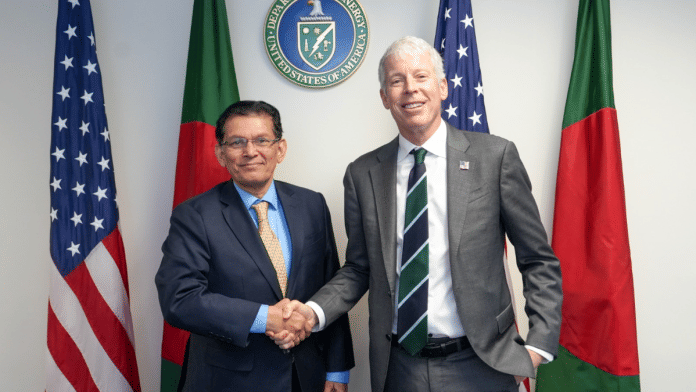
The agreement, signed by Bangladesh’s foreign minister, Khalilur Rahman, and US Energy Secretary Chris Wright, in Washington on 14 May, aims to advance strategic cooperation on energy resources, infrastructure development, and long-term energy security. It is expected to expand Bangladesh’s access to American LNG, LPG and other energy products while encouraging investment across the energy sector.
US firms Chevron and Excelerate Energy already control a major share of Bangladesh’s natural gas production and LNG supply, with Chevron supplying 40 percent of the country’s natural gas supply.
The MoU, which aims to expand cooperation in oil, gas, and energy infrastructure, was signed two days after the US Ambassador to Bangladesh, Brent Christensen, met with Chevron President Javier La Rosa and Excelerate Energy President and CEO Steven Kobos.
According to Bangladesh Energy Regulatory Commission officials, about 40 percent of Bangladesh’s LPG imports in April came from the United States.
In March 2026, Bangladesh faced a sharp increase in LNG import costs after Qatar suspended LNG deliveries amid the West Asia crisis.
To ease the supply crunch, state-run Petrobangla secured two spot-market LNG cargoes for March to maintain energy supplies despite soaring global prices.
Moreover, India’s Adani Power was Bangladesh’s largest foreign electricity supplier, providing as much as 10 percent of the national grid’s power during peak demand periods through its 1,600-megawatt Godda power plant in Jharkhand.
But Adani cut exports to Bangladesh by half in October 2024 following payment delays amid Dhaka’s foreign exchange crisis, forcing one of the plant’s two generating units to shut down the following day. It was restored in March 2025.
The Jharkhand-based plant, developed under a 25-year power purchase agreement signed in 2017 during the tenure of former Prime Minister Sheikh Hasina, consists of two 800-megawatt units dedicated exclusively to supplying electricity to Bangladesh.
The agreement has faced mounting criticism in Bangladesh over allegations that Adani’s electricity prices are substantially higher than other imported Indian power.
Adani Group and the Bangladesh Power Development Board then agreed to pursue international arbitration to settle disputes over payments related to Bangladesh’s electricity imports.
However, the Bangladesh High Court in November 2025 ruled that the arbitration process would remain suspended until a high court-appointed committee submits its findings on the fairness and possible irregularities surrounding the power agreement between the Bangladesh government and Adani.
The investigation follows a directive by Bangladesh’s High Court last year ordering an expert review of the contract after Bangladesh’s interim administration under Muhammad Yunus accused Adani of allegedly withholding tax benefits linked to the project, allegations the company denies.
Growing US-Bangladesh ties
Bangladeshi officials framed the US-Bangladesh deal as part of an urgent effort to secure reliable and affordable energy supplies for a rapidly growing economy increasingly vulnerable to external shocks.
Energy security is the prime concern for Bangladesh, which relies on more than 60 percent of imports for power generation and 44 percent for primary energy supply, according to a 2025 IEEFA report.
“Energy security is critical for all countries,” Rahman said at the ceremony at the US Department of Energy. “We feel it every day given the war going on.”
Under the memorandum, the two countries will cooperate on technical studies, knowledge-sharing and capacity-building initiatives involving oil, gas, geothermal energy and bioenergy.
Bangladeshi officials said the agreement would eventually lead to commercial purchase arrangements between Bangladesh’s energy agencies and American suppliers of LNG, LPG, diesel and other fuels.
In a statement following the ceremony, Wright said the agreement reflected Washington’s broader strategy of expanding American energy exports while reinforcing alliances abroad. The pricing and commercial terms of those agreements, officials said, would be negotiated separately.
The accord also spotlights the growing economic relationship between Washington and Dhaka.
The energy agreement comes as Bangladesh and the United States are also reportedly nearing broader strategic and defense arrangements.
According to reports from US-based analytical centre SOLID INFO, negotiations are underway on two defence accords: the General Security of Military Information Agreement, known as GSOMIA, and the Acquisition and Cross-Servicing Agreement, or ACSA.
Together, the agreements would allow greater military coordination between the two countries, including potential US access to Bangladeshi ports and airfields for refuelling, maintenance and logistics operations.
The energy deal is being presented as a way to strengthen energy security and diversify supplies during global instability.
However, some reports claim it is also tied to broader US strategic interests in the Bay of Bengal, including future offshore exploration rights for American companies.
(Edited by Sugita Katyal)
Also Read: Belgium to retain its nuclear plants, reversing 2025 phase-out plans amid West Asia war