



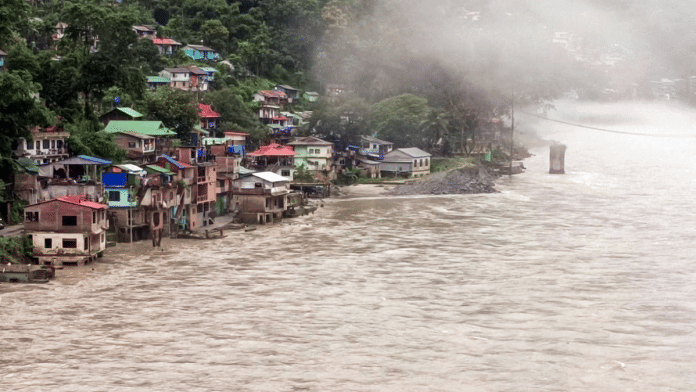
New Delhi: Bangladesh cannot afford to wait indefinitely for a Teesta agreement with India and is keen to continue discussions with China to move forward with development projects in the region, Bangladesh Foreign Minister Khalilur Rahman said Monday.
“Bangladesh cannot just sit idle,” Khalilur Rahman told reporters in Dhaka, before departing for a three-day visit to China. “We have our own work to do.”
He said the Teesta restoration project—in which China is investing significantly—will certainly be discussed during his official meetings in Beijing and will be a key topic of bilateral talks. He is scheduled to meet with Chinese Foreign Minister Wang Yi and other senior officials.
Rahman’s remarks follow the fall of West Bengal’s Trinamool Congress government, led by Mamata Banerjee, who stalled a proposed India-Bangladesh water-sharing agreement in 2011.
With a new government at the helm in West Bengal, India and Bangladesh could have considered reviving the Teesta water-sharing agreement.
Khalilur Rahman, however, suggested that waiting for internal political consensus in India on a Teesta agreement was no longer a viable strategy.
“A government has not yet been established in West Bengal. And, what they are thinking or what they will do, they have to tell us. It is not my job to read their minds.”
The Teesta dispute
Water sharing has long been a source of friction between India and Bangladesh, which remain connected by 54 rivers that cross the border.
The dispute over the Teesta River stretches back more than four decades.
A temporary water-sharing arrangement was reached in 1983. Under the deal, Bangladesh was granted 36 percent of the dry-season flow. India, meanwhile, would retain 39 percent.
It, however, never evolved into a lasting treaty.
In 2011, Prime Minister Manmohan Singh was about to sign an interim agreement, scheduled during his visit to Dhaka. Under the revised conditions, India would retain 42.5 percent of the dry-season flow. Bangladesh, meanwhile, would be granted 37.5 percent.
However, at the time, West Bengal Chief Minister Mamata Banerjee refused the agreement, contending that the river did not have enough water to share.
Following Sheikh Hasina’s June 2024 visit to India, officials from the Narendra Modi government and Bangladesh agreed to pursue technical discussions on the Teesta agreement.
The two sides decided that the Teesta talks would include a proposed conservation “mega-project” and negotiations on extending a Ganges accord, which is currently set to expire in December 2026.
However, Mamata Banerjee’s exclusion from these discussions led to a controversy at the time.
Later, Hasina was ousted from power.
Also Read: Dhaka’s top diplomat in Delhi, India-Bangladesh look to further meets while keeping irritants aside
‘An extremely important friend’
China’s involvement in the Teesta project dates back to 2016, when it signed a memorandum of understanding with Bangladesh to conduct technical studies on the river. Following studies in the Rangpur region of Bangladesh, the Bangladesh Water Development Board and PowerChina signed the Teesta River Comprehensive Management and Restoration Project in May 2019.
The project aims to create new embankments, repair existing ones, oversee river training, reclaim land using dredged materials, and manage the Teesta’s dry-season flow by building storage facilities. The newly proposed embankment will span 102 km, running from the Teesta Barrage to the confluence at Chilmari in Rangpur, Bangladesh.
Now, Khalilur Rahman’s visit—the first to China by Bangladesh’s new government—will broadly focus on expanding bilateral ties. Describing China as an “extremely important friend”, Rahman said that Dhaka was interested in elevating its relationship with Beijing beyond its current strategic partnership.
“China is an extremely important friend of ours, with whom we have a strategic cooperative partnership. This is our new government’s first visit to China. We will discuss in detail how to deepen and broaden our bilateral relationship further,” Rahman added.
India’s concerns
Originating at Sikkim’s Tso Lhamo, the Teesta River runs a total length of 414 km, of which 113 km lies in Bangladesh. India sits upstream of Bangladesh on the Teesta River, which is part of a broader river system where China is upstream of India.
In 2020, China offered a $987 million loan to Bangladesh as part of the Teesta restoration project. Beijing’s move prompted a bilateral India-Bangladesh meeting, which, at the time, was attended by Indian Foreign Secretary Harsh Vardhan Shringla.
With both India and China having shown interest in a Teesta conservation project with Bangladesh, it was to be seen which party eventually entered an agreement first.
China’s upstream control poses risks for both New Delhi and Dhaka. BNP’s concerns over water flows from China’s planned mega hydropower project in Tibet even echo India’s anxieties.
However, Dhaka has increasingly leaned towards Beijing on the Teesta restoration project.
BNP’s promise
In its election manifesto for the recently concluded national elections in Bangladesh, the BNP pledged to fast-track the China-backed Teesta restoration project if it came to power.
It promised to treat the project as a priority to address the river’s long-unresolved challenges.
Teesta’s waters are used for irrigation in roughly five districts of Bangladesh. Nearly 63 percent of all crops grown in Nilphamari, Kurigram, Lalmonirhat, Gaibandha, and Rangpur depend on irrigation, making the river crucial for Bangladesh.
Bangladesh has blamed India for the lean irrigation season—from December to May—when India’s Gazaldoba Barrage, located upstream in North Bengal, diverts water.
The Teesta agreement that could have minimised economic losses by regulating seasonal water flows has been under negotiation for a long time but has never been agreed upon.
(Edited by Madhurita Goswami)