



New Delhi: Amid an offensive by the Houthis, Saudi Arabia is facing its biggest military setback in decades, and with it the rude realisation that its carefully crafted military alliances have been missing in action. The kingdom found itself on its own when Houthi militants from northern Yemen, wearing slippers and carrying AK-47s, seized control of the Bab al-Mandeb strait earlier this week.
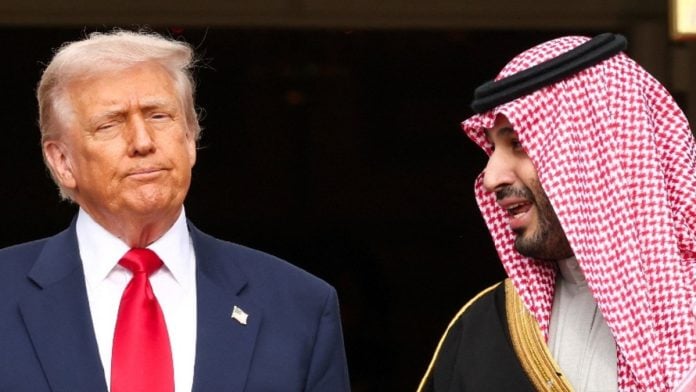
While US President Donald Trump has turned down Saudi Crown Prince Mohammed bin Salman’s request to intervene, a report by Reuters revealed that Washington separately held previously undisclosed talks with Houthi representatives in Oman over the weekend. It was agreed upon that the Iran-backed militia would not attack US and Israeli merchant vessels.
A day after capturing the port of Mokha last Thursday, Houthis attacked sections of the pipeline carrying Saudi oil from eastern refineries to the Red Sea, forcing its closure.
With Iran blocking the Strait of Hormuz along its eastern coast, Saudi Arabia now risks losing access to both its major maritime oil export routes.
For decades, Saudi Arabia based much of its security strategy on a straightforward assumption: enormous financial resources, combined with strong American support, would shield the kingdom from the surrounding instability. That assumption has now come under threat.
Repeated attacks by Houthis, pressure from Iran, and an increasingly transactional relationship with Washington have forced Riyadh to confront an uncomfortable reality: the alliances it once relied on are less dependable than they appeared.
The immediate vulnerability is also being seen as a result of Riyadh’s attempts to manage competing regional alliances, its assessment of developments in Yemen, and its reliance on external security guarantees.
Also Read: Strategic time-out: Hours after UAE crown prince departs, Saudi FM lands in Delhi for BRICS
Intra-coalition struggle in Yemen
Known formally as Ansar Allah, the Houthis emerged from the Zaydi Shi’ite community in northern Yemen. They fought a series of wars against the Yemeni government between 2004 and 2010.
Six months after the Houthis seized Sanaa in September 2014 and established control over northern Yemen, Saudi Arabia and the United Arab Emirates (UAE) formed a coalition to push back the Tehran-aligned bloc.
But as the conflict continued, strategic priorities of the two Gulf powers increasingly diverged. Riyadh wanted a unified Yemen under the authority of the internationally recognised Presidential Leadership Council. Abu Dhabi, meanwhile, backed the Southern Transitional Council, which favoured an independent southern Yemen and sought control over strategically important ports.
The resulting division transformed what had begun as a united front against the Houthis into an increasingly complicated intra-coalition struggle.
As the Southern Transitional Council expanded its influence in southern Yemen, Saudi Arabia launched military operations against UAE-backed forces. Riyadh also targeted UAE weapons shipments and issued ultimatums demanding that Abu Dhabi exit the southern theatre. The objective was to weaken southern forces. But the broader effect was a deeper fracture within the anti-Houthi coalition.
With its opponents divided and the UAE reducing its direct combat presence, the Houthis consolidated their control over northern Yemen and strengthened their position along the Red Sea coast.
Saudi Arabia was left increasingly isolated in its effort to contain the group. The Houthis, meanwhile, moved from a primarily defensive posture toward territorial dominance across northern Yemen and greater leverage over Bab el-Mandeb Strait.
The Houthis’ consolidation of territory in Yemen has now placed them in a position to exploit a maritime route critical for oil tankers travelling between the Indian Ocean and European markets through the Suez Canal.
By securing Perim Island and the port of Moka earlier this month, the Houthis have established positions overlooking the narrowest sections of the Red Sea.
Washington, meanwhile, showed little appetite for yet another foreign conflict and instead engaged with the Houthis to protect American vessels, leaving Saudi vessels exposed.
External guarantors with no guarantee
As their confidence in a US security guarantee fumbled amid the West Asia war, Riyadh looked to its eastern neighbour, Pakistan.
Under the newly minted Mecca Mutual Defence Agreement, a multi-defence framework borrowed in part from NATO’s collective-defense principle, Riyadh sought security guarantees from regional powers, including Pakistan and Turkey.
But the arrangement, it now appears, was dead on arrival.
Pakistan, a nuclear power, declined to deploy troops or commit forces to an active conflict against the Houthis, instead maintaining a neutral diplomatic position. Turkey offered verbal support but stopped short of offering direct military assistance.
Without active backing from Washington, Abu Dhabi, Islamabad or Ankara, Riyadh finds its strategic options increasingly constrained. This, despite the fact that it is one of the world’s top military spenders. The Stockholm International Peace Research Institute (SIPRI) in its 2025 and 2026 defence budgets noted that Riyadh allocated upwards of $64 billion to $78 billion annually, routinely accounting for over 20 percent of its total government expenditure.
The United States this month approved a possible $5 billion weapons package for Riyadh which includes more than 10,000 precision-guidance kits and thousands of bombs. However, those conventional capabilities have proved less suited to dealing with asymmetric warfare along narrow maritime corridors.
Also Read: Saudi firm bets $200 mn on Afghanistan’s energy sector. Can it succeed where Chinese failed?
When regional conflicts come home to roost
The dispute between Saudi Arabia and the UAE is not confined to Yemen. Beneath it lies a growing economic rivalry over influence in West Asia.
Saudi Arabia’s Vision 2030 programme has sought to diversify the kingdom’s economy and establish Riyadh as a regional commercial center. As part of that effort, Saudi Arabia introduced a rule in 2021 that only multinational companies with regional headquarters in Riyadh will be considered for government contracts. The move directly challenged Dubai’s longstanding position as the Middle East’s principal business hub.
The UAE entered this competition with significant early advantages. It had already established major logistics and financial centers and had normalised relations with Israel through the Abraham Accords.
Saudi Arabia now faces the possibility of a two-front conflict as it considers a response to the Houthi advance. The Houthis have moved down the Red Sea coast and seized islands close to the Bab al-Mandeb Strait. At the same time, Iranian-backed militias in Iraq attacked Saudi Arabia’s East-West pipeline.
The Houthis subsequently launched attacks on Saudi Arabia and allegedly attempted a drone attack on Mecca Tuesday.
For Riyadh, the result is a growing sense of isolation. Other Gulf states have been considering a meeting with Iranian representatives in Oman. US Secretary of State Marco Rubio has praised Oman, months after President Trump threatened the country. Saudi Crown Prince Mohammed bin Salman travelled to Cairo this week, raising the possibility that Egypt could support a Saudi military response.
Then there is Qatar. In 2017, Saudi Arabia, the UAE, Bahrain and Egypt severed diplomatic ties and imposed a land, air, and sea blockade against Qatar, alleging support to extremist groups, including the Muslim Brotherhood, al-Qaeda, and ISIS.
Turning to unlikely allies
Meanwhile, Israel and Saudi Arabia have held talks, mediated by the US Central Command, on helping Riyadh defend itself against an escalating Houthi offensive, The Jerusalem Post reported Tuesday.
Israel has already demonstrated intelligence and operational capabilities in the maritime environment around the Strait of Hormuz, where it has assisted the US in developing layers of intelligence on the locations and activities of Iranian forces.
At the same time, another issue has led to concern within Israel’s security establishment: the decision by President Donald Trump to allow Saudi Arabia to develop a civilian nuclear programme. The issue was raised with Trump, who quickly linked progress on the Saudi civilian nuclear programme to the possibility of normalising relations between Saudi Arabia and Israel.
Riyadh, however, has said it wants to advance a diplomatic process with Israel only after the Israeli-Palestinian conflict is resolved. Despite the absence of formal diplomatic relations, Israel and Saudi Arabia share security interests, particularly regarding threats from Iran and its regional allies.
Saudi Arabia has also sought assistance from Britain in pushing the Houthis away from the Bab al-Mandeb Strait and protecting its oil infrastructure, reported Bloomberg. According to the report, British Prime Minister Andy Burnham has for now agreed to send military advisers to Saudi Arabia.
India, too, Tuesday expressed concern over Houthi attacks against Saudi infrastructure, cautioning that such strikes undermine regional stability and threaten freedom of navigation through the Bab-el-Mandeb strait.
(Edited by Amrtansh Arora)
Also Read: Mecca Pact is an alliance of unequals. Pakistan’s silence on the attacks by Houthis shows why