





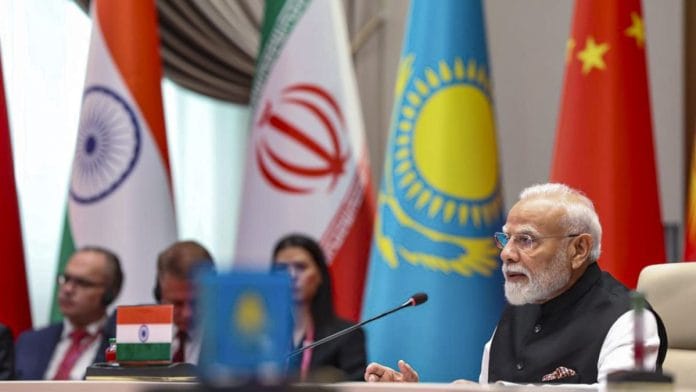

New Delhi: Prime Minister Narendra Modi warned countries against using terrorism as an “instrument of state policy”, in his address to the Shanghai Cooperation Organisation Tuesday, just as Pakistan is set to assume the presidency of the forum for the next year.
“Terrorism remains a grave challenge for all of humanity. In the fight against it, we cannot limit ourselves to a mere ‘action-reaction’ mindset. We must dismantle the entire ecosystem of terror financing, recruitment, radicalisation, and safe havens,” Modi said in his remarks during the Heads of States Summit in the Kyrgyz capital of Bishkek.
“We must speak with one voice to declare that there is no room for double standards on this critical issue. Countries that use terrorism as an instrument of state policy and provide shelter and support to terrorists must be sent a strong message: terrorism cannot be a strategic asset for anyone.”
The SCO as an organisation has only two permanent institutions—the Regional Anti-Terrorist Structure (RATS) and a Secretariat. The organisation, since its inception, has focused on solving border issues and combatting terrorism. Pakistan takes over from Kyrgyzstan as chair of the SCO until the next Heads of States Summit next year, which will be held in the South Asian country.
India has long raised the issue of cross-border terror attacks emanating from Pakistan’s border. More recently, the April 2025 attack in Pahalgam left 26 people dead and led to New Delhi launching Operation Sindoor. The military operation struck 9 terror complexes across Pakistan and Pakistan-occupied Jammu and Kashmir (PoJK).
New Delhi has remained non-committal in how it will approach the Pakistani presidency, with Secretary (West) in the Ministry of External Affairs, Sibi George, stating last week that participation will be decided by the “appropriate authorities at the appropriate time”.
PM Modi doubled down on India’s growing engagement with the Taliban regime in Afghanistan, highlighting that New Delhi “will continue to contribute to the development and humanitarian needs of the Afghan people”, in his remarks.
“Our shared aspiration for a peaceful and secure Eurasia is also linked to peace and stability in Afghanistan. India has been contributing—and will continue to contribute—to the development and humanitarian needs of the Afghan people,” said Modi.
The Taliban regime has had a tenuous relationship with Islamabad in the last 18 months, with cross-border strikes occurring a few times, and Islamabad blaming Kabul for its continued support of terrorist organisations such as the Tehreek-i-Taliban Pakistan (TTP).
India elevated the status of its technical mission in Kabul to that of an embassy last October. A number of high-level delegations from the Taliban regime have come to New Delhi in the last year, as the two sides continue to find ways to deepen the ongoing engagement.
The SCO completed 25 years of its foundation this year. The organisation was originally established as the Shanghai Five–China, Kazakhstan, Kyrgyzstan, Russia and Tajikistan. It was expanded to include Uzbekistan when the organisation was institutionalised in 2001. In 2017, India and Pakistan joined the organisation, which was later expanded to include Iran and Belarus.
“Over the past twenty-five years, the SCO has developed a robust tradition of dialogue and cooperation across the vast expanse of Eurasia. Together, we have made valuable contributions not only to the well-being of our people but also to the progress of humanity,” said Modi.
“We have laid a strong foundation for cooperation over these twenty-five years. Now, our goal for the next twenty-five years should be to translate this cooperation into tangible results.”
India chaired the organisation in 2023, when it held the heads of states summit virtually. A year later, Pakistan chaired the heads of government summit, with External Affairs Minister S. Jaishankar representing India in Islamabad for the meeting.
PM Modi’s two-day visit to Kyrgyzstan began Monday with a number of bilateral meetings including with Iranian President Masoud Pezeshkian and Russian President Vladimir V. Putin. He also held a bilateral meeting with President Sadyr Japorov of the Kyrgyz Republic on the same day.
The Indian Prime Minister also attended the inauguration of the 6th World Nomad Games in Bishkek. Modi exchanged views informally with Chinese President Xi Jinping and President Putin Tuesday morning as the leaders gathered for the SCO Summit.
Modi will depart Bishkek Tuesday afternoon and return to India following a four-day visit to Central Asia. Before arriving in Kyrgyzstan, Modi was in Uzbekistan for a stand-alone bilateral visit.
(Edited by Niyati Kothiyal)
Also read: India’s response to US-Israel war on Iran isn’t muted. Just read what SCO said on Khamenei killing