



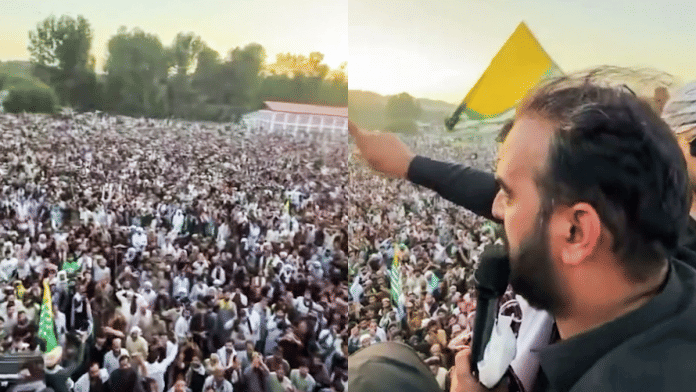
New Delhi: Women, students and children are now at the forefront of the ongoing protests in Pakistan occupied Kashmir. The protests, which began two weeks ago demanding constitutional amendments before the 27 July elections, saw the Pakistan Army use brute force, resulting in at least 20 deaths and a blanket ban on the internet in the region.
Protesters Monday gathered across several towns and villages in PoK, while a mass sit-in at Rawalakot’s Eidgah Ground has continued to draw tens of thousands of participants. According to reports, more than 70,000 people have joined the encampment over the past 14 days.
In Tarar Khel, in Sudhnoti district, groups of schoolchildren gathered in public spaces chanting slogans demanding freedom and protesting against the Pakistan Army. In Mandhole, women marched in dozens through the streets, calling for independence and denouncing what they claim is political and military domination by Islamabad.
At the main protest site in Rawalakot, children held placards bearing slogans such as ‘Pakistani Forces Out, Out’; ‘We Want Basic Rights’; ‘We Want Free Education’ and appeals for international attention, according to local reports.
The demonstrations are being led by the Joint Awami Action Committee (JAAC), an umbrella organisation that has presented Islamabad with a charter of 38 demands and set 23 June as a deadline for action.
Organisers have now reportedly threatened to escalate the movement by launching a march of more than 1,00,000 people from Rawalakot to Muzaffarabad, the region’s administrative capital, if the government does not respond before the deadline.
What is happening in Pok
A political dispute over legislative representation has erupted into one of the deadliest episodes of unrest in the region in decades, with at least 20 people dead and 70 injured, according to local reports. In the past two weeks, thousands of protesters took to the streets after authorities moved to suppress demonstrations against the abolition of reserved legislative seats for refugees who migrated to Pakistan from Kashmir in India
Tension had been building for weeks ahead of a planned 9 June protest over the status of 12 PoK Legislative Assembly seats reserved for refugees from Kashmir in India who settled in Pakistan after 1947. JAAC leaders argue that the abolition of the seats allows Pakistan’s major political parties to exert disproportionate influence over governments in Muzaffarabad, the region’s capital, Dawn reported.
Amid concerns, the PoK government on 5 June designated JAAC, a prohibited organisation under anti-terrorism laws, asserting that it was engaged in activities threatening public order and security. Thirty-one members and leaders were reportedly placed on a list of individuals associated with the banned organisation.
Authorities said intelligence reports indicated that planned demonstrations could turn violent. Government officials alleged that some activists possessed weapons and intended to block roads, disrupt economic activity and damage public property.
JAAC leaders rejected those accusations, insisting that their movement had remained peaceful and that the ban reflected official anxiety over growing public support rather than genuine security concerns.
(Edited by Viny Mishra)
Also read: PoK unrest is a 1971 moment for Pakistan. It’s a strategic opportunity for India