





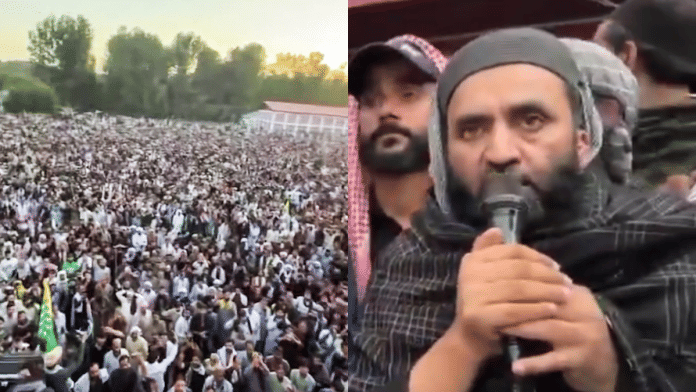


New Delhi: Pakistan Jammu and Kashmir Joint Awami Action Committee (JAAC), the grassroots coalition leading months of anti-government protests in PoK Sunday called on residents to boycott the ongoing legislative elections, calling the vote a “fraud” being conducted “at gunpoint” as Pakistani Rangers continued their crackdown across the region.
In a video statement posted on the Facebook page of JAAC leader Sardar Umar Nazir, the group reiterated longstanding demands for electoral reforms while insisting it was not opposed to democratic elections.
“This election that’s ongoing right now is being carried out at gunpoint,” Nazir said. “We will not create obstacles for this election but we, as JAAC, declare these fraudulent and farcical.”
Calling on residents to stay away from polling stations, he argued that the electoral process lacked credibility because, in his view, much of the population had been excluded from meaningful participation.
“We are not against democracy or elections. However, we demand that the elections be impartial, but that is not the case for these elections,” he added. “JAAC has announced that the elections that are taking place are a fraud election being held at gunpoint.”
He then asked supporters in PoK to join demonstrations in Muzaffarabad instead of voting, saying any government formed through these elections would lack public legitimacy.
The appeal came after weeks of escalating violence that has transformed a movement initially centered on economic grievances and governance in PoK into one of the most significant challenges to Islamabad’s authority in the territory in years.
Pakistan’s government designated JAAC a banned organisation in June under anti-terrorism legislation, accusing it of activities prejudicial to public order. Since then, security forces, including the Pakistan Rangers and other paramilitary units, have expanded their presence across towns in the Poonch division, conducting patrols and enforcing restrictions on public gatherings.
The crackdown followed a series of violent confrontations that began in early June after a trader was killed during an encounter with law enforcement. Tensions escalated further after JAAC activist Shahzaib Habib was fatally shot by unidentified gunmen days later. The following night, clashes between protesters and police left civilians and police officers dead, according to local authorities.
On 9 July, JAAC organised a region-wide strike that shut businesses, schools and public transport, while protesters established sit-ins across several towns. Activists say the demonstrations were met with force by paramilitary units deployed throughout the region.
Violence intensified again during the first phase of legislative elections on 27 July, when JAAC supporters marched into Rawalakot despite curfew orders. Activists alleged that security forces fired on demonstrators and bystanders, while Pakistani authorities accused protesters of attacking security personnel and rejected allegations of using excessive force.
Competing narratives have been accompanied by sharply different casualty figures. Local activists say more than 90 civilians have been killed since the protests began in June, including dozens during the latest clashes. Pakistani officials dispute those figures and deny that security forces deliberately targeted civilians.
Pakistan’s defence minister, Khawaja Asif, last week justified the killings, saying there would be “no dialogue” with protesters and comparing them to “enemies like India”.
Other senior officials have similarly accused JAAC of acting against the state’s interests. Rana Sanaullah, an adviser to Prime Minister Shehbaz Sharif, acknowledged that the government had previously held talks with JAAC over a list of demands but accused the movement of launching what he described as an “India-like attack”, while denying reports that civilians had been killed in the latest round of unrest.
Meanwhile, the election has also become the focus of an increasingly bitter political dispute. The ruling Pakistan Muslim League-Nawaz won the majority of seats contested in the first phase of voting in Mirpur, a result celebrated by party leaders as reflecting the will of the electorate.
Opposition parties, including the Pakistan Peoples Party, rejected the results, accusing the government of securing a “fake mandate” through intimidation and the use of state institutions.
Low turnout in several areas has been attributed by residents and activists to both the boycott campaign and the continuing security restrictions, although Pakistani authorities have rejected claims that the election lacked legitimacy.
(Edited by Viny Mishra)
Also read: Munir’s crackdown in PoK polls: Region’s politics, complexities & Pakistan’s ‘Kashmir’ pretence