



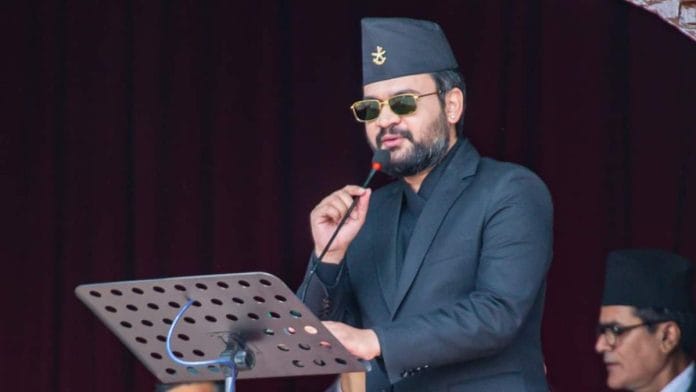
New Delhi: In his first Parliament speech, Nepal’s newly elected PM Balen Shah Sunday gave a fresh twist to the India-Nepal border row, saying that territorial encroachments along India-Nepal border were not a one-sided issue. He said that both countries are occupying land claimed by the other, and that China and the UK should be involved in the border dispute.
“After becoming prime minister, I came to know that not only has India encroached on Nepal’s land, but Nepal has also encroached on India’s land in multiple places,” Shah said, responding to questions in Parliament.
He added that Nepal had also raised the issue with China and the United Kingdom. “We have spoken not only with India and China, but also with the UK government,” Shah said. “Our view is that the UK should also take an interest, as the issue dates back to the period when British India left the region.”
The remarks came during a discussion of the dispute over the Kalapani-Limpiyadhura-Lipulekh region, a strategically important area near the trijunction of India, Nepal, and Tibet. India maintains that the territory is part of the northern Indian state of Uttarakhand and has consistently rejected Nepal’s claims. Nepal bases its claim to the Lipulekh area on its interpretation of the 1816 Sugauli Treaty signed with British India.
Shah did not specify which parts of India he believed Nepal had encroached upon. He said, however, that both governments had agreed to address the matter through diplomatic engagement.
Responding to a separate question from Padma Aryal, the deputy parliamentary party leader of the Communist Party of Nepal (Unified Marxist-Leninist), Shah said the disputes over Lipulekh, Limpiyadhura, and Kalapani would be resolved through dialogue.
“Both sides need to sit down and look into the matter,” he said.
“The Nepal government has officially sent a diplomatic note to India, mentioning the issue of encroachment of territories by India, including Lipulekh, and we have already received their response.”
According to Shah, India’s reply indicated that both countries would establish teams of historians, surveyors, and territorial experts to examine the dispute and seek a resolution through negotiations. “The response states that both governments will form teams comprising historians, surveyors, and experts familiar with the territory and seek a resolution through table talks,” he said.
Following the remarks, Nepal’s Ministry of Foreign Affairs issued a statement clarifying the government’s position on the border issue with India.
Preliminary findings by the committee, the ministry said, indicate that in some locations land presently used by Nepali citizens may technically lie on the Indian side of the border, while land used by Indian citizens may fall within Nepal’s territory. It added that this technical reality formed the basis of Shah’s parliamentary observation that “Indian land may be on Nepal’s side in some places”.
According to the ministry, the PM’s remarks were intended to refer to these cases of cross-border occupation, and not to alter Nepal’s longstanding position regarding the disputed territories of Kalapani, Lipulekh and Limpiyadhura.
“In the areas where the long border between Nepal and India has been systematically and scientifically mapped, the border-related mechanisms and technical teams of the two countries are active to construct and repair border pillars, collect data on encroachment of the ten-gaja area and cross-border occupation,” the statement read.
“The study of the Technical Committee has shown that in some places, the land currently under the use and enjoyment of Nepal may fall on the side of India and the land currently under the use and enjoyment of India may fall on the side of Nepal. The reference to the statement made by the Honorable Prime Minister in the Parliament that ‘Indian land may be on Nepal’s side in some places’ is linked to this technical reality and ‘cross-border occupation’.”
The border dispute intensified in 2019 after Nepal objected to a new political map issued by India that depicted the Kalapani area as Indian territory. New Delhi responded by saying that it had not altered the border and that the map accurately reflected India’s sovereign territory.
Tensions escalated further in May 2020 when India’s Defence Minister Rajnath Singh, inaugurated a road linking the Lipulekh Pass to the Kailash Mansarovar pilgrimage route. Nepal protested the move, arguing that the road was built through territory claimed by Kathmandu and violated understandings between the two countries.
In June 2020, Nepal’s Parliament amended the Constitution to incorporate a revised national map that included Kalapani, Limpiyadhura and Lipulekh within Nepal’s borders.
India had rejected the move at the time, describing Nepal’s claims as an “artificial enlargement” not supported by historical evidence.
Earlier this month, Nepal’s Ministry of Foreign Affairs again objected to the Kailash Mansarovar pilgrimage route being conducted through what it described as Nepali territory. The ministry said it had communicated its position to both India and China through diplomatic channels and had repeatedly called on India not to undertake activities such as road construction, expansion projects, border trade, or pilgrimage operations in the disputed region.
India responded by reiterating what it called its “consistent and clear” position. MEA spokesperson Randhir Jaiswal said Nepal’s territorial claims were “neither justified nor based on historical facts and evidence”.
The latest developments also come as Rabi Lamichhane, chairman of the ruling Rastriya Swatantra Party, prepares to undertake a two-day visit to New Delhi beginning 1 June. The Bharatiya Janata Party announced that it had invited Lamichhane in a press release Sunday.
Lamichhane will lead a three-member party delegation and is expected to return the following day. Shah has also indicated that he does not intend to meet foreign leaders or heads of state at this stage.
(Edited by Varnika Dhawan)
Also Read: Balen Shah is changing Nepal’s India-China balancing act. It’s a risky foreign policy
Nepal wants the UK to be involved due to their “historical” ties to the Indian Sub-Continent.
Why go back 80 years… why not 800 years… or longer… when Nepal did not exist and Bharat embraced the whole of the Indian Sub-Continent…. NO BORDERS… just Open Lands… with ALL living in Peace & Harmony… 🤔🤔🤔
You keep the land you occupied, and we keep the land we occupied. Stop wasting time.