



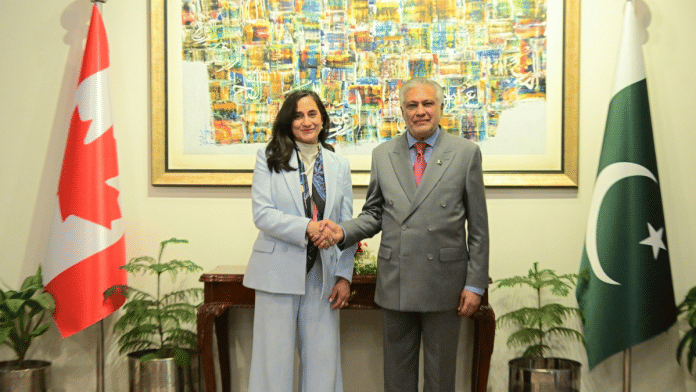
New Delhi: Pakistan’s effort to rally international support for the restoration of the Indus Waters Treaty (IWT) received no visible endorsement from Canada Monday, after Foreign Minister Anita Anand declined to publicly address Islamabad’s appeal during a joint press conference in Islamabad.
Standing next to Anand, Pakistan’s Deputy Prime Minister and Foreign Minister Ishaq Dar called on Ottawa to support his country’s call for India to immediately reinstate the six-decade-old water-sharing agreement.
Canada’s official statement on the visit, however, omitted any mention of the issue.
India suspended the IWT after the April 2025 terror attack in Pahalgam, which killed 26 people. It would remain in abeyance until Pakistan takes credible action against cross-border terrorism, New Delhi has asserted.
Dar, meanwhile, claimed New Delhi’s decision introduced another source of instability into an already fragile regional security environment.
Appealing directly to Canada, the Pakistan Deputy PM then called on Ottawa and other partners to support what he described as the immediate restoration of the treaty and to oppose the “weaponisation of water.”
“We seek the support of our friendly countries, including Canada, towards India’s immediate restoration of the IWT, ending the weaponisation of water and upholding international law and treaty obligations,” he added.
But, the Canadian delegation offered no public response. Its statement after the meeting focused on bilateral relations and broader areas of cooperation, without referring to the treaty or Pakistan’s request.
Signed in 1960 with the facilitation of the World Bank, the Indus Waters Treaty has long been regarded as one of the world’s most durable transboundary water agreements. It allocates control of the Indus basin’s three eastern rivers to India while granting Pakistan primary rights over the three western rivers, subject to limited upstream uses by India.
The agreement also established a Permanent Indus Commission to facilitate technical cooperation and created a structured dispute-resolution process involving neutral experts, international arbitration and the World Bank. The treaty contains no provision allowing either side to suspend it unilaterally.
With the treaty in abeyance, Pakistan’s political brass has repeatedly targeted India for its hard stance despite Islamabad lacking proper infrastructure to handle its water shortage. Islamabad argues that the treaty cannot be amended, revoked, suspended, or put in abeyance unilaterally.
(Edited by Tony Rai)
Also Read: Inside the second partition of India-Pakistan—the full story of the Indus Waters Treaty