



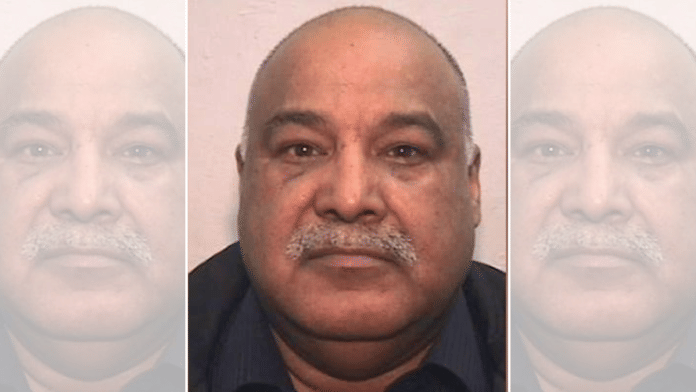

New Delhi: Pakistan has rejected the UK’s efforts to deport Shabir Ahmed, the convicted ringleader of the Rochdale child grooming gang, insisting that the onus lies with the country where “he grew up, was raised, groomed, and spoiled.”
Ahmed was released earlier this month after serving 14 years of a 22-year prison sentence for leading one of the UK’s most infamous child sexual exploitation networks.His release reignited public outrage and intensified pressure on the UK government to remove him from the country.
Pakistan, however, has refused to accept him even as the episode threatens to create a diplomatic rift between the two countries. Islamabad is demanding that London extradites political dissidents such as Mirza Shahzad Akbar, a former minister in the erstwhile Imran Khan government, for the deportation to take place.
“The individual concerned (Shabir Ahmed) is a British national who spent his entire adult life in the UK and was duly convicted by a British court for the reprehensible offences he committed on British soil,” Pakistan’s Ministry of Foreign Affairs spokesperson Tahir Andrabi was quoted Thursday by the BBC as saying.
“Regardless of where he was born, the onus lies on where he grew up, was raised, groomed and unfortunately, spoilt.”
Pakistan has rejected the UK’s request to repatriate convicted child grooming gang leader Shabir Ahmed. By claiming he was "spoiled" in the UK, they are completely deflecting blame and evading accountability. This refusal to take responsibility is a massive insult to the victims… pic.twitter.com/y5Xc111whI
— ICRR (@ICRROfficial) July 16, 2026
The matter, he asserted, was entirely an internal matter of the UK.
Ahmed, the spokesperson argued, had spent virtually his entire adult life in Britain, where he committed his crimes, was prosecuted and sentenced by British courts, and therefore remained Britain’s responsibility.
“Any decision regarding his release, supervision or legal status falls exclusively within the jurisdiction of the competent British authorities. The government of Pakistan has no connection whatsoever with this matter.”
He added that Ahmed’s crimes demanded “serious introspection” rather than efforts to shift responsibility elsewhere.
Pakistani-born Ahmed, who emigrated to Britain in the late 1960s, held dual citizenship before being stripped of his British nationality following his conviction in 2012. British officials are seeking his deportation, arguing that existing immigration protections should not shield individuals convicted of the most serious crimes.
The 73-year-old was one of nine men convicted for systematically grooming and sexually abusing vulnerable girls, some as young as 13, in Rochdale and Oldham. Prosecutors said he led a network that exploited runaway children and girls seeking food or shelter, subjecting them to repeated rape, trafficking and sexual abuse.
He was convicted on multiple counts of rape and child sexual exploitation in 2012. In a separate trial, he was found guilty of dozens of offenses involving the prolonged abuse of a British Pakistani girl over nearly a decade.
The British government has placed Ahmed in supervised accommodation under strict licence conditions, including GPS monitoring, and says he will be returned to prison if he violates those conditions.
His deportation, however, remains blocked by a provision of the Immigration Act 1971, which protects certain Commonwealth citizens who arrived in Britain before 1973 from deportation after long-term residence.
UK Home Secretary Yvette Cooper announced plans to amend the legislation, arguing that individuals convicted of child sexual exploitation, human trafficking, war crimes or offenses posing national security risks should no longer be able to rely on those protections.
Cooper Wednesday further added the UK would impose visa sanctions on Pakistan if it refuses to take Ahmed back.
Justice Secretary Shabana Mahmood, too, argued that the law was never intended to prevent the removal of offenders such as Ahmed.
Yet even if Parliament changes the law, deportation cannot proceed without Pakistan’s agreement to receive him. That has transformed Ahmed’s case from a domestic immigration issue into a broader diplomatic negotiation.
Conservative politicians have gone further, suggesting that London should consider suspending aid or imposing wider visa sanctions to pressure Islamabad.
Chris Philp, the Conservative shadow home secretary, said Britain should consider “very robust measures” if Pakistan continues to refuse.
Pakistani officials have dismissed those threats. “Our position is that the UK must listen to us too,” a senior Pakistani official told The Telegraph Wednesday. “Pakistan cannot be railroaded into agreeing to terms that are suitable only to the UK.”
The official added that Britain was dealing with “a different Pakistan,” warning that “arrogance is not acceptable to us.”
Behind the public disagreement lies a wider set of unresolved issues between the two governments.
Pakistani officials have privately linked the UK’s request to longstanding demands that London extradite several high-profile Pakistani political figures, including Altaf Hussain, the exiled founder of the Muttahida Qaumi Movement (MQM), former military officer-turned-commentator Adil Raja, and Akbar.
The UK has consistently declined those requests, citing domestic legal standards and human rights protections. Islamabad argues that London cannot invoke human rights to shield political dissidents while simultaneously demanding cooperation in criminal deportation cases.
In a statement to ThePrint, Akbar asserted that the UK must uphold its legal principles, human-rights obligations and commitment to freedom of expression. “Under no circumstances should it contemplate exchanging dissidents for a convicted criminal, particularly with a state accused of persecuting its political critics,” Akbar, a critic of Pakistan’s current regime, added.
(Edited by Tony Rai)
Also Read: Pakistan, UK fight over Rochdale rapist deportation. Who has the better bargaining chips?