



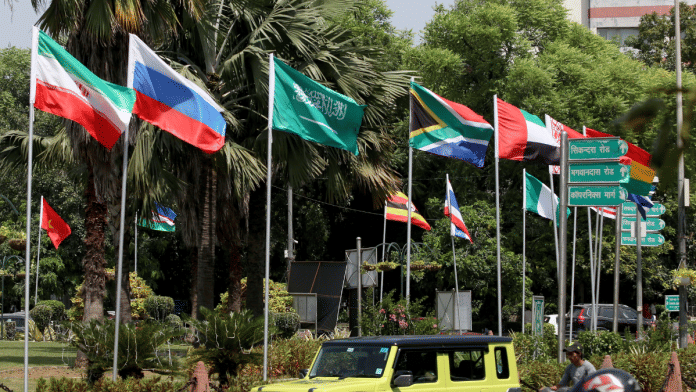

New Delhi: Bangladesh has decided to skip the BRICS Leaders’ Summit in New Delhi this weekend. Dhaka stated it won’t send any representative because Prime Minister Tarique Rahman was invited only in his capacity as the chair of the BIMSTEC, not as Bangladesh’s head of government.
Interestingly, Rahman was invited for a bilateral visit in official capacity and then as the chair of the BIMSTEC, which Bangladesh currently holds. The development comes a month after ThePrint’s exclusive report last month that PM Rahman will not undertake a bilateral visit to India anytime soon and was also expected to skip the BRICS Leaders’ Summit.
As the BRICS Chair 2026, India is hosting the 18th Summit in New Delhi on September 12-13.
Speaking to reporters in Dhaka on Thursday, State Minister for Foreign Affairs Humauin Kobir told, “How shall we go? Has anyone from the Bangladesh government been invited? Our prime minister was not invited. Who told you that our prime minister was invited? The BIMSTEC Chair was invited.”
India had earlier confirmed that an invitation was extended to Rahman as the chair of the Bay of Bengal Initiative for Multi-Sectoral Technical and Economic Cooperation (BIMSTEC). A separate invitation for a bilateral visit has been in place since February.
Bangladesh assumed the BIMSTEC chair in 2025 for two years.
Kobir further said that the Bangladesh PM’s first visit to India cannot be a multi-lateral visit, and a bilateral is being discussed. It will take place when “the timing is conducive”.
There is “no justification for rushing into a top-level visit by going beyond the national interest,” Kobir had earlier said in an interview last month, when he was Bangladesh’s foreign affairs adviser.
Kobir had then called the reports of his potential visit “baseless and assumption-driven,” saying Bangladesh would not rush into a high-level visit without clearly defined national interests.
Political sources in Dhaka had earlier told ThePrint that no bilateral visit was likely in the coming months until “India moved beyond symbolic outreach”.
The tension in ties
Bangladesh’s latest decision comes amid growing differences between the two countries over former prime minister Sheikh Hasina and her press conferences and interviews with the media in New Delhi.
Kobir had said in his interview that the future of relations with India, including a possible visit by Rahman, would depend partly on a change in the approach of India’s leadership.
“The neighbouring country must properly understand the reality of Bangladesh’s July Mass Uprising, which took place through the sacrifices of more than 1,500 people,” he said.
Kobir expressed strong opposition to what he described as the political and media space given to Hasina from Indian territory. “After the fall of autocratic rule through the July Mass Uprising, in which more than 1,500 people sacrificed their lives in Bangladesh, providing political or media space in India to fascist Sheikh Hasina, who fled there and took shelter as a criminal, is contrary to India’s democratic etiquette,” he said.
He said allowing Indian territory to be used for activities that could destabilise Bangladesh, or providing a platform to people accused or convicted of serious crimes, had angered millions of Bangladeshis.
New Delhi, he had said, could not justify such activities under international diplomatic norms or simply invoke freedom of expression.
Kobir in his interview said Dhaka also wanted clarity on the kind of relationship New Delhi intended to establish with a Bangladeshi government elected with a two-thirds majority.
(Edited by Ajeet Tiwari)
Also read: Hasina isn’t the real reason behind Rahman’s cancelled India tour. It’s about local issues