





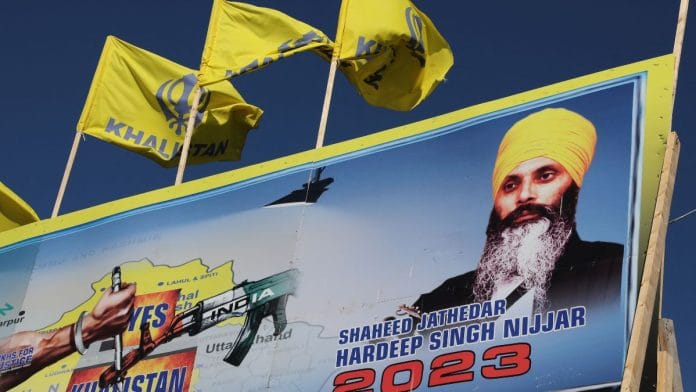


New Delhi: Authorities found no evidence of linking Indian government officials to the killing of Sikh separatist Hardeep Singh Nijjar, the Royal Canadian Mounted Police (RCMP) indicated Tuesday.
The shift in position is significant as allegations made by then Canadian Prime Minister Justin Trudeau linked Indian officials to the killing of Nijjar, who was also a designated terrorist.
As part of a multi-national effort, the US Department of Justice (DOJ) Tuesday unveiled an indictment against three transnational criminal gangs, while charging gangster Lawrence Bishnoi with the killing of Nijjar, who was shot outside a Canadian gurdwara in June 2023.
However, for years, Trudeau maintained that the Indian government had a link to the killing, which cratered ties between New Delhi and Ottawa for a couple of years. The RCMP had at various times indicated efforts by the government of India to keep an eye on Sikh separatists in Canada.
On Tuesday, RCMP Deputy Commissioner Lisa Moreland made it clear that the evidence collected under ‘Operation Hard Ball’, allegedly linking the Bishnoi gang behind the killing, had no links to the Indian government.
“There is no evidence through this organised crime investigation and the charges and indictment laid forth that Indian officials were charged or involved in these investigations,” Moreland told CBC News in an interview.
“As with any good arrest, there were over 50 search warrants that were conducted today. So various intelligence and evidence will be collected through the look into devices…I firmly state that nothing has come out today to link the Indian government.”
It is the first time that the RCMP has explicitly stated that there are no links between the Indian government and the killing of Nijjar, through its specific investigation into the workings of the Bishnoi gang across Canada.
However, four Indians are facing charges of killing Nijjar in the Canadian courts, and Moreland refused to comment on the nature of that case.
The allegations made by Trudeau on the floor of the Canadian Parliament on 18 September 2023 set off a firestorm in ties between the two countries.
India had rejected Trudeau’s allegations and pointed to the existence of transnational criminal gangs in Canada and the perception of space given to them to operate within the Northern American country.
By October 2023, the Canadian missions in India were asked to remove 41 diplomats and their dependents from the country. A year later, India withdrew six of its diplomats from Canada including its High Commissioner, while expelling six Canadian diplomats including Acting High Commissioner Stewart Wheeler.
The steep deterioration of ties was curtailed only when Trudeau relinquished power and Mark Carney assumed leadership of the Liberal Party in March 2025. Carney’s victory in the Canadian federal elections saw a marked shift in Ottawa’s handling of the case.
The new Prime Minister bifurcated the security issues from the larger relationship. He travelled to India for a standalone bilateral visit this March. Prime Minister Narendra Modi also travelled to Canada last year for the G7 summit, allowing for the stabilisation of ties.
On Tuesday, the US Department of Justice indicted 24 individuals from three transnational criminal gangs, including the Bishnoi gang, with a number of charges. One of those includes the killing of Nijjar.
The other gangs indicted include the Jaggu Bhagwanpuria cartel and the criminal syndicate led by Ravinder Singh Dhanda.
(Edited by Tony Rai)
Also Read: ‘Armed & dangerous’: FBI puts $50,000 bounty on gangster Lawrence Bishnoi’s aide Goldy Brar