





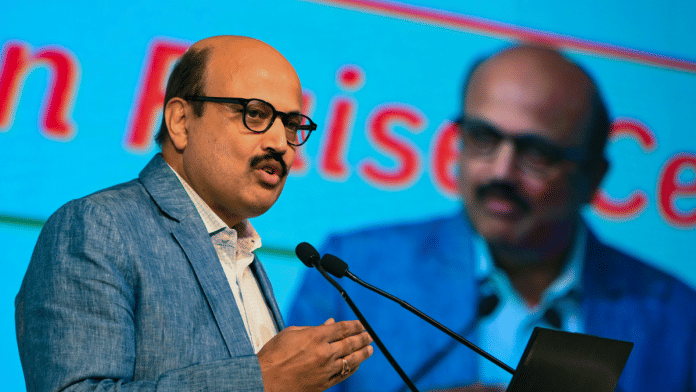


New Delhi: The India-US framework trade deal is ready, while the two sides are waiting for an “appropriate time” to sign, Commerce Secretary Rajesh Agrawal said Monday.
The deal has been delayed following the US Supreme Court striking down the earlier tariff architecture imposed by President Donald Trump in February.
“They (the US) are in discussions with other countries, but they have not come out with a deal yet…There has been a set of developments since the removal of IEEPA tariffs (International Emergency Economic Powers Act)…Very good discussions have been ongoing. The framework deal is ready. Whenever it is the right time, the appropriate time, the deal will be signed,” Agrawal said, briefing the media on the monthly trade statistics.
“Both sides understand what goes within the framework deal and what goes into the larger bilateral trade agreement.”
Making it clear that no “differences” exist on either side, Agrawal underlined that the trade agreement will be signed including pathways for the resolution of the ongoing investigations launched by America under Section 301 of the US Trade Act of 1974.
The US launched two Section 301 investigations against India and other economies this year looking at potential manufacturing overcapacity and the absence of proper regulations to prevent entry of goods allegedly manufactured by forced labour.
The draft findings in the forced labour probe, has seen the US propose anywhere between 10 percent to 12.5 percent tariffs on countries. For India, the US proposed an additional tariff of 12.5 percent due to its failure to adequately prevent the trade of goods produced allegedly through forced labour.
India has raised its concerns against the proposed tariffs. The two Section 301 investigations were launched in March, weeks after the US Supreme Court struck down the global tariffs regime imposed by Trump last August.
On 2 February, just a couple of weeks before the US Supreme Court ruling, the two countries announced that they reached an agreement on the framework for an interim deal. The deal would have seen India’s final tariff rate slashed to 18 percent.
The Indian tariffs would have offered its exporters especially in sectors such as textiles a comparative advantage to other countries in the region including Bangladesh, Pakistan and Vietnam.
The deal was announced following a call between Prime Minister Narendra Modi and Trump. However, with the IEEPA tariffs struck down, the US moved to impose a 10 percent tariff on all countries–a duty rate that is in operation under American domestic law till 24 July.
Following 24 July, it is unclear what would be the contours of the US tariff architecture, following the end of the current temporary tariff rate. India has consistently maintained that it is keen to sign a trade deal with the US, only if its own exporters gain advantages from such a trade deal.
US Trade Representative Jamieson Greer had held extensive consultations with his Indian counterparts last month during his visit to New Delhi. India negotiators travelled to the US in May to hold consultations over the framework deal.
Trade between the US and India has grown in the first quarter of the 2026-2027 financial year. India’s merchandise exports to the US between April and June touched $25.47 billion, which is roughly the same as the first quarter of the previous year. However, India’s imports of American goods have increased significantly.
This year, between April and June, India imported roughly $16.65 billion worth of goods from the US, a 23.79 percent increase from the same period last year. The US has consistently urged India to import more and reduce the trade deficit.
(Edited by Tony Rai)