



New Delhi: The Free Trade Agreement (FTA) between India and New Zealand, which came into force on 20 October, promises greater market access for exporters in both countries.
But, trade data for 2025 shows that India already had a trade surplus with New Zealand, and that its exports faced substantially lower standard tariff rates than New Zealand’s goods entering India.
India’s largest export categories to New Zealand, fuels and chemicals, also largely fell under zero-tariff categories before the FTA came into force. As a result, tariff reductions could matter more for Indian exporters of textiles, machinery and metals.
For New Zealand, wood and paper products qualify for immediate duty elimination, while vegetable products, chemicals and base metals will largely receive phased or conditional concessions.
Also Read: India & Poland have ‘no conflicts of interest’, PM Tusk says as both sides push defence, space ties
Pre-FTA tariff structures
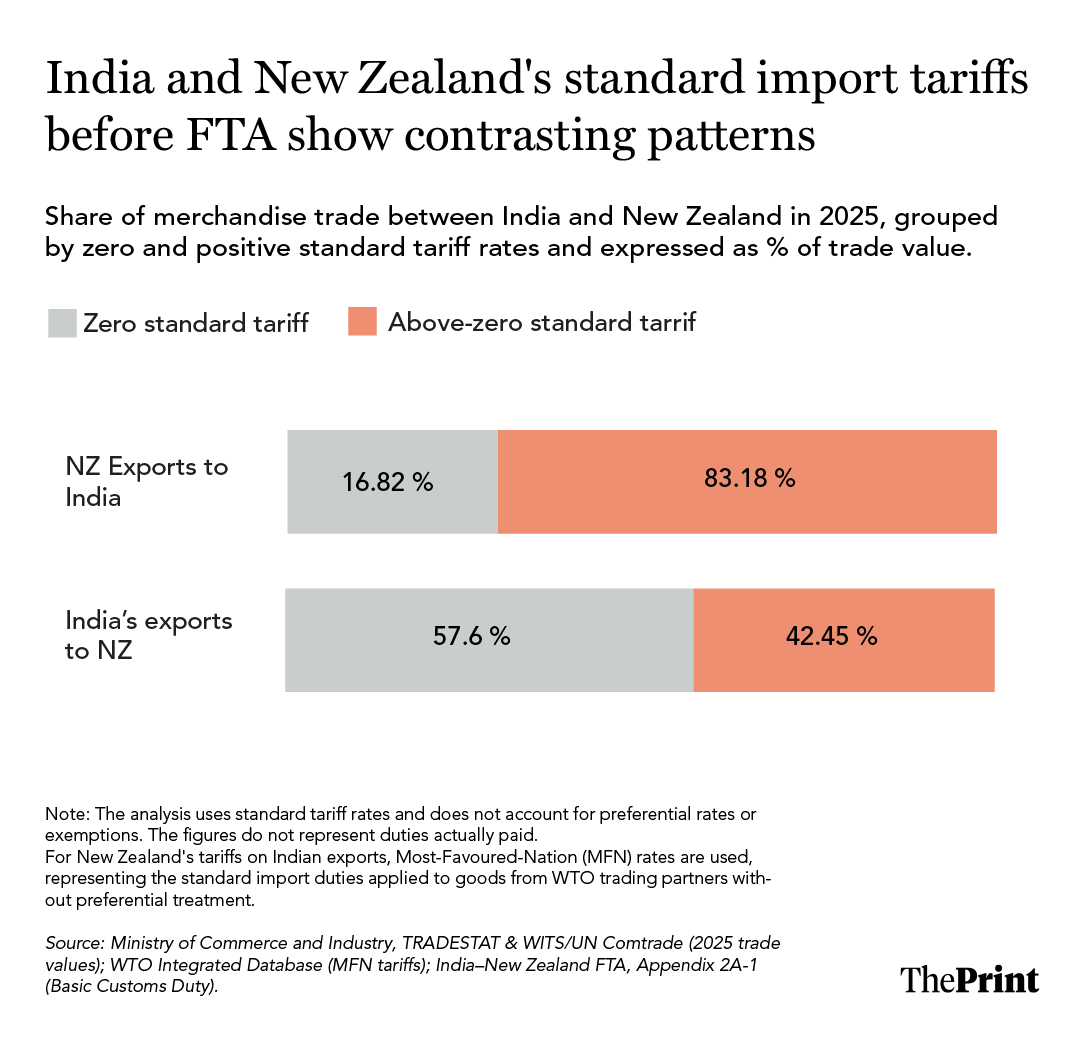
In 2025, India exported goods worth $881.75 million to New Zealand, while New Zealand exported $575.64 million worth of goods to India, according to international trade data. Of India’s exports, 57.6 percent fell under zero standard tariff rates, compared with just 16.8 percent of New Zealand’s exports to India.
Standard import tariffs are rates countries generally apply to imports in the absence of preferential treatment. This analysis uses New Zealand’s Most-Favoured-Nation (MFN) tariff rates for Indian exports and India’s Basic Customs Duty (BCD) rates for New Zealand’s exports to assess standard duties applicable before the FTA. These rates may differ from duties actually paid because of existing exemptions or preferential arrangements. The analysis, therefore, does not measure exact tariff savings resulting from the agreement.
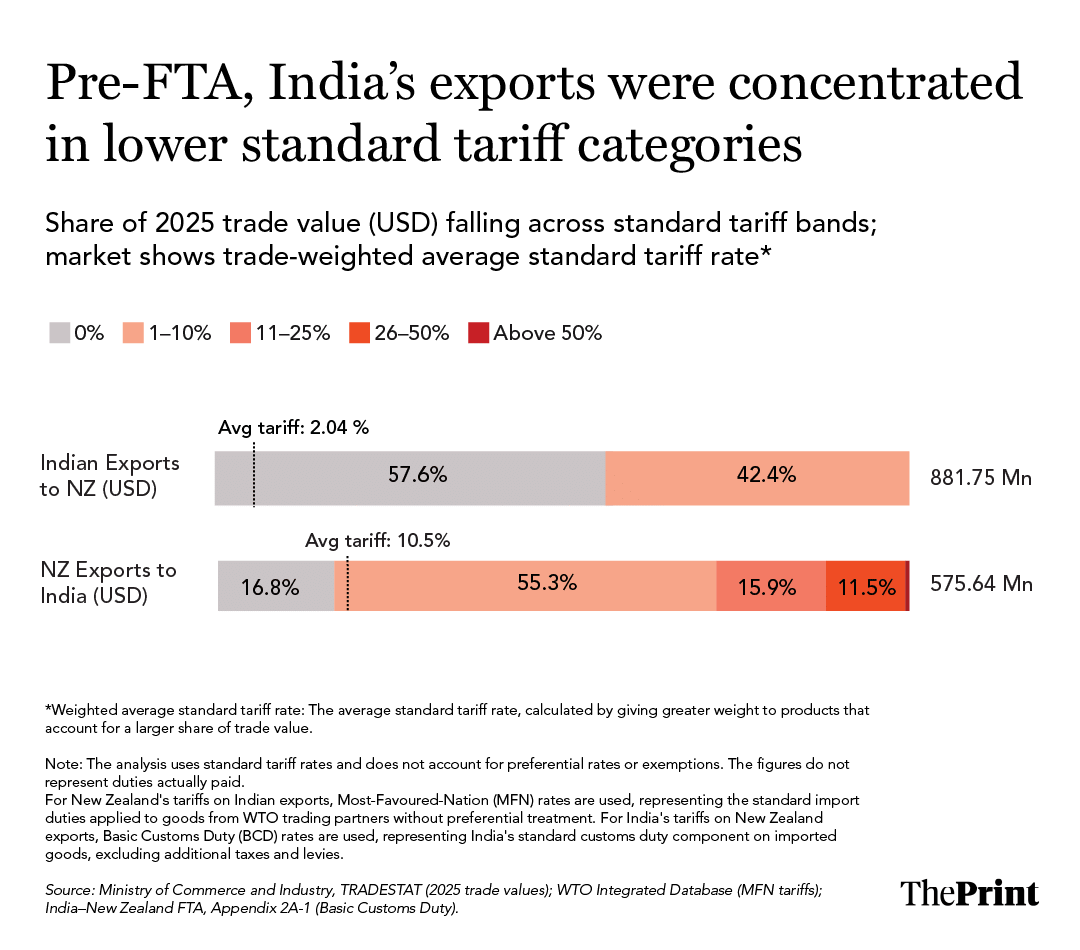
The trade-weighted average tariff was also substantially lower for Indian exports, at 2.04 percent, compared with 10.5 percent for New Zealand’s exports to India. This indicates that Indian goods generally entered a lower-tariff market even before the agreement.
Trade-weighted average tariff rate is the average standard tariff rate across products, weighted by their share in the total value of trade. Products accounting for a larger share of trade have a greater influence on the average.
More than half (55.3 percent) of New Zealand’s exports to India fell into categories with standard duty rates above zero and up to 10 percent. Another 27.4 percent, worth $160.7 million, fell into categories with rates exceeding 10 percent.
India’s largest export sectors had limited tariff exposure
Although New Zealand has eliminated import duties on all Indian exports under the FTA, the potential benefits of these reductions are likely to be concentrated in textiles and clothing, machinery and electrical equipment, metals, transport equipment, plastics and rubber, and footwear. India’s two largest export sectors to New Zealand, fuels and chemicals, already fell largely under zero-tariff categories before the agreement.
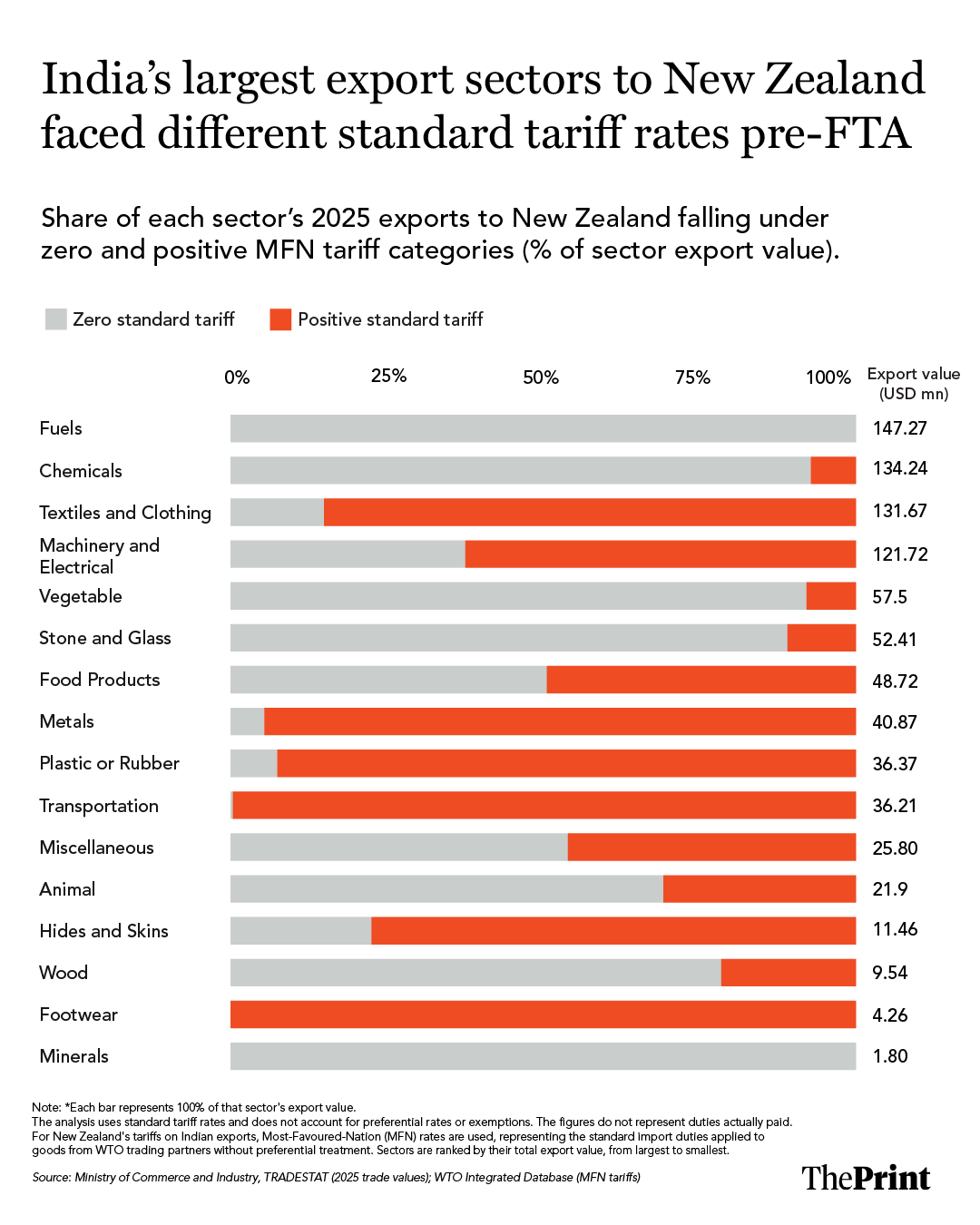
In 2025, approximately 85 percent of India’s textile and clothing exports and 62 percent of its machinery and electrical equipment exports to New Zealand fell under positive standard tariff rates. Together, these sectors accounted for 28.73 percent of India’s total exports to New Zealand.
Positive standard tariff rate is a standard import duty, greater than zero, imposed on a product category. This indicates that the product category carries a non-zero tariff under the standard tariff schedule, but does not necessarily mean that the duty was actually paid, as exemptions or preferential rates may apply.
By contrast, fuel accounted for the largest share of India’s exports, valued at $147.27 million, or 16.7 percent of the total. All recorded fuel exports fell under zero standard tariff rates before the FTA. Chemicals, the second-largest export sector at $134.24 million (15.2 percent), also had relatively limited exposure to positive tariffs.
Half of New Zealand’s tariffed exports to be immediately duty-free
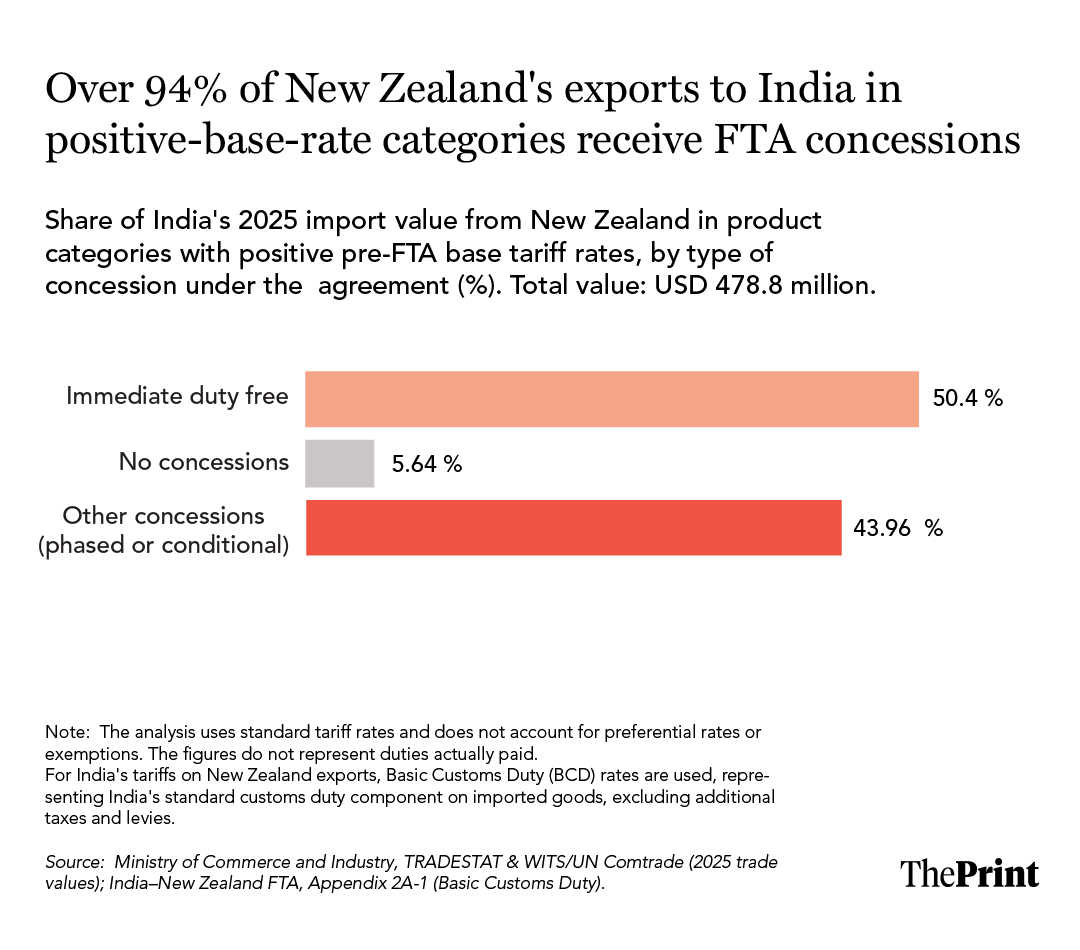
Around half the value of New Zealand’s exports to India in 2025 that fell under positive standard tariff rates qualifies for immediate duty elimination under the FTA. Most of the remaining value falls under phased or conditional concessions.
Of the $478.8 million worth of New Zealand goods exported to India in 2025 under positive pre-FTA tariff rates, $241.32 million (50.4 percent) qualifies for immediate duty-free access. Another $210.47 million (43.9 percent) falls under phased or conditional concessions, while $27.01 million (5.6 percent) belongs to categories receiving no tariff concessions.
According to the Ministry of Commerce and Industry, India has offered tariff concessions under varying conditions on 70 percent of its tariff lines, covering 95 percent of New Zealand’s bilateral trade, while excluding the remaining lines to protect sensitive sectors.
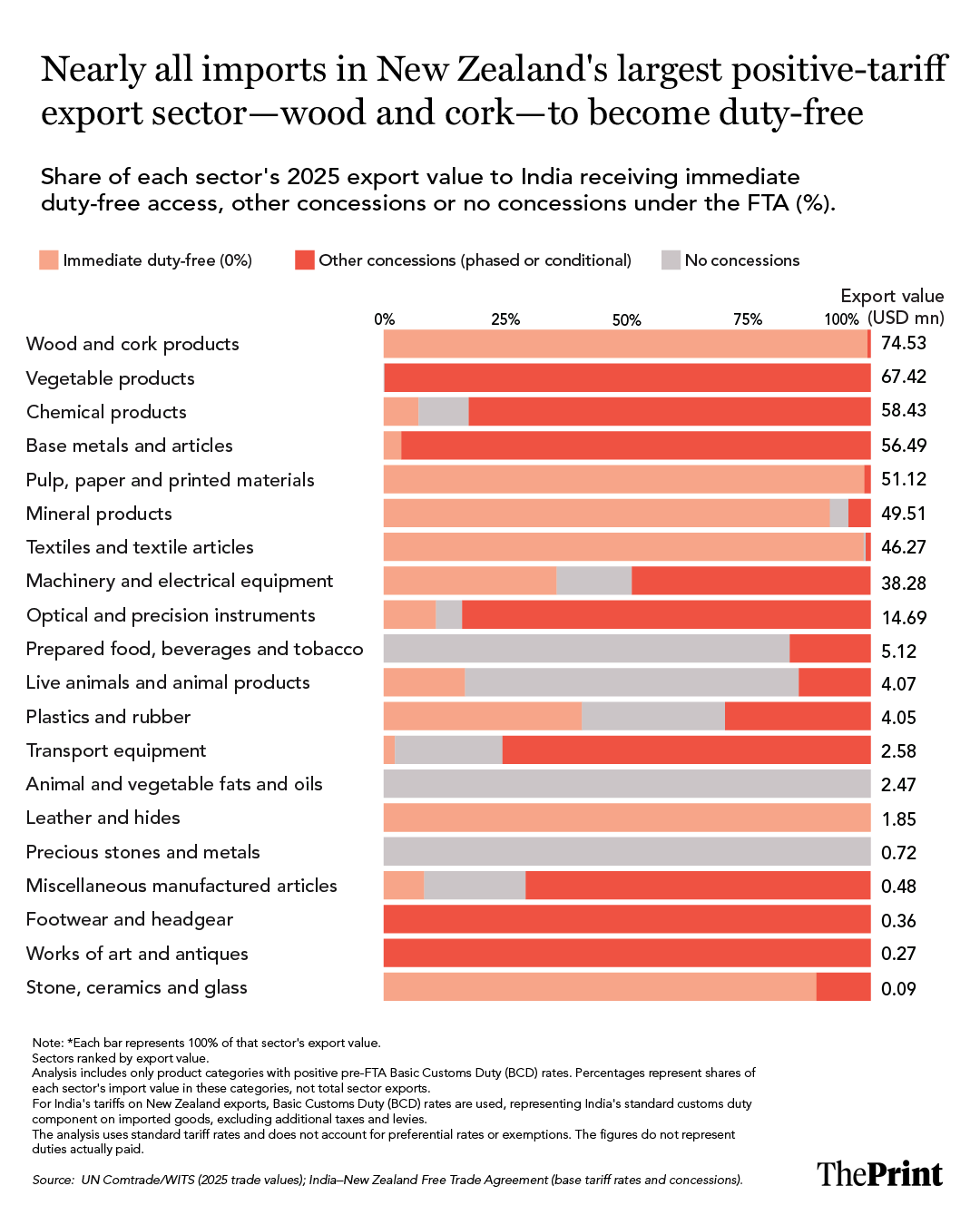
For New Zealand, the benefits vary substantially by sector. Among exports that previously faced positive tariffs, most wood and cork products, pulp and paper, textiles, and mineral products qualify for immediate duty elimination.
Earlier, wood and cork products—the largest category among goods that previously faced positive tariffs, with a trade value of $74.53 million—had a trade-weighted average tariff of 5.62 percent. Pulp, paper and printed materials, valued at $51.12 million, faced an average tariff of 6.27 percent. Textiles, worth $46.27 million, and mineral products, worth $49.51 million, each faced an average tariff of 3 percent.
In contrast, 99.8 percent of vegetable-product exports, 96.4 percent of base-metal exports and 82.5 percent of chemical exports in positive-tariff categories fall under phased or conditional concessions rather than immediate elimination.
India-New Zealand trade over past decade
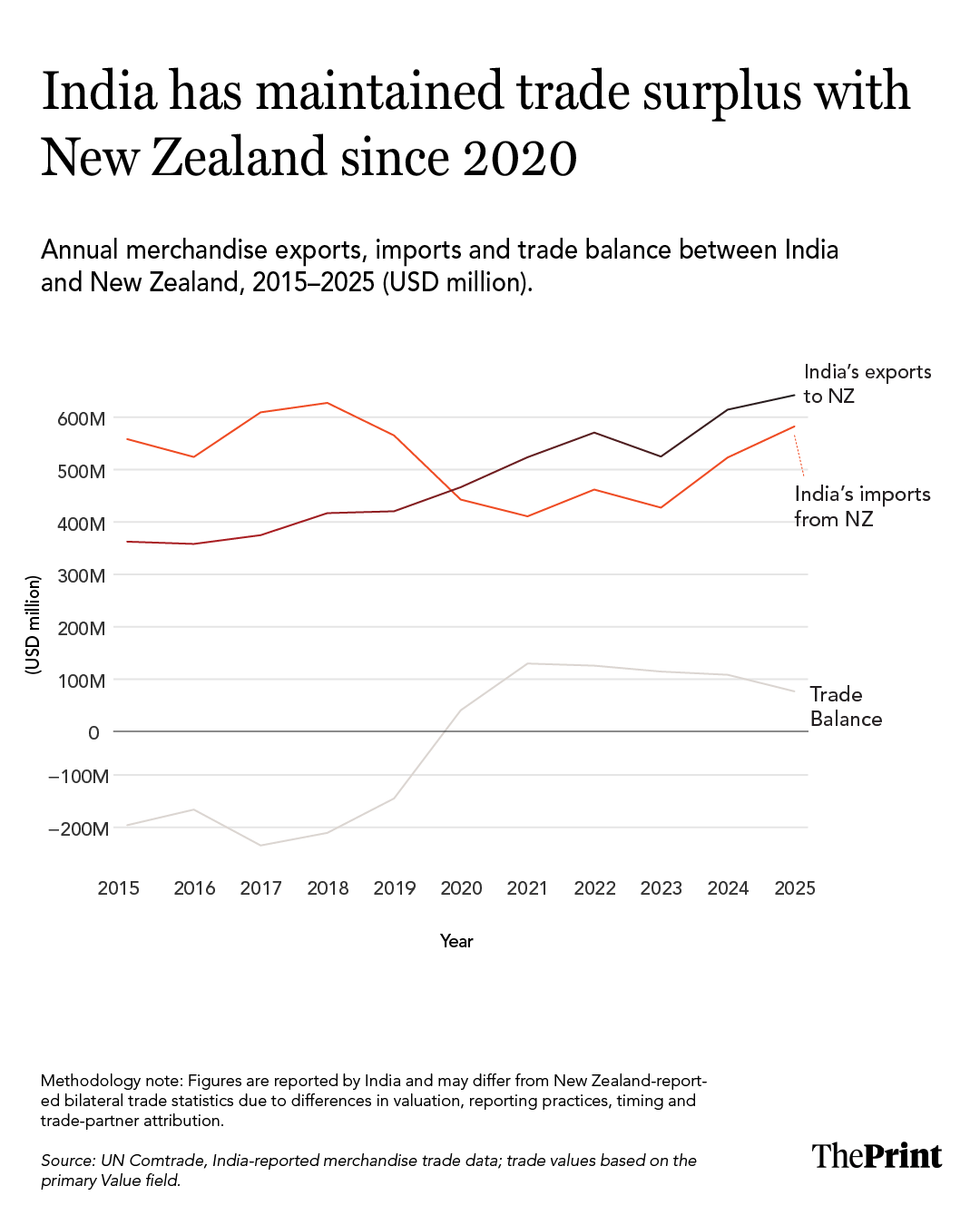
India’s merchandise trade balance with New Zealand has shifted over the past decade, from a deficit of $235.9 million in 2015 to a surplus of $71.7 million in 2025, an analysis of UN Comtrade data shows.
India’s exports to New Zealand more than doubled from $313.9 million in 2015 to $650.7 million in 2025, while imports rose only marginally, from $549.8 million to $579 million.
India first recorded a trade surplus in 2020, which peaked at $135.7 million in 2021. Although the surplus has since narrowed, India has continued to export more goods to New Zealand than it imports.
The FTA aims to double bilateral trade in goods and services by 2030 to approximately ₹35,000 crore ($7 billion).
Overall, the data suggest that the FTA’s significance could lie less in correcting an existing trade imbalance for India than in expanding market access in sectors where tariffs previously posed a greater barrier, while offering New Zealand exporters a pathway to compete more effectively in India’s market through immediate and phased duty reductions.
(Edited by Chingkheinganbi Mayengbam)
Also Read: Trade friction aside, US and Indian firms are building together