



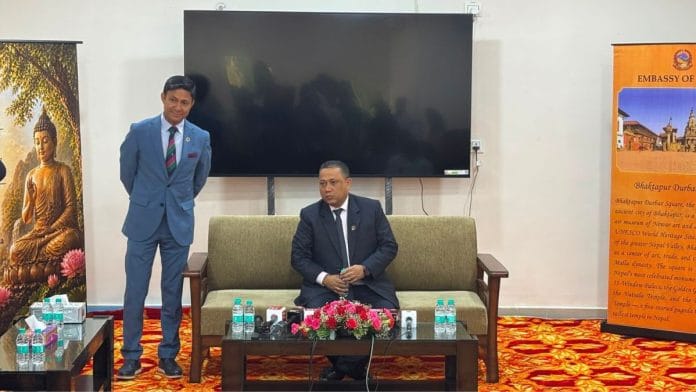
New Delhi: The border issue between India and Nepal will be resolved bilaterally, Shishir Khanal, the Nepalese foreign minister, has said. Khanal, who wraps up his three-day visit to India Sunday, has made it clear that Kathmandu is not seeking mediation from a third country.
“The Prime Minister [Balendra Shah] was asked in Parliament about Nepal and India border disputes and the Prime Minister was responding to an MP’s question, and in that, what he was explaining was… in Lipulekh and Kalapani area, where Mansarovar Yatra is taking place or will take place because of the agreement between India and China, that is a land that is ours, we have historical evidence,” Khanal told ThePrint.
“India and China cannot make a bilateral agreement between the two countries to resume that Yatra, so because that’s Nepali land, the two countries should not do anything in that land without seeking permission or without our engagement in that.”
Kathmandu has claimed that three areas—Limpiyadhura, Lipulekh and Kalapani—are sovereign territory of Nepal, and urged India and China to not make any unilateral adjustments to the border dispute.
New Delhi has rejected Kathmandu’s claims, pointing out that the Kailash Mansarovar Yatra has been happening since at least 1954. The dispute took a different turn last week when Nepal’s Prime Minister Balen Shah asserted in the Parliament that Kathmandu had written to the UK and China as well on the issue.
Explaining Shah’s statement, Khanal told ThePrint that Kathmandu had sent diplomatic notes to both India and China on their claims with regards to Lipulekh, while reaching out to the United Kingdom for documentary evidence dating back to the 1800s, when London was in control of the subcontinent.
“We want to solve this dispute between the two countries based on evidence and facts, especially historical facts, and because this dispute arises in 1814-1816, when there was a war between then Gurkhali Nepal and East India Company and Nepal’s current boundary is largely set by that,” said Khanal. “We potentially might need some historical document and reference certain documents that we know also exist in England in the old archives and the library, so we wanted to get access to that.”
Khanal affirmed that all disputes would be resolved through “existing bilateral mechanisms, based on evidence and facts”.
The foreign minister of Nepal arrived in New Delhi Friday. On Saturday, he held a bilateral meeting with External Affairs Minister S. Jaishankar, as well as National Security Adviser Ajit Doval.
This is the first official visit by an official from the new government of Nepal. Khanal has repeatedly said that the new government led by the Rastriya Swatantra Party is not “encumbered” by “old baggage” as the previous administrations were. The RSP stormed to power in elections held earlier this year.
On Sunday, Khanal interacted with media persons, and in his remarks, underlined the RSP’s key goal of building ties with India to strengthen Nepal’s domestic economy.
“True independence means our shared borders act as highly efficient bridges, not frustrating barriers. Rather than engaging in hyper-nationalistic grandstanding, we are pursuing calm, data-driven and evidence-based discussions to resolve challenges in good faith,” said Khanal during the interaction.
He highlighted that the RSP came to power on two promises: good governance and delivering fast economic growth. As a part of this policy, India and Nepal signed a number of memoranda of understanding Saturday, including on ensuring easier cross border payments through unified payments interface (UPI), as well as an agreement to build a national voice first translating platform.
Asked if the recruitment of Gurkha soldiers by the Indian Army was discussed, Khanal said that no such talks have been held, but that Kathmandu is willing to engage with New Delhi on the matter. Since the implementation of the Agniveer scheme by the Indian Army, the recruitment of Gurkha soldiers has been suspended.
(Edited by Mannat Chugh)
Also Read: Why Balen Shah’s ‘encroachment’ remark has put India-Nepal border dispute back in focus
India must make one thing clear to Nepal. The border between India and Nepal is open, this happens only when there is complete faith and understanding between the two countries. In such a case, hyper-nationalism must take a backseat and any misunderstanding must be resolved bilaterally and in closed doors. Also both countries must co-operate in security and foreign relations because many terror attacks, fake-currency network have entered India from Nepal due to open borders. The “ROTI, BETI KA RISTA” relationship must not be unilateral, it has to be mutual.